Architecture, in its essence, is designing places that would have an impact on the lives of the users. It is not just about creating structures today but comes with the idea of narrating a tale with the intent to express the standards, vision, and personality of its users. This approach discussed above as *storytelling architecture* is becoming popular today due to a growing trend in engagement between the architects/ designers and the clients on how the structure being developed could best embody personal, relatable, and profound or elaborate stories. However, this process is a strategic amalgamation of the client’s ideas, experiences, and vision, and that is why they play an essential role in determining the architectural result. In storytelling architecture, the architect and the client jointly rewrite the process of construction as a quest, where design is informed by the story of an object coming into creation.
Storytelling architecture is not about aesthetically designing structures or just creating an effective environment; the concept enriches the given space with value by intertwining cultural, emotional, and personal storylines. This design philosophy does not see buildings as mere utility – they shouldn’t be seen as containers for lives – but as receptacles for tales of the people that occupy them. Also known as ‘emotional architecture’, storytelling architecture aims to build buildings for homes, offices, commercial complexes, and other public domains that people can feel, imagine and live in.

One of the bases of this approach is the thought that each building always contains a tale to be said. The narration might be based on such facts as the history of the territory, the history of the people living there, or the history of the client. Only by knowing these stories, the architects can create an environment that is functional as well as has an appealing catalytic or psychological aspect. This makes client involvement critical as the architect has to elicit and understand the narratives that will inform the solution.
The Importance of Client Collaboration
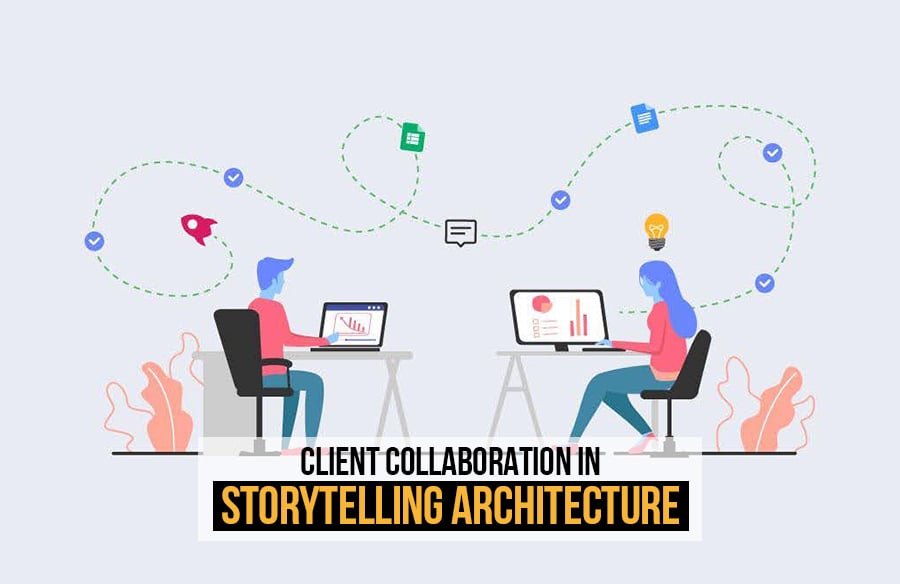
This is a view that is supported by the fact that in storytelling architecture the client is not just a passive receiver of the story that the architect is telling but an actor in the whole process. The importance of collaboration is because the architect has to know the story of the building’s user or the owner, and these are the story, the life, values, and dreams of the user/owner. Of course, this definition of ‘space’ aligns with the principles of client-centred architecture, which not only provides the necessary environment that is also beautiful but also responds to a person in profound ways.

It also usually starts with several discussions and meetings during which the architect’s main goal is to understand what the client wants, what emotions or memories he or she would like to be associated with the space, or what experience the client expects to get in the designed interior. In these sessions, the architect serves more as a listener, a questioner, and then the weaver of a good story where the main plot is the client’s story. Such conversations are not restricted to the specifics of the project, although they may sometimes ask about the project specifications for how one would like to feel in a space, what memories one wants to create for loved ones, or what impact one hopes the room will leave on people once they are gone.
At times, the narrative of the client may be related to a specific subject matter, including tradition, environment, or creation. For instance, while constructing a house, a family may want to add aspects that they associate with their tradition, perhaps through arrangements with the doors, the kind of wood they use, or even ornaments. At the same time, a business might desire a building to showcase to the company reliability, sustainability, or innovation and in this way convey these ideas into the physical layout and create a dramatic architectural image.
Challenges and Opportunities
However, there are some issues associated with client collaboration in storytelling architecture Even though it appears to have a host of advantages. There are several questions that we need to address there and one of the most acute issues is communication. This is a major factor because architects and clients mostly originate from diverse working professions and may perceive and/or convey ideas in a dissimilar manner. Thus, the architect has to express the relativity of sophisticated ideas in the context of the project so that the client can easily decipher as well as comprehend the client’s story and vision.
One of the issues is capturing the client’s needs and wants while also considering what is feasible for the location, including limitations like and budget or zoning ordinances, or in the environment. At times, the client may have a vague or grandiose vision and it becomes the architect’s challenge to take this vision and apply practicality to the final architectural design. This involves a lot of improvisation and a problem-solving mentality so that one can make changes to the design as the situation changes.
But these remain as challenges that have opportunities for innovations. This is because the conventions of storytelling architecture place certain constraints in front of architects that force them to be innovative and come up with innovative solutions that are out of the ordinary and are not normally considered. Thus, the process of cooperation contributes to the creativity of thinking and provides unique ideas for creating designs.
A primary focus of storytelling architecture has to do with using the clients in the implementation of the technique. The process of designing spaces by architects and clients is therefore an ongoing one through dialogue and learning to fashion spaces that are not only technologically useful and aesthetically pleasing but also emotionally resonant. This way, an architect can interface with the client and create structures that embrace and embody who they are and what they do as well as what they wish to become hence making architecture a way of telling stories. As such, in this partnered effort, architectural work is no longer simply a discipline: it is a process and a quest for people to encounter each other.