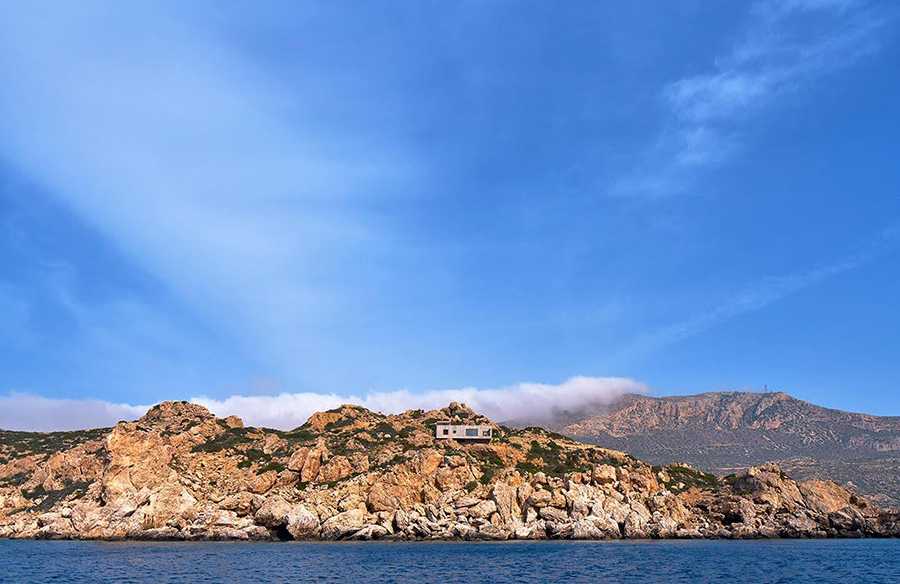
Pristine, unspoiled wilderness in what appears to be the most remote corner of the planet – this hardly seems like the perfect setting to imagine a residential development. Yet, nestled on the tiny island of Karpathos in the Southern Sporades, The Patio House stands resiliently amidst this challenging landscape, enveloped by harsh and unwelcoming conditions. Designed by OOAK Architects, they asked themselves, what methods can be employed to incorporate a foreign element, such as a house, into a dramatic landscape while preserving its inherent character and at the same time enhancing its attributes. (OOAK Architects, 2018)
The Windy Island Presents The Perfect Location

The Patio House is located on the southeastern shore of the windswept island of Karpathos, a member of the twelve islands that comprise the Dodecanese archipelago. The winds in this region have established Karpathos as a premier destination for windsurfers, as the diverse ranges and intensities of the Karpathian winds create optimal conditions for the sport. The building’s site is located in the southern part of the island, close to Kipi Afiarti, commonly referred to as Afiartis village, which features three distinct bays, each providing unique opportunities for windsurfing enthusiasts.

This passion for the sport was the reason why the clients, a couple from Paris with French-Swedish roots, chose to build their summer home on the rocky hills overlooking the Aegean Sea. The proximity towards Afiartis with its windsurfing community as well as the breathtaking views over Vrachonisida Moira indicates that they have discovered their sanctuary within the rugged landscape. This terrain, characterised by its wild, thinly vegetated, and striking features, formed the basis for OOAK Architect’s design approach.
Two Entities Becoming One: The Patio House And Its Surroundings

It was clear from the beginning that this building’s site is spectacular, clearly favouring the architectural idea of placing the alien object into the landscape without altering it. The Patio House is herby compared with a shell by the designers, which slowly morphs over time with the underlying rock together, thus forming a new entity. This initial juxtaposition of the foreign object to its dramatic landscape is underlined by its choice of material and form. A clean, cubistic structure with wooden accents within a concrete mass, stands to be noticed at first glance.

The natural constitution of the terrain with its plateaus, alternating in height, allowed OOAK Architects to place their project in such a way that it seemingly appears to hover over the rocks. Built as a cantilever, it reaches over the higher natural plateau, giving the impression of being built directly into the Aegean Sea. The designer’s approach incorporates the existing nature by framing distinctive views over the untouched surroundings. With an inner patio and different openings in both horizontal and vertical directions, the sleek structure interconnects its man-made insides with the possibility to access the lower plateau, which harbours an extensive outdoor terrace. Each of these openings is of a different size and placement, offering the visitor whilst scrolling through each room a unique scenario over the natural landscape and Aegean Sea.
The Jagged Exterior Shelters A Serene Interior In The Patio House

Given its name, The Patio House’s program is concentrated around its courtyard, presenting the floor plan with a fluidity to its sheltered interior. This layout provides unrestricted access to the single raised block in the Southwest. Due to the varying terrain levels, this block can be viewed as a distinct component, presenting an opportunity for guests to stay during their visitations. Due to its upper private balcony, the spectacular panoramic views can be enjoyed equally from this retreat inside the house.

Taking into consideration the importance of preserving the natural surroundings, materials that endure the harsh external conditions have been selected with the exterior of The Patio House made of reinforced concrete. This has been cast in situ with an exposed rough finish and yet again forms a juxtaposition not only with its surrounding rock formations but also with the interior. Wooden elements accentuate the carefully placed openings, directing the Aegean sunlight throughout the house in different forms whilst presenting a curated view of the natural elements. A minimal aesthetic with subtle textural accents like the plant-filled notches at the entrances, the lightly green-stained timber panels of the kitchen cabinets, the different stone tiles placed throughout the interior parts and their outdoor red-brick counterparts combined with the island’s traditional built-in elements such as the soufas and pagali create a modern home. A light palette of natural materials forms the canvas for the colourful foci of Karpathian-style ceramics, making The Patio House with its Scandinavian furniture a well-rounded assembly.

In conclusion, The Patio House stands as a testament to the power of thoughtful design that respects and enhances its natural context. By integrating the foreign structure into the landscape without making any modifications, the architects have created a remarkable entity that resonates with its surroundings. Moreover, the building’s design is not static but intended to evolve, much like the natural environment that surrounds it. The architects envision a dynamic relationship between the structure and the landscape, where seasonal changes and the passage of time will influence the way the building is perceived. The Patio House invites the viewer to a deeper appreciation for the intricate relationship between architecture and nature.