It’s like rekindling the past when heritage structures get repurposed. Adaptive reuse transforms old, historic, abandoned structures into new-age, usable structures by giving them a new life while promoting sustainability, conservation, and restoration. Lakshmi Mills, an old textile mill with a rich heritage from the early 1900s, has been repurposed into an urban retail centre and a public plaza while retaining the old structural typology and the ancient touch intact. This centre stands as a great example in the category of Adaptive Reuse by preserving the valuable community behind it and serving as the finest leisure hub for the public.

The Legacy Behind Lakshmi Mills
The city of Coimbatore, in Tamil Nadu, is known as the “Manchester City of South India,” considering the diverse textile industries in the city nourished by vast cotton fields, it is the textile hub of Tamil Nadu. More than a hundred years ago, in 1910, a textile industry founded by a visionary pioneer, the late G. Kuppuswamy Naidu, found its way into the wing of yarn and cloth manufacturing of textile mills in Tamil Nadu, named “The Lakshmi Mills.” This iconic mill, while contributing to the development and growth of the industry, played a significant and remarkable role in creating a history that led to Coimbatore being named Manchester City.


During its years of operation, the renowned mill consistently proved its forerunning ability with the quality of service and guaranteed customer well-being with its prime objective of manufacturing and exporting quality goods to domestic and international markets and promoting product range, advancement, research, production efficiency, and autonomy. Lakshmi Mills also paved the way for the growth of several workers and supported the expansion of other textile units in various cities. Even today, several decades later, the respect and admiration for the mill stands still.
The Planning and Architecture of Lakshmi Mills
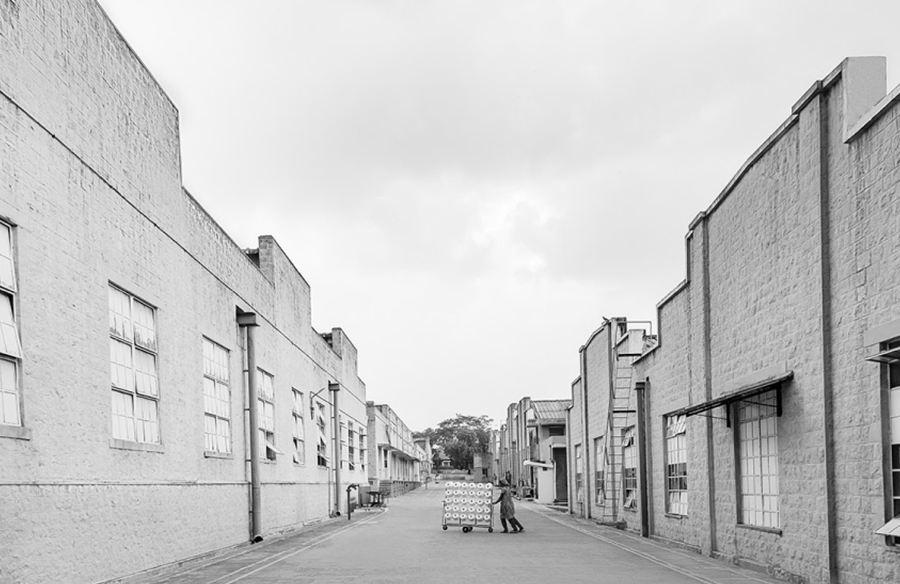
The textile mills at the Lakshmi Mills campus portrayed a distinguishing architectural feature, defining the magnitude and massiveness behind the emblematic industry. The features included large and sequential glazings, windows and doors that enhance natural lighting and ventilation, wooden and iron beams, exhaust pipes and stacks, and walls built out of locally available materials such as bricks and stones that eventually offer strength and safety. These characters play a vital role in improving the work quality within the unit and providing the right amount of comfort by blending functionality with uniqueness that speaks of history.

Deceleration and Entrust of the Legacy
In 2008, a few units in the factory shifted their operations elsewhere. Due to the development of modern technologies and the advancement of instruments, Lakshmi Mills witnessed a financial crisis that led to a significant downfall in 2012. However, the modernization program in the manufacturing units resulted in an increase in production and sales in the years 2013–14. During 2019–20, the owners of Lakshmi Mills gave the mill a makeover, with a notion to establish an urban centre by retaining the rustic charm of old structures while creating temporary retail spaces, commercial plazas, and much more.

Industrial Relic into an Immortal Icon—Rebirth of Lakshmi Mills
Lakshmi Mills and evolution go hand in hand. Renewing this mill into a commercial centre by Aishwarya Pathy, great-granddaughter of G. Kuppuswamy Naidu, has been a sincere gesture of public outreach to share her happy memories. Considering adaptive reuse, the main goal was to preserve and repurpose the existing structures while concentrating on the innovation and design style that align with current trends. Each structure in the urban centre replicates the characteristics of an ancient mill and the magnificent architecture behind it.

At first, several commercial retail locations, including Westside, Croma, and Zudio, were conceptualised, planned, and built. The structure of these shops at Lakshmi Mills followed industrial architecture, carrying exposed brickwork, large windows, cross beams, and other architectural features. Following that, other retail units and hypermarkets came into existence. This pattern created an impactful trend, satisfying the functional and aesthetical characters. More than just a retail shop, the sense of interaction and fresh air through large and open spaces, the exposure to natural light through large sequential windows, and the connection with culture through the materialistic details and features display the ultimate motive behind the site’s transformation.

Bridging people and places—The Urban Hub
As cities expanded as concrete jungles, community spaces started to shrink. Lakshmi Mills Urban Centre, a renowned landmark in the heart of the town, established enduring relationships, fostering interactions between people and their surroundings through shopping markets, food courts, amphitheatre, pop-up streets, and public squares. Converting a private mill into a community space that creates a visual connection by attracting the public must have been the challenge. Every zone of the new Lakshmi Mills Urban Center has been thoughtfully designed and segmented according to its intended use. Existing vegetation and greeneries were preserved and modified to the current softscape and hardscape needs. Each zone’s entry/exit nodes, peripheral road networks, and pedestrian paths add feasibility and a sense of comfort to the users.

Broad zoning of each block based on the intended functionality and existing structures (Retail, Cultural, Commercial, Office, Services, and Public zones) with parking zones and connection nodes eased the visual connection for public accessibility. The interiors of each structure resonate with the spirit of old Lakshmi Mills, giving a touch of modernity with cultural art deco and murals. The double-height retail spaces and food courts forge an inviting atmosphere while generating a mass volume. Each building’s facade showcases its industrial architecture, with clerestory windows bringing plenty of natural light and vibrant vitality. These components and architectural features achieve the purpose and objective of such innovation and heritage preservation.


As Lakshmi Mills transitions from an industrial icon to a dynamic urban hub, it marks a notable landmark in the history of Coimbatore’s evolution. This progression sets an example and inspires future generations to safeguard and relive a more than 100-year-old legacy with a contemporary touch. This rapid shift in the architectural realm, while encouraging social connections, boosts the spirits of young, aspiring architects and designers.