When John Pawson decamped from art school to architecture, he had no idea that he was going to make such an impact with his minimalistic architectural approach.

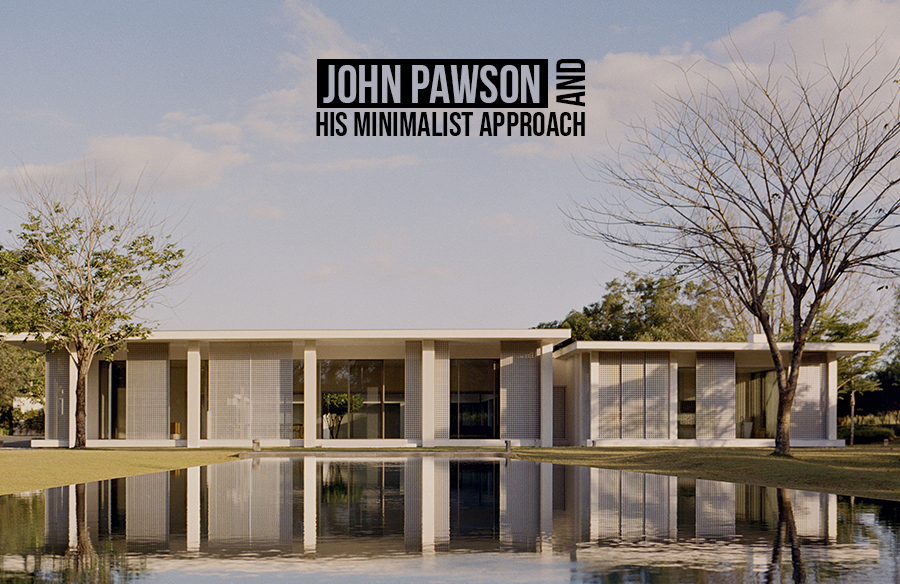
John Pawson is one of the most admired modern architects; he is the minimalist personified. Logically, the body of works that can be attributed to him is comparatively small in terms of the number of buildings and is characterised by simplicity, the clarity of the ideas, and a strict orientation towards the analysis of space. Over these years of commissions which involve private homes and art spaces up to churches and even bridges, Pawson has brought out an architectural aesthetic that is borne out of the reductive process of the forms, materials, and details. His designs remove all the frills, open up a space to let air in and give an experience of architecture in its rawest form.
Origins and Influences
He was born in 1949 in Halifax, England, and was brought up in a family that had some links to the textile business. This first-hand experience of craft, and a knowledge of materiality, was to leave a lasting impression on his output. Pawson’s interest in Japanese design was shaped after he worked in Japan during his twenties, and he has been greatly inspired by Japanese aesthetics and the use of void and the transience of things as espoused by the Zen Buddhists. During his time in Japan, he became aware of the works of Shiro Kuramata and other minimalist designers and Architects. It was, for Pawson, the clarity and the rigour of the Japanese architecture that was to become a part of his architecture of space.

After moving back to the UK Pawson studied at the Architecture Association in London, but soon left feeling that it was not what he wanted from the subject out of school. He decided not to apply the rationality and magnificence of the traditional architectural approach and the grandeur of conventional luxury in the contemporary sense but to create a highly particularised concept of minimalism, stripping the notion of luxury to its basics, emphasising calmness and clarity of purpose combined with an elegant, almost exaggerated simplicity.
Minimalism in Pawson’s Work
For Pawson, minimalism is not just a design direction, it’s a way of doing things, the only way. The essence of his belief in architectural design is grounded on the tenets where he believes that spaces offer a chance at reflection, a commodity scarce in today’s society and world. He is fond of designing installations that would let the user enjoy the slower pace and increased focus on the environment.
This is one of the most crucial components of Pawson’s minimalism: everything in his works is stripped down to the architectural core. To him, it deposes abstract artistic decorations and concentrates on the type, degree, proportions, and material of lighting. He aims to make spaces stir emotions through limited complexity to let the elegance of the raw forms of wood, stone, and concrete be seen. For such reasons, Pawson frequently selects natural materials that mature gracefully, a principle he holds dear: objects and spaces are temporary. Lack of ostentation adds to his work in the way that the eye is led to appreciate the interplay of light and dark, the feel of surfaces, and the relative position and scale of adjacent spaces.
Different from that, Pawson’s minimalism remains very precise. It has been a stroke of genius that every line, joint, and surface in his designs is deliberate. His architecture has its austere discipline and no extras or anything that will rely on good fortune. Even the function of the spaces that are created by Pawson is kept measured; he nearly always commissions The work of interior architecture always culminates in the use of bespoke furniture and fittings to achieve the defined idea of balance and symmetry. He aims for the kind of customers to inhabit the spaces without understanding just how much work has gone into designing them.
Iconic Projects
One more successful project of Pawson is the **Novy Dvur Monastery** in the Czech Republic designed in 2004. It is one of his first great religious works, and it captures his modus operandi: to build sacred spaces with the barest of needful. The place has the cold feel of white walls, yet it is dusted with natural light, which makes it very much like a soothing spiritual retreat. The style reflects the early Christian living – the sparseness of the structures and the harmonious relationship with its occupants.
Another important work that can be mentioned is the Design Museum in London, which Pawson finished in 2016. Here, he converted one of the typical examples of the 1960s – a modernist building – into a new home for the museum. The design proves his ability to integrate historic preservation in combination with a minimalist modernist style. The interior zones are now rather lightweight, and the formal strategy that dominates them defines the choreography of movement and the tensions between light and mass. Thus the speciousness of the building’s form and the absence of frippery or idiosyncrasy encapsulates this principle of Pawson’s architecture.

Other homes that he designed included private residences in London hence reflecting his minimalist views. It’s severely minimalist; the house is painted white with stone tiles on the floor and wooden beams. In all rooms, space and light are guest-facing, particularly a tenet of strong natural light impacting the surfaces that characterise the rooms. However, it does so in a way that reflects Pawson’s view of a house as a kind of refuge and one that should be free of extraneous decoration.
Criticisms and Challenges
On the whole, Pawson’s straightforward style has been effectively received, although it is not free of detracts. Others respond that it is overly minimal: that organising architecture around the strict minimum of what is required suggests a kind of sterility or—perhaps at the limit—boredom. Some of his designs are even difficult to purchase due to the noble use of high-quality materials and the efficient work of tailors.
Besides, reductionism in architecture can be seen as unfair and designed to attract only such buyers who would be able to maintain the interiors of such complicated constructions. Today many architects focus on social aspects such as the sustainability and the affordability of the built environment, some critics wonder whether Pawson’s simple style can be applied in response to these concerns.
Legacy and Impact
Still, the criticisms have not been capable of tarnishing the reputation of John Pawson and he remains at the peak in the architectural practice today mainly in the high-end residential market and in designing cultural buildings. His devotion to the ethos of less is more, clear lines and the integrity of materials has provoked a whole generation of architects and designers to rethink the position of reduction in architectural practice.

It is important to note here that Pawson’s work can be a useful intervention against the idea of ‘more’ being better. What his buildings provide is a different notion of luxury – simplicity, the elegance of geometry, and the simplicity of organic shapes, and free from clutter. In a world that to most of us is so impersonal and clamant, his architecture is orderly, calm, and directed.
All in all, it can be stated that John Pawson aims at purism in architecture, in which minimalism is both a form of expression of the architect and the engineer and a protest against the growing commercialization of design. The artist’s job is to remove all the unimportant and show the sublime in the generosity of space and the luminosity of light, to produce spaces that act as oases in a confusing world. With all the projects Pawson completes, he persists in proving that at the heart of minimalism is the ability to create architecture that is productive and elegant and can also be abstractedly significant.