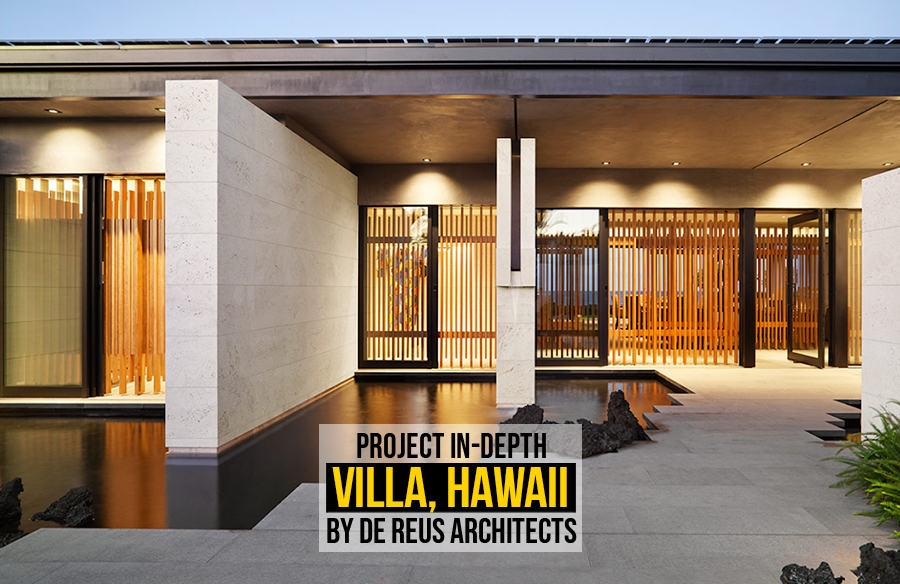
De Reus Architects, the firm in charge of the design and construction of The Bias House, describes the project as a “modern architectural home composed with a clear understanding of its owners’ lifestyle, designed to embrace its tropical island setting.” The team, led by co-founder Mark de Reus, proposed a contextual and handcrafted design of the home. The team’s intent in the design of the home was for it to feel appropriate for the location and, at the same time, to remain tailored to the needs and identity of the clients.

The Bias House
From its inception, the design philosophy of the abode was about finding a marriage of tropical modernism and modern architectural response. The Bias House is located alongside a lava flow dating as far back as the 1850s on the leeward coast of Hawaii. Rather than orienting the building directly toward the ocean’s horizon, the house is turned to face the coastal view, pulling the view of the lava into the interior spaces and ensuring that the coast, ocean, and lava are all in view simultaneously.

The spaces in the home are intentionally broken into distinct zones, forming a series of interlocking yet separate pavilions. According to Mark, the intention behind this choice is that hallways or corridors are not always needed in the tropics, especially on the leeward side of the island. To enhance the experience of the home by merging the interior and exterior spaces, the building is zoned in a way that focuses on the definition of the space itself and one’s relationship with the space, which is important to experiencing the pavilions. For example, one can traverse the garden, using it as a hallway, to reach another portion of the house.
Road Map of The Bias House
Situated at the entry court is a water feature set to welcome visitors to the home. Guests are ushered in through a gallery into the home’s main area, which is an amalgamation of the kitchen, living, and dining rooms under high cathedral ceilings that follow the building’s roof outline. Some rooms showcase the seamless indoor-outdoor living experience by incorporating sliding doors that open up to create the impression of a continuous expanse of space, blurring the lines between interior and exterior.

The master bedroom is located in a different building and is connected to the main building via a walkway. It includes a walk-in closet and an en-suite clad entirely in white marble, which opens up to a lush courtyard with an exterior shower. The other three bedrooms are located closer to the living and dining rooms and share conveniences such as a separate lounge area.

Lastly, the guest bedroom is housed in a separate pavilion accessible through the entry courtyard. The pavilion provides its inhabitants with privacy as it has a restroom and an outdoor shower.
Finishes


The interior design team, led by Marion Philpotts of Philpotts & Associates, aligned with the design’s “tropical modernist or minimalist” approach. The traditional design elements are tempered through a Japanese sense of restraint and interest in craftsmanship. Throughout the villa, a muted palette of natural wood and light stone finishes can be seen. Finishes include veneer plaster walls, granite counters, grey-stained white oak ceilings and cabinetry, millwork, and stone and teak floors. Another criterion for choosing exterior materials, apart from their natural aesthetic and durability, is their contribution to the minimalist aesthetic and serene sense of restraint. The finishes include zinc metal roof shingles, black anodized aluminium doors and window frames, painted steel fascia and columns, stone terraces, walls and columns, and integral colour cement plaster. To make the villa fit into its surroundings, hipped roofs were used for the individual pavilions, whereas flat roofs were used where solar panels had to be hidden from sight.


The landscaping, with its use of plants and reflective pools, contributes to the exotic yet ultra-simple aesthetic. Most of the furniture pieces, including the contemporary free-form sculpture, custom dining table, lychee wood coffee tables, and bedroom headboards, were sourced from Bali. Many of the pieces feature Polynesian tapa patterns intricately carved into teak. In the main bathroom, the carved Calacatta marble wall, including a stone shower wall, provide a striking contrast to the teak vanity.

The limestone walls behind the master bedroom headboard and the back wall of the kitchen were inspired by a graphic kimono pattern. The guest pavilion includes custom pieces like the albizia and koa longboard by Gary Young, a rare “ulu” wood surfboard handcrafted by Tom Pohaku, and a set of surfboards by Firewire/Sig Zane Design.
In summary, and in the words of the designer, the entire design of the residence was conceived as one concept of minimalism, restraint, and craftsmanship. The villa manages to be contextually appropriate while still fulfilling its owners’ individualistic needs.
References:
de Reus Architects, n.d. de Reus Architects | Residential & Commercial Architects | USA | Hawaii. [online] Available at: https://dereusarchitects.com/projects/kolomuo/ [Accessed 19 August 2024].
Alvarez, L., n.d. de Reus Architects reveals the Kohala Co|Houses. Amazing Architecture. [online] Available at: https://amazingarchitecture.com/houses/de-reus-architects-reveals-the-kohala-coast-residence-hawaii-a-tropical-minimalist-design-solution-that-reveals-the-visual-drama-of-the-natural-setting#images-27 [Accessed 19 August 2024].
Howarth, D. and Steely, C., 2017. Hawaii house designed as a mini village by De Reus Architects. Dezeen. [online] 7 August. Available at: https://www.dezeen.com/2017/08/07/kauhale-kai-hawaii-house-designed-as-mini-village-de-reus-architects/ [Accessed 19 August 2024].