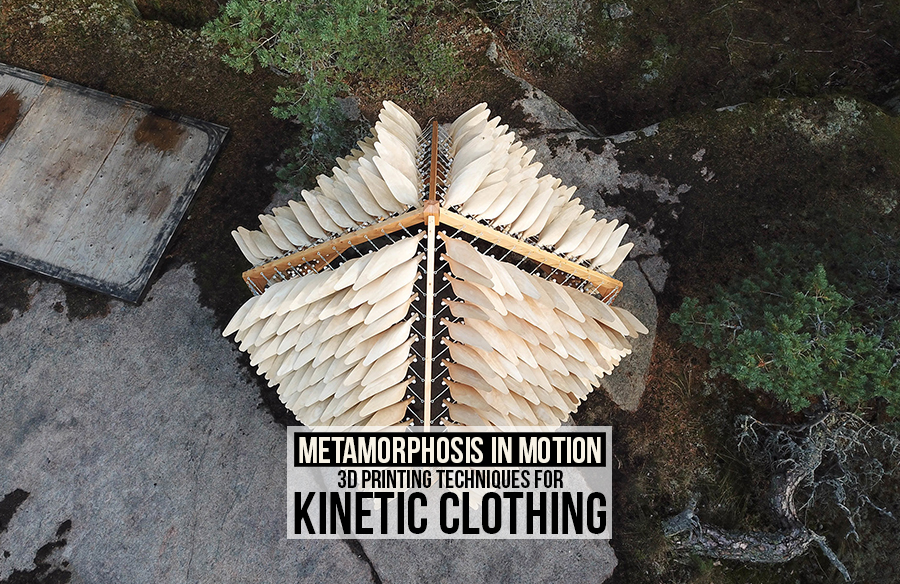
“The fusion of architecture and wearable art challenges traditional notions of fashion while expanding the potential for architectural design and material science. This is through a transformational era in design that knows no limits, thanks to the intersection between technology and fashion. One such revolutionary progression is the use of 3D printing techniques in making kinetic garments.”

This article is about the revolutionary world of 3D-printed kinetic clothing, it focuses on the techniques, materials and architectural principles that facilitate metamorphosis.
The Convergence of Architecture and Fashion

Traditionally, architecture and fashion have been separate fields with unique rules, materials, and procedures. However, the advent of 3D printing has challenged these distinctions, making it possible to produce buildings that are not just functional but also visually pleasing. Kinetic clothing, characterised by its ability to change shape, colour, and form in response to environmental stimuli, exemplifies this convergence.
3D Printing Techniques in Kinetic Clothing
- Stereolithography (SLA): By interfusing layers of liquid resin and hardened plastic, an SLA removes flexible circular modes from kinetic clothes. The SLA can also use different types of resins such as elastic or flexible ones which are necessary when making moving garments.

2. Selective Laser Sintering (SLS): SLS combines particles with beams from a special type of light that travels quickly through space making very tough objects. It could manufacture moving units that have the following characteristics: flexibility, and sufficient strength for clothes meant for active games or hard physical work. The essence of SLS technology is that it enables the creation of self-supporting complex three-dimensional figures without any additional facilities thus implying that various parts are capable of interpenetrating within textiles.

3. Fused Deposition Modeling (FDM): Objects are constructed by FDM extruding thermoplastic filaments layer by layer and it is available to the general public plus it is also affordable, which makes it ideal for prototyping and customizable kinetic clothing designs. This is because the availability of various thermoplastic materials such as flexible filaments enables designers to play around with material aspects until they get the desired kinetic effects.

Architectural Principles in Kinetic Clothing Design
Biomimicry:
Nature-Inspired Structures: Designers make clothes that mimic the movement of animals, plants and other living things by imitating them through the process of natural forms. This method results in outfits that reflect a real-life style owing to their ability to adjust under various circumstances.

Parametric Design:
Algorithmic Control: By using parametric design principles, designers can develop adaptive structures that are sophisticated and their shapes can change according to certain parameters including temperature, light, and movement; hence, this enables one to have a detailed management of the kinetic behaviour for clothes.

Modularity:
Interchangeable Components: The manufacture of “interchangeable-parts” clothing and the use of these in other garments gives an infinite variety of appearances and uses for them due to the modularity of designing modularity. It is in the way of architectural modular systems that human beings talk about individuality and variability of anything.
The Future of Kinetic Clothing in Architecture
The progress seen in 3D printing and kinetic garments has completely transformed fashion and fundamentally changed the way we look at architectural design. The groundwork that has been laid down in the domain of or related to wearable technologies can easily translate into adaptive envelopes of structures that are very sensitive to different changes around them, buildings that adjust themselves according to our needs, such as heat or light requirements or some other criteria we might come up with. The combining of fashion and architecture in innovative ways points towards a future in which constructions and outfits are both changeable, and interactive, and react to the demands of the people using them and the environment around them.
The intersection of 3D printing with kinetic clothing represents a major change in fashion and architecture. Advanced printing techniques, innovative materials, and architectural principles contribute to designing clothes that are both visually striking and functionally dynamic as well as pushing the limits of possibility. This technology will keep evolving and encourage the development of new expressions and features thereby beginning a new design era where transformation is evident.