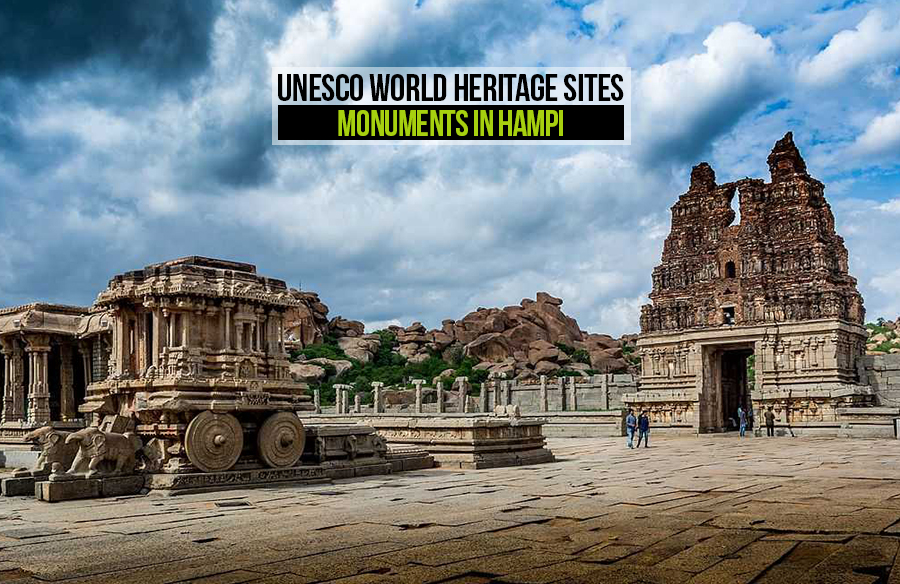
Situated on the southern bank of the Tungabhadra river in the Vijayanagara district of Karnataka, the ancient ruins of the historic village of Hampi, which spreads over 4187.24 hectares, is a UNESCO World Heritage Site.

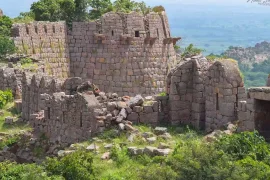
Hampi was a fortified city that served as the Vijayanagara empire’s capital in the 14th century. In 1500 CE, it was the world’s second largest city, after only Beijing. It was a prosperous city, attracting commerce from Persia and Portugal. The monuments of Vijayanagara city were built between 1336 and 1570 AD, from Harihara-I to Sadasiva Raya. Krishnadevaraya also made contributions to royal architecture between 1509 and 30 AD. The structures include Dravidian architecture. However, in 1565, the Muslim sultanates captured Hampi, bringing it to ruin. Despite being pillaged and in ruins, Hampi’s gorgeous natural backdrop, which includes the River Tungabhadra and rocks, can still be seen today.
A Brief Walkthrough

In recognition of its outstanding universal value, the United Nations Educational, Scientific and Cultural Organization (UNESCO) inscribed Hampi as a World Heritage Site in 1986.
Hampi’s appealing location is characterised by the Tungabhadra River, rocky hill ranges, and broad plains, all of which include numerous physical relics. With more than 1600 surviving remains, which include forts, riverside features, royal and sacred complexes, temples, shrines, pillared halls, Mandapas, memorial structures, gateways, defence check posts, stables, water structures, and so on, illustrate the diverse and advanced design of the heritage site.
Dravidian architecture thrived throughout the Vijayanagara Empire, and its culminating form is distinguished by huge dimensions, cloistered enclosures, and tall towers over entrances surrounded by ornate pillars. The Vitthla temple is an ornate edifice on the site, representing the pinnacle of Vijayanagara temple construction. It is a fully constructed temple with linked buildings like the Kalyana Mandapa and the Utsava Mandapa, all within a cloistered enclosure with three entrance Gopurams. In addition to the conventional areas seen in modern temples, it includes a Garuda shrine shaped like a granite ratha and a vast bazaar street. This complex also features a big Pushkarani (stepped tank) with a Vasantotsava mandapa (ceremonial pavilion in the centre), wells, and a network of water canals.
Hampi’s Outstanding Universal Value

As per UNESCO standards, the preliminary step towards listing a site as a Heritage Centre is its nomination by its respectful country. The site is then assessed according to an ‘Outstanding Universal Value’ for which 10 criteria are enlisted. To fulfil this requirement, the proposed site must satisfy at least one of these criteria.
Listed below are the 3 criteria fulfilled by Hampi to be recognized as a World Heritage Site by UNESCO:
Criterion (i): The remarkable integration between the planned and defended city of Hampi with its exemplary temple architecture and its spectacular natural setting represent a unique artistic creation.
Criterion (iii): The city bears exceptional testimony to the vanished civilization of the kingdom of Vijayanagara, which reached its apogee under the reign of Krishna Deva Raya (1509-1530).
Criterion (iv): This capital offers an outstanding example of a type of structure which illustrates a significant historical situation: that of the destruction of the Vijayanagara kingdom at the Battle of Talikota (1565 CE) which left behind an ensemble of living temples, magnificent archaeological remains in the form of elaborate sacred, royal, civil and military structures as well as traces of its rich lifestyle, all integrated within its natural setting.
An Architectural Haven

The Hampi in Karnataka’s old city is entirely made of burnt bricks and local granite, on which lime mortar is also used. The architecture of Hampi is acknowledged as being inspired by and related to Indo Islamic architecture. Hampi’s architecture stood out from other ancient towns for a number of reasons. Hampi, in Karnataka, was an ancient and well-fortified city that had existed for thousands of years. And the remains of Hampi in India are world-famous. Hampi’s construction and walls contained no mortar or cementing materials. In Hampi, they built beautiful orchards and pleasure gardens decorated with sculptures and themes such as the lotus and corbels. Their goal was to wedge them together by interlocking.
The royal complex’s structures featured great arches, halls with massive columns, and domes with niches for sculptures. It was a beautiful and rich city, with numerous temples, farms, and markets that drew tradesmen from Portugal and Persia. The Vittala Temple Complex is a well-known and popular temple in Hampi. Hampi was constructed in the sixteenth century, and the temple is dominated by 56 monolithic pillars known as the Musical Pillars. The Virupaksha Temple, located near the western end of Hampi Bazaar and built in the 15th century, is Hampi’s oldest temple, with a 50-metre-high gopuram.
Hampi’s Temple Architecture

A traditional Hindu temple is made up of a collection of structures, with the sanctorum serving as the focal point. A tiny temple could be a single-chambered shrine with the image of the God or Goddess put in the sanctum.
Large Vijayanagara temples are often encircled by massive compound walls. The temple campus’s gates are tall pyramidal towers. The sale axis includes the great towered entryway and the principal shrine in the heart of the site. Usually, this axis runs east-west, with the temple facing east. The auxiliary shrines of the Goddess (usually the consort of the God) and Hindu pantheon gods are located immediately adjacent to the principal shrines.
The Virupaksha Temple in Hampi village is a prominent example of Vijayanagara (Vijayanagar) temple construction. The temple is devoted to Lord Siva, the god of destruction. Next to the main temple are two shrines dedicated to the Goddesses Pampa and Bhuvaneswari. The towers of the majority of Vijayanagara’s big temples were built using Tamil architecture (Chola architecture). The lower half is often constructed of massive granite stones, with a massive wooden door put in the centre. Both sides of the doors include sculptures of doorkeeper deities carrying clubs or other similar weapons. The sides of the corridor are carved with life-sized nymph figures or depictions of gods.
Lotus Mahal

The Hampi Utsav, also known as the Vijaya Utsav, or Hampi Festival, has been held since the Vijayanagar period. The Karnataka government has referred to this event as the “Nada Utsava.” Hampi, as a World Heritage Site, attracts worldwide visitors. This festival contributes to the enormous cultural spectacle.
The palace’s name refers to the shape it resembles. The balcony and hallways are covered with a dome that resembles an open lotus bud. The central dome is similarly designed as a lotus bud. The palace’s curves have an Islamic influence, and the multi-layered roof form is also related to Indo-style architecture. The style and designs are an intriguing combination of Islamic and Indian architectural styles.
With four towers and a rectangular wall encircling it, the palace is a two-storied structure with a symmetrical design. The pyramidal shaped towers provide the impression of a lotus-like construction. The palace’s balcony and arched windows are supported by about twenty-four pillars. Beautifully carved patterns of birds and sea life may be seen on the pillars and walls.
Hampi Utsav

The Hampi Utsav, also known as the Vijaya Utsav, or Hampi Festival, has been held since the Vijayanagar period. The Karnataka government has referred to this event as the “Nada Utsava.” Hampi, as a World Heritage Site, attracts worldwide visitors. This festival contributes to the enormous cultural spectacle.
Renowned artists from around India have come up to bring the glorious days of the Vijayanagar Period into the present day. Kannadigas’ rich culture in dance, music, and art is therefore presented, complementing Hampi’s artistically sculpted ruins.
Decorated elephants, horses, and men clothed in military uniforms from the Golden Era are posted beneath the red, yellow, blue, and white cloth “Gopuras’ ‘ throughout Hampi’s alleys. The 2-kilometre walkway near the Virupaaksha temple, known as the Raja Marga, has been decked in the Vijayanagar motif. Tokens of “gold coins’ ‘ and “diamonds” were offered by traders, reviving the once-famous open commerce in diamonds, gems, and gold during the Golden Era. Classical dancers and vocalists will amuse the guests with spectacular performances in five venues.
Hampi Bazaar

Hampi Bazaar is a unique attraction in Hampi. The Hampi Bazaar, located in front of the Virupaksha Temple, is a well-known bazaar that spans more than a kilometre. On both sides of the road that leads through the market, there are a succession of historic pavilions.
Every year, the Hampi Utsav is held in November. During the annual festival, the market square becomes a vibrant location.
Hampi Bazaar becomes the hub of all festive activities in Hampi over those few days. It becomes a hub for cultural, religious, and temple festivities. As a result, market activity grows significantly as a large number of tourists visit Hampi to participate in the festivals.
Queen’s Bath

Achyuta Raya is thought to have built the Queen’s Bath for the female members of Vijayanagara’s royal family. Despite its name, the Queen’s Bath was most likely utilised as the king and queens’ private bathing chamber. It is also believed that the luxurious bath was a royal pleasure facility. This assumption is based on the bath’s location, which is outside the Royal Enclosure.
The Queen’s Bath is a complex building with a basic façade and an exquisite interior. Built in the Indo-Islamic architectural style, this enclosed room is unlike any other private or public bath in Hampi.
The Queen’s Bath is a rectangular structure. The building itself covers an area of 30 square metres. The structure’s heart features a massive sunken bath of 15 square metres in size and 1.8 metres deep. The bath is encircled by stunning arched passageways with pillars and elaborate balconies with windows.
The King’s Hall

The King’s Audience Hall at Hampi, as the name implies, is a structure intended for the use of the King of Vijayanagara. The building is located in Hampi’s Royal Enclosure. It is a ruined edifice, with parts visible on the western side of the Mahanavami Dibba.
The construction is thought to have been one of the most impressive in Hampi, suited for the powerful Kings of Vijayanagara. The edifice was used as the King’s Court. The remnants of the King’s Audience Hall continue to draw visitors today.
The King’s Audience Hall was made with massive stone and wood blocks. The edifice contains a ruined stone staircase at the back of the hall, indicating that it was formerly a two-story building.
The building’s superstructure is thought to have been primarily composed of wood, with pillars cut from sandalwood trees. Many analysts believe this as the explanation for the superstructure’s catastrophic destruction.
The King’s Audience Hall has the ruins of lofty platforms from which the surrounding portions of the building may still be seen today. This implies that at its prime days, the edifice offered a good perspective of the other structures within the Royal Enclosure.
Pushkaranis – Famous Water Tanks

Pushkaranis in Hampi are sacred water tanks attached to temples. Most of Hampi’s major temples have a pushkarani erected nearby. The pushkaranis were a noticeable aspect of the devastated town.
The sacred tanks were associated with numerous rites and practical features of the temples and the communities that surrounded them. Historically, the people of Hampi revered the tanks as hallowed locations. Even now, the pushkaranis remain a popular attraction for travellers visiting Hampi to view the Vijayanagara Empire’s remains.
The pushkaranis of Hampi were an important part of people’s lives under the Vijayanagara Empire. Because the temples were such an essential component of the people’s social and cultural lives in ancient Hampi, the water tanks became equally important.
Hampi’s pushkaranis are stunningly beautiful architectural structures. They are constructed in the traditional Vijayanagara style of architecture. Many of these water tanks are surrounded by elegant pillars or ornate arcades.
The vast water tanks included large stone steps that made it easy for visitors to enter the water. The water tanks are connected to a vast network of stone aqueducts and canals. These water channels were utilised to replenish the tanks with fresh water from the Tungabhadra River. Some of these water channels are still operating today.
Even in its ruins, Hampi remains compelling and lovely. Hampi’s landscape is almost as enigmatic as its ruins; it is surrounded by boulders of all sizes, which can be climbed to see the entire city and its surroundings. The way the city was created, with temples and bazaars, is outstanding. Temples and legends abound, allowing one to better comprehend the local tradition. The obliteration of old times is a magnificent sight for pilgrims and tourists alike. We talked about the ruins of Hampi in India, the history of Hampi, and who built it.
References:
Centre, U.W.H. Group of Monuments at Hampi, UNESCO World Heritage Centre. Available at: https://whc.unesco.org/en/list/241/
Radhakrishnan, P. (2023) Hampi – the heritage site of architectural wonder!, Karnataka.com. Available at: https://www.karnataka.com/hampi/about-hampi/.
Everything about Hampi hampi.in. Available at: https://hampi.in/#google_vignette.