Nearly everyone around the world has either heard of or visited the Great Wall of China. Or even both. The Great Wall of China is so great that it has been regarded as one of the seven wonders of the world. There is another wonder out there, somewhere between 5,500 and 6,500 miles west of the Great Wall. That wonder is known as Sungbo’s Eredo.
Sungbo’s Eredo, only second in size to the Great Wall of China, is a large and staggeringly impressive system of man-made defensive walls and ditches. The wall was built in honour of the Ijebu noblewoman, Oloye Bilikisu Sungbo (Asante, 2014).

Sungbo’s Location
Sungbo’s Eredo is located southwest of the Yoruba town of Ijebu Ode in Ogun State, Nigeria. It is said to be an hour’s drive from Africa’s most populous city, Lagos.

About Sungbo’s Eredo
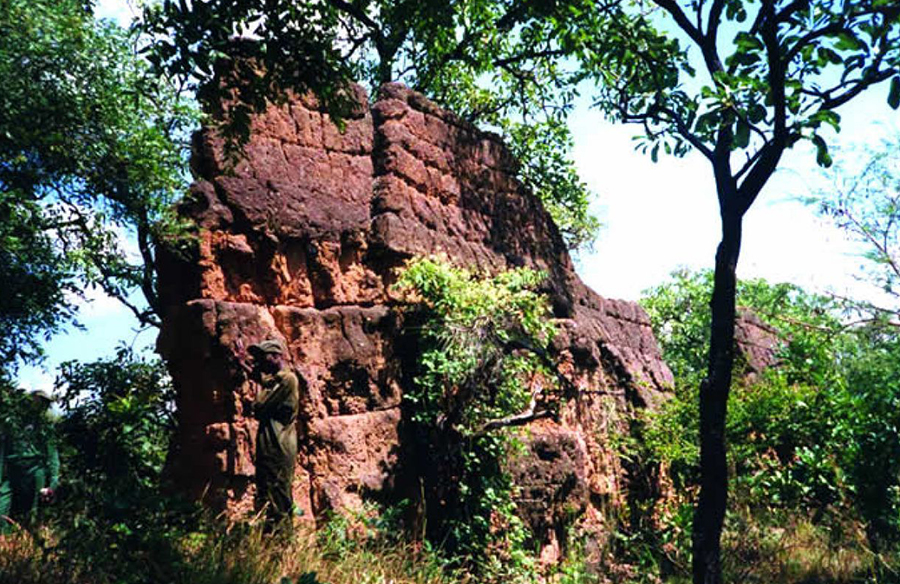
The total length of the fortifications is more than 160 kilometres (99 mi). The fortifications consist of a ditch with unusually smooth walls and a bank on the inner side of the ditch. The Eredo wall is greater in size than the entire area of Greater London, and the walls ran for a further length than Hadrian’s wall in England in their full scale (Dimri, 2021). The works were performed in laterite, a typical African soil consisting of clay and iron oxides. The ditch forms an uneven ring around the area of the ancient Ijebu Kingdom, an area approximately 40 kilometres (25 mi) wide north-south, with the walls flanked by trees and other vegetation, turning the ditch into a green tunnel.
Bilikisu Sungbo was said to be wealthy, influential, and worshipped by her people. According to the Ijebus, the Eredo was built as her memorial, and to buttress this, it is believed that her grave is situated in Oke-Ekiri, a Muslim town north of the Eredo.
Legend has it that Bilikisu Sungbo is in some way connected to the infamous Queen of Sheba. To this day, pilgrims flock in and out to pay their respects. The word Eredo is derived from an Ijebu word; it means embankments.
Sungbo’s Era
Studies on the walls have revealed that the structure dates back to between 670 and 870 AD. It has also been suggested that the settlements around the Eredo area have existed as far back as the Stone Age.
It is believed that the Eredo was built as protection against foreigners and to act as a defence against inter-tribal wars in West Africa.

Sungbo’s Architectural Style
The Eredo was most likely inspired by the construction of similar walls and ditches prevalent in western Nigeria, such as the Benin Iya, a 6,500-kilometre (4,000-mile) series of connected but separate earthworks in the neighbouring Edo-speaking region. It does not conform to the way we were taught about styles (like Gothic and Baroque). The wall and ditches were built long before the mechanical era and therefore required a copious and well-coordinated amount of labour. The Eredo was strategically designed. It created a formidable barrier and would have rendered any attacks useless.
The Eredo was made from rammed earth, and the construction method involved the digging and piling of the dug earth into banks to form the walls. The type of earth used during the construction is known as laterite, which is a reddish soil that is rich in aluminium and oxides that hardens when exposed to air. Given the method of construction of the wall, advanced knowledge of soil mechanics and hydrology must have been required.
The builders of this great wall excavated the earth to create a 165 km (103 mile) ditch with steep vertical walls between 3 and 6 metres (9.8 and 19.7 feet) high.

Sungbo Then and the Urban Fabric Now
- Vegetation surrounds the Eredo Wall, making it a biodiverse site. This green corridor acts as a natural buffer against urban encroachment, thereby contributing to environmental sustainability.
- Eredo’s physical presence has shaped urban planning and land use as it has limited development possibilities in the area. The walls can be integrated into urban planning by creating buffer zones around them. These can go further to serve conservation and recreation properties.
- Sungbo’s Eredo is already an archaeological site and is on Nigeria’s tentative list of potential UNESCO World Heritage sites. The site provides insight into the culture and history of the region in which it was built. This reinforces cultural identity.

Sungbo and Its Historical Importance
- Sungbo’s strategic design and location show the diverse and intelligent measures that communities in Nigeria and West Africa as a whole took to protect themselves from rivalries and threats.
- The architecture of Sungbo Eredo challenges historical narratives about the development of complex societies and the widespread rumour that Africans were uncivilised until the Europeans came to their shores. The structure shows the sophistication and brilliance of pre-colonial West African cultures.
- Politically, the structure emphasises the hierarchical and socio-political structures of the era. It showcases a highly organised society with strong leadership; thus, the Eredo walls survive today as a powerful testament to the unity and cooperation of the ancient Yoruba tribe. Unlike almost every other major construction project in history, these appear to have been built with an emphasis on cooperation and mutual advantage rather than despotic control (Dimri, 2021).
- The construction of such an extensive system reflects the refined technological capabilities of the builders during the period.
All in all, Sungbo’s Eredo is a testament to the symbolic engineering achievement and civilisation of Africa pre-colonisation. The Eredo is a marker of socio-political organisation, a window to the rich and complex history of Nigeria and Africa as a whole. Sungbo’s Eredo is more than a wall that has surpassed and will continue to withstand the test of time.
References:
Asante, M. K. (2014) *The History of Africa: The Quest for Eternal Harmony*. Taylor & Francis.
CometoNigeria (n.d.) *Sungbo Eredo – Yoruba Lost City And Nigeria’s Hidden Wonder – CometoNigeria*. Available at: [https://www.cometonigeria.com/sungbo-eredo/](https://www.cometonigeria.com/sungbo-eredo/) (Accessed: 31 May 2024).
Dimri, B. (2021) ‘Sungbo’s Eredo: The Walls of the Real Queen of Sheba?’, *Historic Mysteries*, 30 December. Available at: [https://www.historicmysteries.com/archaeology/sungbos-eredo/22768/](https://www.historicmysteries.com/archaeology/sungbos-eredo/22768/) (Accessed: 1 June 2024).
Stone, P. G. (ed.) (2011) *Cultural Heritage, Ethics and the Military*. Boydell Press.
UNESCO (n.d.) *States Parties: Nigeria*. Available at: [https://whc.unesco.org/en/statesparties/ng](https://whc.unesco.org/en/statesparties/ng) (Accessed: 1 June 2024).