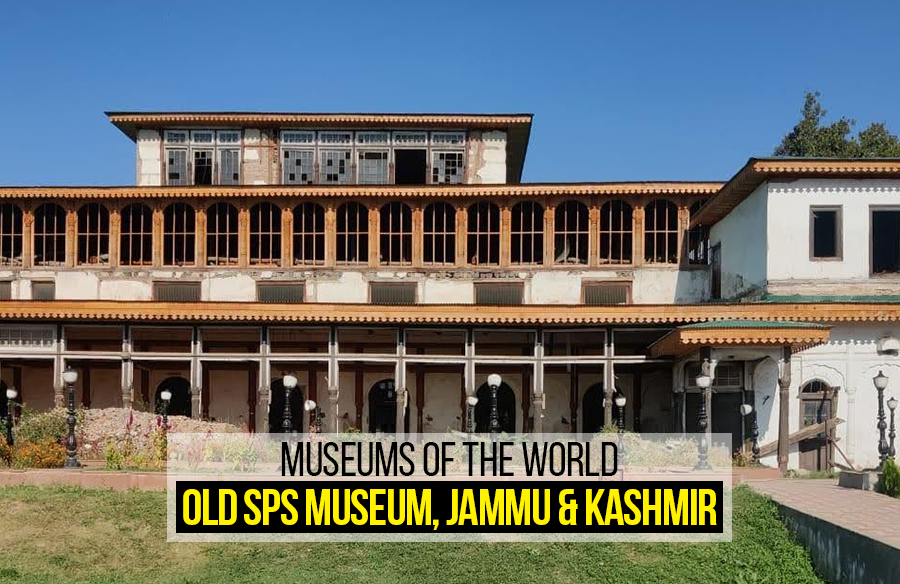
The Shri Pratap Museum, commonly known as the old SPS Museum is a distinguished, yet overlooked, exemplar of the architectural, cultural and historical legacy of Jammu and Kashmir. Named after the erstwhile Maharaja of Jammu & Kashmir, the museum was set up to exhibit an extensive collection of relics and antiquities from Jammu, Kashmir, Baltistan, and Gilgit. Built in the late 19th century, the museum serves as an important case study of architectural design and construction during the Dogra rule in Kashmir and is renowned for perhaps one of the best interior decorations found in the region’s heritage structures. Although currently defunct and ongoing conservation, it remains an exemplar of the valley’s exquisite traditional architecture and a museum to the awe-inspiring Kashmiri craftsmanship and artistry.

Location

[ Originally conceived as a guest house for the Maharaja, the old SPS Museum occupies a strategic position between Raj Bagh and Lal Mandi, offering panoramic views of Srinagar city. The location was ideal because as Srinagar gradually expanded from north to south, the southern banks of the Jhelum were largely uninhabited. The museum’s placement along the left side of the river Jehlum was strategic, providing historical access via ghats, which were once bustling with boats and ferries ferrying guests and goods. In 2005, a pedestrian bridge was constructed adjacent to the museum, thereby enhancing accessibility and integrating the museum further into the city’s urban fabric. ]

Architectural Design
[ The architectural design of the old SPS Museum blends traditional Kashmiri influences with foreign inspirations, showcasing a unique synthesis. The layout and organisation of the museum reflect its dual use as a former palace converted to a museum, serving well for the visitor experience and artefact presentation. Strategically positioned along the Jhelum River, the museum offered convenient access via waterways, integrating seamlessly into Srinagar’s urban landscape. Archival records depict the building in an expansive open space with front courts paved with indigenous Devri stone, with a sizable forecourt adorned with steps descending to the river.]

Spatial Planning
[ The old SPS Museum building features a symmetrical design with turret-like form with rooftops at its corners. Originally planned on a square layout, it includes verandas on all four sides, providing a seamless transition between the interior and the exterior, allowing for natural light and ventilation. The rooms and halls are interconnected to one another through archways and doorways, with an octagonal room in the centre of the plan. The building’s square plan, symmetrical facades, and interconnected rooms facilitated the seamless transition from a royal guest house to a public museum.


The structure also displays symmetrical facades on all sides, featuring the first floor adorned with multi-foiled cusped arches with windows. On the second floor, intricate parapets are featured, typical of structures like the museum, where the roof is crowned by a central open square pavilion topped with a pyramidal roof known locally as Zoon Dub. The original roof, called Burzapash, was traditionally constructed using layers of birch bark, fertile clay, and turf, adorned with vibrant tulips and lilies that burst into bloom each April. The museum originally boasted a three-tiered roof and double-storied flanking towers with upper-level collonaded multifoil arched verandas. The building had been reduced to a single-story structure with a central clerestory. Currently, the old SPS Museum is undergoing restoration to rebuild the museum according to its original design.

The building incorporates four identical corner blocks that serve as connectors to various wings, housing staircases and featuring sloping roofs typical of Kashmiri architecture, designed in response to the climate. The primary decorative elements of the building remain consistent, accentuated in different ways through the utilisation of latticework screens (Pinjrakari) and window shutters, intricately carved wooden brackets, eaves boards (Marakh-Patt), and pendants (Dour), some of which need restoration to their original design. ]

The Historic Interiors
[ The old SPS museum building features load-bearing brick masonry walls, gradually thinning towards the upper levels, set in lime mortar. Internally, wooden columns form the structural framework, supporting arches that serve as both doorways and decorative niches. The building’s interiors are exceptionally exquisite, showcasing stunning craftsmanship through elaborate decorative elements. The main hall, once the Maharaja’s state banquet hall, stands out as the building’s most stunning space. Within, the museum displays wall Naqashi (painted stucco), Khatamband (wooden ceilings with geometric patterns), and papier-mâché decorations, highlighting the craftsmanship of local artisans. The central octagonal room features painted stucco that culminates elegantly in a cornice band, exemplifying the intricate detailing typical of Kashmiri architecture. ]


Style
[ The old SPS Museum is an exemplary representation of the traditional Kashmiri architectural style, characterised by intricate woodwork and carvings. Constructed using the Dhajji Diwari technique, the museum showcases the indigenous construction methods of the valley. During this time, Kashmiri architecture was renowned for its rich cultural exchanges, which are reflected in the style of this museum as well which blends Kashmiri architectural style with Turkish architectural elements such as the Pinjrakari, creating distinct Kashmiri layers. Similarly, Kashmiri motifs are also integrated with influences from Central Asian and Persian traditions, showcased through features like Naqashi, Khatamband, and symmetrical designs. This style reflects the period of its construction, marked by cultural and architectural exchanges along the historic Silk Road. ]

Construction and Materials
[ The construction of the old SPS Museum integrated locally sourced materials such as Maharaja bricks, Devri stones, lime mortar, and local timber, selected for their availability and suitability to Kashmir’s climate. The local building tradition involved constructing structures using a foundation of stone, topped with wooden frames for pillars and floors, while brick formed the walls, both inside and out. This building utilises the Dhajji Diwari style, employing load-bearing brick masonry walls set in lime mortar. This construction technique integrates a wooden bracing system akin to a patchwork quilt, filled with stone rubble and single brick fillings, making the museum structurally stable and earthquake resistant, crucial in the region’s seismic context. Internally, walls underwent a process called Livum, where fine clay overlays a base of coarser clay mixed with straw or lime and animal hair.

The roofs of the old SPS Museum were crafted from wooden planks supported by wooden rafters, resting on a continuous log (Nar Kooth) spanning the building’s length and upheld by load-bearing masonry piers. Traditional Kashmiri roofs (Burzapash), featured low-pitched designs coated with Burza (birch bark) that provided waterproofing and insulation. This bark layer was covered with soil, and flowers such as tulips, daffodils, and narcissus were planted enhancing the rooftops with seasonal blooms from spring onwards. These choices highlight the museum’s ties to regional construction practices and cultural heritage, echoing architectural traditions prevalent in late 19th and early 20th-century Kashmir. ]

Historical Significance
[ Established during the Dogra rule under Maharaja Shri Pratap Singh in 1898, the old SPS Museum holds immense historical significance as an initiative to document and safeguard the diverse cultural heritage of Jammu and Kashmir. The establishment of a museum in Srinagar was proposed by General Raja Sir Amar Singh (the younger brother of the Maharaja) and Captain S.H. Godmerry (a European scholar) to showcase exhibits and artefacts from the region of Jammu, Kashmir, Baltistan and Gilgit. The establishment of the museum was overseen by John Marshal, a British archaeologist and director of the Archaeological Survey of India, renowned for his work in preserving the archaeological history of India. The construction of the museum took place as part of broader developmental endeavours by the Dogra rulers, under whom the modern state of Jammu and Kashmir started taking shape.

As one of Srinagar City’s earliest museums housing rare and invaluable artefacts and relics, it has served as a vital resource and place of leisure for antiquarians, historians, and art enthusiasts. The museum boasted a collection of diverse artefacts, including rare sculptures, numismatics, terracotta and pottery, miniature paintings and photographs, armour, utensils, upholstery, woodwork specimens, papier-mâché, and shawl weaving, chronicling both ancient and modern histories of Jammu and Kashmir. Despite being disused as a museum, the historic and cultural significance of its architecture and artistry serves as a valuable resource for historians, researchers, and visitors interested in exploring the region’s rich past. ]


Urban Impact

[ The old SPS Museum’s location in central Srinagar profoundly impacts the city’s urban landscape. Historically, Srinagar’s development along the Jhelum River has been a key development of its urban fabric, particularly waterways, narrow alleys (Galis), and bridges becoming characteristic of its spatial organisation. The museum’s position near the river and connectivity through pedestrian bridges integrate it seamlessly into the urban landscape of the city. Its presence highlights Srinagar’s historical relationship with the river, symbolising it as a former hub for cultural activities and public engagement. While the historic museum undergoes conservation and remains closed to the public, the new SPS Museum adjacent to it extends its role in the city’s cultural tourism and educational offerings. ]

Current State & Future
[ The old SPS Museum is considered to be a crucial cultural institution that showcases the rich architectural, social, and historical heritage of Jammu and Kashmir The museum was an important landmark for educational and cultural engagement. Unfortunately, the museum building was significantly damaged by earthquakes in October 2005 which led to its long-standing closure to the public. With only 25 percent of its 80,000 artefacts on display due to inadequate space and unsafe structure, a new SPS Museum building was constructed in 2017 in accordance with modern preservation standards. This new building, located next to the old one, now serves the public.

The old museum building, a testament to the historical skill of Kashmiri craftsmen, showcases surviving techniques of Kashmir’s architectural and artistic legacy, which need conservation. Recognizing its importance, the government declared the old SPS Museum a State Protected Monument in 2018. The building is currently undergoing conservation, reconstruction, and renovation. However, back in 2014, the museum again sustained severe damage from floods, exacerbating the deterioration of the structure and further lengthening the restoration process.
Once a celebrated centre of Kashmir’s cultural heritage, the Old SPS Museum today stands as a shadow of its former glory, half sturdy, half shambles. The ongoing restoration process has been drawn out and seems interminable with no conclusive timeline. This has left the museum indefinitely closed to the public, resulting in a significant loss of cultural experience. However, the only hope is that once completed, the museum will once again serve as a cherished institution of history and culture for future generations. ]
Reference List:
- Directorate of Archives, Archaeology & Museums (no date). Available at: https://jkarchives.nic.in/Museum_Srinagar.htm [Accessed date: 13 May 2024].
- PTI. (2017). Shri Pratap Singh, Kashmir’s lone museum, opens a new building for the public in Srinagar. Firstpost. Available at: https://www.firstpost.com/india/shri-pratap-singh-kashmirs-lone-museum-opens-new-building-for-public-in-srinagar-3541683.html [Accessed date: 13 May 2024].
- Museums – The World Museums Network (no date). SPS Museum Srinagar. [online]. Available at: https://museu.ms/museum/details/18163/sps-museum-srinagar [Accessed date: 13 May 2024].
- PTI. (2017) Valley’s lone museum opens to the public. Tribune India News Service. Available at: https://www.tribuneindia.com/news/archive/j-k/valley-s-lone-museum-opens-to-public-420829 [Accessed date: 13 May 2024].
- Beg, M. Salim, and Shakeel, Munazah. (2022). Interview regarding Case Study of SPS Museum.
- Haq, Ehsan-ul, and Shakeel, Munazah. (2022). Interview regarding Case Study of SPS Museum.
- Abha Narain Lambah Associates. (no date). Detailed Project Report for the Conservation and Design of the SPS Museum. Srinagar: Directorate of Archives, Archaeology & Museums, J&K.
- Mathawan, P. (2018). The Treasures of the Shri Pratap Singh Museum. Travel The Himalayas. Available at: https://travelthehimalayas.com/kiki/the-treasures-of-the-shri-pratap-singh-museum [Accessed date: 21 May 2024].
- Mathawan, P. (2018). Kashmir Stone and Bronze Sculptures from Antiquity (SPS Museum). Travel The Himalayas. Available at: https://travelthehimalayas.com/kiki/kashmir-stone-and-bronze-sculptures-from-antiquity-9-sps-museum [Accessed date: 21 May 2024].
- Hicyilmaz, K.M.O., Wilcock, T., Izatt, C., da-Silva, J., Langenbach, R., (2012). Seismic Performance of Dhajji Dewari. 15 World Conference on Earthquake Engineering. Available from: https://www.iitk.ac.in/nicee/wcee/article/WCEE2012_2691.pdf. [Accessed: date: 17 May 2024].
- Walter, D.M. (1906) The romantic East: Burma, Assam, & Kashmir, Internet Archive . London: A. and C. Black. Available at: https://archive.org/details/romanticeastburm00delmrich/page/n7/mode/2up [Accessed date: 20 May 2024].
- Mast, G.M. (no date) Lady Curzon’s escort at Museum boat – landing, Srinagar, India, Online Archive of California .Underwood & Underwood, Keystone-Mast Collection, UC Riverside, California Museum of Photography. Available at: https://oac.cdlib.org/ark:/13030/kt038nd2qh/?order=2&brand=oac4 [Accessed date: 20 May 2024].
- Mast, G.M. (no date) Her Excellency Lady Curzon, and His Highness the Maharaja of Kashmir, Leaving Museum, Kashmir, India, Online Archive of California. Underwood & Underwood, Keystone-Mast Collection, UC Riverside, California Museum of Photography. Available at: https://oac.cdlib.org/ark:/13030/kt1b69r0zg/?brand=oac4 [Accessed date: 20 May 2024].
- Short, J. (no date) Victorian stereoview card from circa 1900, historic social image. Her Excellency Lady Curzon and His Highness the Maharaja of Cashmere leaving Art Museum, Posterazzi. Design Pics. Available at: https://www.posterazzi.com/her-excellency-lady-curzon-and-his-highness-the-maharaja-of-cashmere-leaving-art-museum-victorian-stereoview-card-circa-1900-india-poster-print-by-john-short-15-x-16/ [Accessed date: 20 May 2024].