We all know that architecture can be seen and adored but have you ever heard it No right? That’s where how sound is a segment where architecture has been least encountered. But Maybe that’s just in our heads because there are several structures in the world in which sound has played a vital role in architecture.

Sound is something that everyone considers as an entity to eliminate while designing. On the other hand, it can be a major natural tool to increase the quality of a space. From the old times till date, several structures have made use of the play of sound using enormous techniques.
Integrating Nowadays technology and creative ideas we can formulate sound as a design element infusing one more human sense into the field.
From Residence to sanctuaries in every structure, we can implement sound as a focus point.
Can Architecture be heard?
What is the role of sound in architecture, considering light can be seen and radiates to give us an impression similarly sound reflects and it gives us an impression of form and materiality.

People in our generation are Busy. There are inside a mixture of sounds via more like noise. So nowadays they go for outing to experience nature without noticing the fact that nature be induced inside the buildings. The use of natural ways makes it more organic like from the sound of the flow of water to the sound of branches from trees and plants.

Coming into the buildings the technology has grown very vast and they are evolving but these aren’t open to the public commoners. Mostly they are limited to a small group of people related to that field. The vast infrastructure of facilities and equipment goes largely unnoticed. But coming into public venues these come together all at once the visibility, art, and technology are open to the public vision.

Architecture becomes interesting when experienced via auditory senses beyond physics. Sound helps to construct an understanding of forms, objects, and distances. The interplay between aural and visual architecture creates captivating spatial experiences.

Sound can be celebrated inside a structure making it more interesting via auditory senses beyond physics. Sound can be used to understand the form, shape, and density of a space. It creates a varying spatial experience that has more of an organic flow rather the one created through other appliances. Many of the material and social functions of architecture can be fulfilled by sound, as a supplement or complement to conventional architecture and has great potential.
Architecture that can be heard?
Now look at a few examples that already exist that bulge the sound from nature from the very old times to our modern designs.
Baptistery of Saint John – The Pisa Baptistery has a special acoustic phenomenon. Material composition formal arrangement of spaces, and structural spatial connections give this space an intense reverberation time of 15+ seconds.

This allows the singer to harmonise with their vocal reverberation creating a dramatic sonic experience. This is created by the several reverberations taking place in different ways inside the Baptistery
Music Hall at the Ali Qapu Palace – A nation using architecture to enhance its traditional music takes us to Iran amid some 17th century to be precise mud bricks. The magnificent ceiling of Ali Qapu with an umbrella of niches overhead helps to reduce echo. That means a low reverberation time for sound. Ideal for intimate music especially Iranian ballads.

So if you stand inside the Music Hall and clap, you won’t hear any echo. In a room of such size and volume the wall and ceiling ensure that the guests would enjoy the live performance without any distortion.
Musical Pillars – In south India, there are many famous temples in which we can see these musical pillars like Vithala Temple in Hampi, and Nellaiappar Temple in Tirunelveli. These are spectacular examples of using sound from nature as an interesting element in design.

There are two types of musical pillars found in these temples. They are called (1) Beating or tapping pillars and (2) Blowing pillars.
The tapping pillars will produce different singing tones by tapping on them with fingers while the blowing pillars will generate a sound by blowing air in the holes like wind instruments.
Golconda Fort –Another mesmerising example we can see is the giant Golconda Fort. Perched atop a rocky outcrop on the western outskirts of the city, this imposing citadel was once the hub of a powerful Indian dynasty, the Qutb Shahis.

The noise of a clap can reportedly travel more than 1km inside the citadel thanks to the input of Iranian architects. It’s amazing to hear the sound of a clap reaching the 400-foot-high Citadel from the entrance. The construction of many arches and porticos which helped to amplify sound
Chandigarh Capitol Complex – ASSEMBLY – One of Le Corbusier’s most prominent buildings from India, the Palace of the Assembly in Chandigarh boasts his major architectural philosophies and style.

Among these solutions, we could find the floating ‘acoustic clouds’ included in the built version, with changing shapes, whose geometry always respected the minimal absorbing surface. Being a hyperboloid of revolution, geometrically, is not very good for acoustic repetitive regular reflection of the sound, echoes, etc. and the reinforced concrete material is not very helpful too.
The Whispering Gallery of St Paul’s Cathedral, London – When you whisper, the sound waves ‘creep’ around the gallery, hugging the walls.
The same system that propagated in Marconi’s first radio signals that crossed the Atlantic Ocean in 1902, guided by radio waves that traversed the parallel conducting surfaces formed by the earth and the ionosphere, makes the sound clings to a curved wall – this mechanism is responsible for the whispering gallery effect in St. Paul’s.
The circular shape allows sound waves to bounce round and round multiple times because the angles involved are so slight. That’s how someone on the other side of the walkway can hear you so clearly.
Technological Impacts in Soundscape
Technology is a major factor where we can make use of sound on another level. This best use of sound and technology together has produced a lot of major projects around the world, let’s check out some:
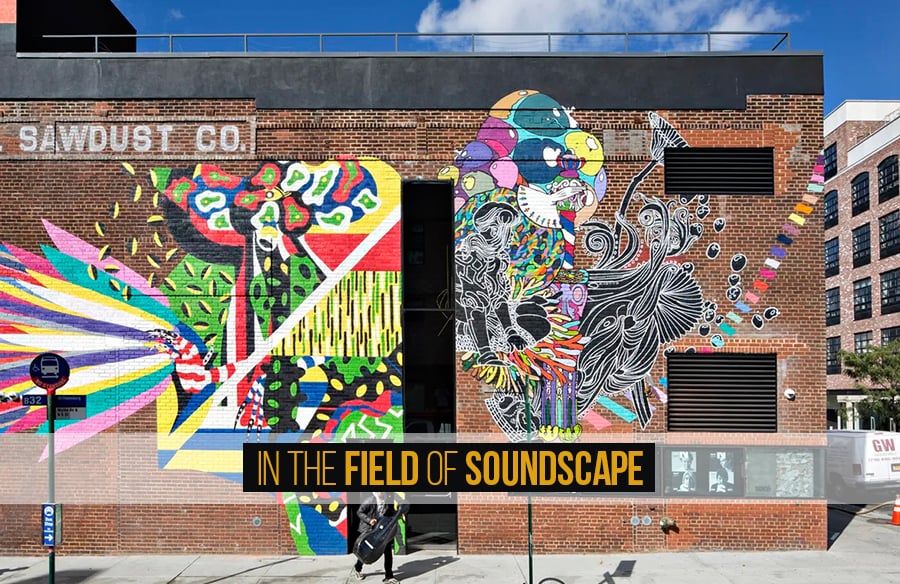
National Sawdust Co. – Location – Brooklyn, New York
Located in the industrial portion of Brooklyn. This once was the most happening chamber hall in the city. National Sawdust provides an extraordinarily intimate space—with a capacity ranging from 120 to 350—to experience genre-spanning music, at accessible ticket prices.

All the materials used for the interiors have been carefully chosen by acoustic designers. Perforated metal and fabric composite panels have been used to create the sound-amplifying skin of the Chamber Hall. Black ceramic tiles have been used as wall cladding for the Lobby space.

The result is a rich auditory experience to accommodate a range of repertoire, both amplified and unamplified. The chamber hall is housed in a solid concrete shell floating on spring isolators. This “box-in-box” construction allows the entire space to achieve the low background noise levels are consistent with the world’s finest recording studios.
Home Theatre Studio Interior /Sfurna Designs RAJKOT, Ahmedabad –
The room is designed using the natural material as the acoustic element implementing the old technique to attain the same. It is equally good for listening to and watching movies. Each chair position has its own RT and one can change the position of the chair to experience different typologies of sound. Such as for recording, speech, and music.

Dolby Atmos Installation, high-end speakers from the stage accompany. Walls are made using fire bricks locally available without any additional acoustic proofing. The stones used here for the walls from the south Indian temple are used in specific ways to achieve the desired sound quality, thus it is inspired by the past.

By breaking all the norms that brick can never be used to make a sound room, this is a perfect example of the same. These walls of the demo room have been built by using the locally manufactured in Rajkot’s sister city Morbi.
Ecotone Hotel in Bikanoo/ Sound of Wind – The Setre Marina Hotel in Moriyama City looking at the lake Biwa, pretends to be its catalyst for its creation.

Overlooking the future constructions, and how they can be operated, leads to the construction and reconstruction of projects that besides having technology and materials that dwell in nature and the history of the city, connect people to this concept of natural life and style.
The idea of a chapel is associated with the hotel. A space filled with strong wind from the lake. So seeking the project as a stringed instrument played by the natural wind, as seen in Greek mythology, the god of winds Aeolus. A space that plays sound when the wind passes through.

By deeply understanding the internal spacing, simulations of the openings and the architectural form overall to create a frame structure continuous to domestic larch LVL as a structure, structural plywood to frame from the outside, thereby play a horizontal force as an upper airway of the internal space
Looking above we have seen a lot of structures that are different from each other incorporated well by a single entity called sound. In modern days we have to come across such different ways to use sound inside buildings.
How we can increase the quality of spaces by deeply understanding the need and available resources we can make use of. Maybe sound is an underrated element in the field of architecture in the future holds many possibilities how it can come again in the modern era.
Citations:
Websites referred for data and information:
- https://www.artforum.com/features/sound-architecture-210441/
- https://researchoutreach.org/articles/listening-city-architecture-soundscape/
- https://thespaces.com/10-buildings-with-extraordinary-acoustics/
- https://www.remotelands.com/travelogues/golconda-the-eerie-acoustics-of-a-hyderabad-fort/
- https://www.yumpu.com/en/document/read/9146784/the-journal-of-acoustic-ecology-world-forum-for-acoustic-ecology#google_vignette
- https://drawingmatter.org/the-assembly-and-museum-at-chandigarh/