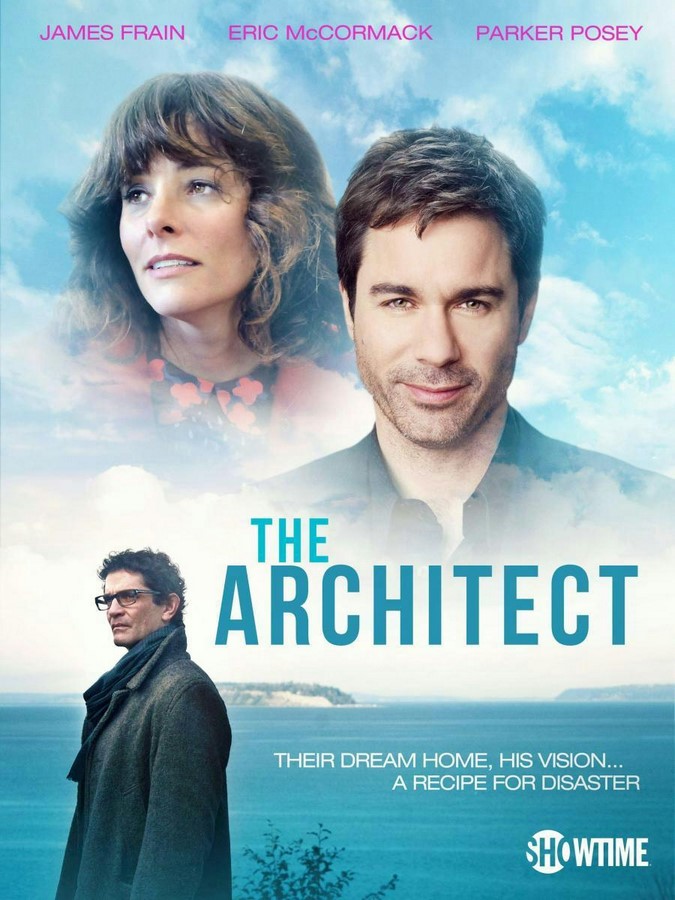
The Architect (2016) is a drama-comedy film directed by Jonathan Parker and starring a married couple, Drew (Parker Posey) and Colin (Eric McCormack), and their Architect, Miles Moss (James Frain).
After visiting a friend’s renovated home with a water view, this suburban couple is inspired how to invest in their dream home. They hire an Architect to realise this dream. It doesn’t take long before the dream Architect becomes a nightmare, as his agenda goes from his professional engagement to breaking through the cracks of an unstable relationship between the couple.
Drew is a dreamy Artist, struggling to find a perfect, unhinged expression for her Artworks. Miles notices this, latches onto her struggles, and sells his dreams to her as a fulfilment of their dream home. He sells the idea of who a perfect client is to Drew, and she is determined to be a perfect client. Her desire to be a mother made her marital life unfulfilling. Hence, she finds comfort in being the Architect’s “muse”.
Colin is in the financial industry, but his financial obligations in the marital space left him constantly on edge. He is suspicious of Miles and his moves. He finds the Architect’s approach egotistical and makes initial attempts to refrain from engaging his services. A lower professional fee puts Miles on his path. Colin’s dream home idea requires lots of storage space, mostly for his medal display, kayaking, and exercise kits.
As a couple, Drew is expressive, while Colin is stiff and practical. She wants to go with the flow, while he prefers to plan his moves. She wants a baby, and he clearly stays busy (constantly exercising), to avoid having sex.
Miles is a junior Architect in an Architectural company known as Sullivan+Moss. Moss is Miles’s late father, while Moss’s partner, Sullivan, died unexpectedly 3 months ago. In keeping the company afloat, Miles had struggled to convince his past clients of his dreams for their projects. Meeting the couple and Drew in particular, he finds her susceptible and finally builds his first physical building project.

To the Designer and Architect in practice, here are eight lessons to glean from this movie.
-
Your project speaks for you
Take every project as an advertisement tool. Your vision, style, personality, and philosophy are displayed for every live project you design. Drew and Colin should have asked for referrals from their friends. They saw a building, fell in love with it, searched for it online, and contacted the designer.
-
Create and maintain an online presence
Many architects need to catch up on the internet space because they are too involved with creating the designs. The Architect could have lost out on the prospects without his online presence. Create a blog, a forum, or a website, showing your works and explaining the details, processes, and challenges in layman’s terms. Set aside time to go on social media, consider her ways and be wise, engaging in conversations and comments within and outside Architecture.
-
Get to know the lifestyle of your client
And, by extension, anticipate what their future indoor lifestyle could be. The Architect is a psychologist who understands spaces and the humans using them. Getting to know the spaces a client requires is one thing; enjoying dinner with the family is another. You don’t need to get too personal to know how a client uses a space. Know when and where to draw the line.
-
Don’t design alone
Know when to bring in other professionals and to build industry members. Miles chose to get the contractor involved at the presentation stage. The little squabble between Miles and the Contractor in the client’s presence was unnecessary. If Drew wasn’t already enraptured, that could have shown incompetence for a design team.
-
Control your emotions
It’s not about you, the designer; it’s about the client. He or she must find satisfaction in your design solution. Be open to criticisms, constructive or not. Don’t ignore, neglect, or make light of any complaint or client’s dissatisfaction with your work simply because it hurts your ego. Remember that the design concept is the actual statement solution before a plan is put in place and not necessarily the floor plan. Be open and willing to restructure your plans.
-
©Filmaffinity Be a professional
Design professionals understand their duty to a client. He/she does not get involved with an emotional breach of contract. Miles deceived the couple into building his first project, a project he had won an award for but was never actualised. He put aside the client’s dream home ideas and cunningly worked on his own dream. When Drew found out, she was devastated. In today’s world, a client can decide to pursue such unethical behaviour legally. This could cause you to lose your license, go to jail or redeem yourself with a huge fine.
-
Don’t be involved in unethical practices
Miles proved to be an Architect who could cut corners to achieve what he wanted. He is seen telling Colin that the handrails for the stair will be installed for inspection and eventually removed to avoid obstructing the visual flow of the curved stair.
- Learn to work with shapes and lines you understand.
Care must be taken when designing with curved walls or building envelopes. Straight lines are easy to work with. Mass furniture production comes in standard right-angled, straight-line shapes except for customised use. Some curved shapes may be impractical for a practical space unless you intend to design the furniture for each space. Nature may come with something other than right angles and straight lines, but work with what you know until you understand it.
In conclusion, the Architect is a thought-provoking movie that uses architecture and architectural practice to tell a story. From the time the couple saw an existing building, to their site survey, to visits to her home workspace, to the time of the presentation (except for the dinner part with the family, which felt too personal), most Architects will find similarities in practice.
The movie portrayed the life of a struggling Architect who couldn’t get his designs built. Many young Architects need help getting clients, but their approach to getting their project built needs to be revised. It was easy to understand why he couldn’t fulfil his dreams. We didn’t see his previous designs, but from the one we saw, he had lofty ideas that seemed impractical for a residential home with expansion possibilities, such as pregnancies.
Miles seemed more concerned about getting Drew to accept his dream project as her dream home, giving her a space that could be separated from Colin’s space when the need arose.
The result? A massive “showroom” building with one sleeping space and a space for a day bed. It is not an ideal design solution for residency. Miles took his floor plan idea from a Nautilus shell but could have done a better job of sectioning the interior to be practical and useful. This further explains the difference between Art and Architecture, which states that while Art is simply aesthetics and visual pleasure, Architecture must be all Art and, most importantly, useful.