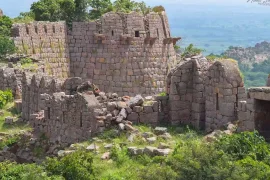
Crowned as a UNESCO World Heritage site at the 44th World Heritage Committee of UNESCO,the Ramappa temple, also known as the Kakatiya Rudreshwara Temple, is located in the Palamet village of Telangana, India. Built during the Kakatiyan period of 1123-123 CE, it is the core Shiva temple that stands as a part of a walled complex situated approximately 200 km northeast of Hyderabad.
Geographically, the Kakatiya empire was situated in the northern area of modern-day Telangana, later spreading its influence in the coastal delta of Andhra between the Godavari and Krishna rivers. One of the four monarchies of Southern India at that time, the Kakatiyas followed the footsteps of pre-existent customs of using local materials and techniques for building places of worship as per Hinduism. Although there were already numerous temples serving the same purpose, it wasn’t until the rule of Kakatiya empire that less globally intended temples of the hilly areas came into existence.5

Cultural Footing: Kakatiya Dynasty
The Kakatiya dynasty ruled a major part of the modern-day Deccan area of India between the 12th and 14th centuries. It was territorial over much of Andhra Pradesh and Telangana, as well as parts of Odisha, Kerala, and Tamil Nadu. The rulers and their cultural beliefs can be perceived through scriptures and more from the era, solidifying the theories on their influence on the populous delta areas that fell under their rule.
The architecture linked to the Kakatiya era was highly influenced by various ancient architecture styles rooted in India. It is said to be a mixture of Chalukya architecture and Vesara style, while also carrying bits of Dravidian and Nagara Bhumja styles of architecture in its details. Proof of that can be seen in the utilisation of the sandbox technology which has traditionally been used to create Vimana-shaped or horizontally stepped towers, especially in temple complexes.2

Depending on the surroundings and the availability of local materials, the Kakatiyans used to opt for bricks and stones for the construction of their marvellous temple complexes. Their plans for temples had five major characteristics: Ekakuta, Dwikuta, Trikuta, Chatuskuta, and Panchakuta, leading geographical alignment in a manner so that all of the main temples of the complex would face the rising sun in the east, following the commands of the Vastu Shastra.3

Elements: Art, Architecture and Sculptures
The temple holds indigenous values at its core as it was built using traditional Dravidian techniques as well as instruments, withstanding the surrounding nature while adding valuable inputs through the irrigation system and the reservoir that were built by the Kakatiyans in the immediate surroundings. Like this, the Ramappa temple is not just an integral part of the architectural advancement of Indians, but also an excellent example of communicating culture through art, as it conveys about 800-year-old traditions through its built structure.4
It is made of porous lightweight bricks using the sandbox technique, which reduces the weight of the roof structure while elevating the strength of the core system, alluding to the name ‘floating bricks.’ As seen in almost every other ancient temple of southern India, the temple has high-quality sculptural illustrations of regional customs and art forms belonging to the Kakatiya dynasty.
The Ramappa temple remained indestructible through multiple attempts at damaging its foundation during wars and natural calamities, the credit for which went to the usage of porous bricks which used to contain saw-dust in 33% of its overall portion as opposed to the 25% of bricks otherwise, make them light enough to be able to float in water and survive major disasters alongside. Although a huge earthquake in the 17th century caused noticeable damage to the structure, the building stood its ground with the strength provided by the aforementioned sand-box technology. Since then the Ramappa temple has been restored, the process for which started in 1914 under the rule of the 7th Nizam of Hyderabad after his donations were offered for the preservation of the temple.6

Universal Value: Tribute to Dravidian Culture
The Ramappa temple is located near the water reservoir of Ramappa Cheruvu shores, surrounded by agricultural fields and forest foothills. This goes to show that the building location pays respect to the values of the dharmic texts which indicate that temples should be created by developing a rhythmic integration of natural entities like forests, lakes, hills, streams, springs, agricultural lands, and catchment areas.4
The upholding of integrity is perceived through their choice of keeping authenticity in choosing the location, materials, reliefs, and values to represent as well as the purpose. From selecting materials that not only lessen the weight but also increase the lifespan of the building, to showcasing native arts and crafts through the scriptures and sculptures; the Kakatiyans made sure to preserve every possible aspect of their culture through their architecture, which now makes this temple a predominant paramount in Indian architecture.
REFERENCE LIST:
IMAGES :
- Telangana’s first world heritage site: Ramappa temple. [Photograph]. Hitex. (https://hitex.co.in/features/telanganas-first-world-heritage-site-ramappa-temple.html)
- (2021). Ramappa Temple as seen from the western doorway. [Photograph]. The Hindu. (https://www.thehindu.com/news/national/telangana/telanganas-ramappa-temple-inscribed-as-a-world-heritage-site/article61431532.ece)
- ojugni. (2023). Kakatiya Rudreshwara (Ramappa Temple), Warangal, Telangana, India. [Photograph]. Instagram. (https://www.instagram.com/ojugni/p/Cx7qhWoRsoQ/?img_index=1)
- (2021). Kakatiya Rudreshwara (Ramappa) Temple, Telangana. [Photograph]. UNESCO. (https://whc.unesco.org/en/list/1570/)
BIBLIOGRAPHY/EXTERNAL LINKS :
- (2022). All You Need to Know About Ramappa Temple – India’s new UNESCO World Heritage Site. Feriado Resorts. Available at: https://tadvai.feriadoresorts.com/all-you-need-to-know-about-ramappa-temple-indias-new-unesco-world-heritage-site/ [Accessed: 30 September 2024.]
- Nanisetti, S. (2021). Telangana’s Ramappa temple inscribed as a World Heritage Site. The Hindu. Available at: https://www.thehindu.com/news/national/telangana/telanganas-ramappa-temple-inscribed-as-a-world-heritage-site/article61431532.ece [Accessed: 30 September 2024.]
- Singh, B. (1998). THE ARCHITECTURE AND ART OF THE KAKATIYAS, A.P. Bulletin of the Deccan College Post-Graduate and Research Institute, vol. 58-59, pp. 379-381. Available at: https://www.jstor.org/stable/42930584 [Accessed: 30 September 2024.]
- (2021). Kakatiya Rudreshwara (Ramappa) Temple, Telangana. UNESCO World Heritage Convention. Available at: https://whc.unesco.org/en/list/1570/ [Accessed: 30 September 2024.]
- Eaton, R. (2005). A Social History of the Deccan, 1300-1761: Eight Indian Lives, Part 1, Volume 8. [Cambridge: Cambridge University Press.]
- Akbar, S. (2021). Ramappa temple’s first renovation effort was taken up in 1914. The Times of India. Available at: https://timesofindia.indiatimes.com/city/hyderabad/ramappa-was-first-renovated-in-1914/articleshow/84744142.cms [Accessed: 02 October 2024.]