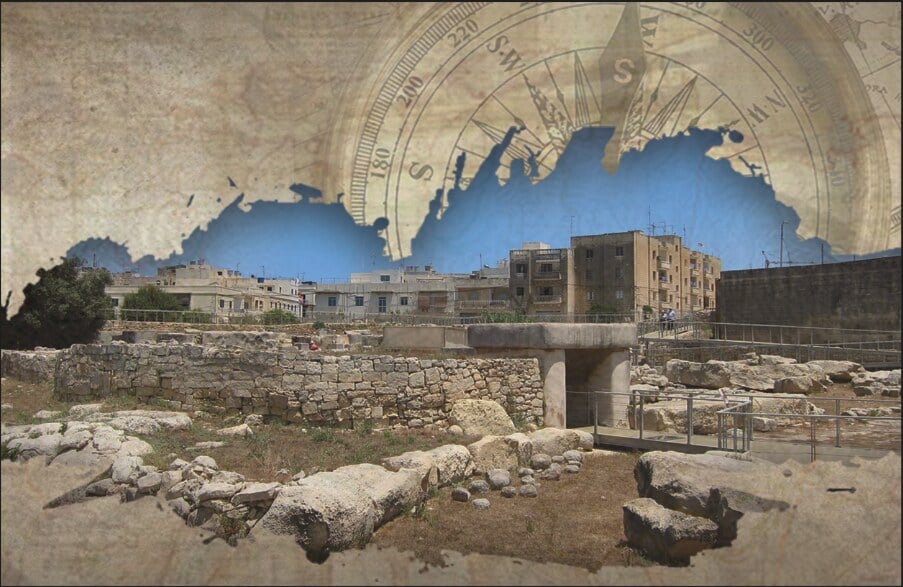
The Ħal-Saflieni Hypogeum is one of Malta’s most fascinating and mysterious archaeological discoveries. This enormous underground complex, built thousands of years ago, also holds many secrets from Malta’s Neolithic period. In this article, we will try to get to know this unique structure and its history by gaining some insight into the many aspects of the Ħal-Saflieni Hypogeum: its history, discovery, architecture, function and cultural significance.
As we mentioned in the introduction, the Ħal-Saflieni Hypogeum dates back to Malta’s Neolithic period. This period is very important in the history of mankind because it was during this period that mankind transitioned from a hunter-gatherer lifestyle to settled agricultural communities. This period, which lasted from approximately 4000 to 2500 BC, saw not only changes in diet and lifestyle, but also significant cultural and religious developments on the island of Malta. The Ħal-Saflieni Hypogeum was built during this period of intense transition and change, and was intended to serve a variety of purposes.

The discovery of the Ħal-Saflieni Hypogeum took place in 1902 and has since been recognized as one of Malta’s most important archaeological discoveries. The Hypogeum is the largest underground structure from the Neolithic period in Malta and contains many important finds, particularly human bones, ceramic ware, and ritual objects. The discovery of These archaeological finds have provided many clues as to how the Hypogeum was used during the Neolithic period.
In terms of architecture, the Ħal-Saflieni Hypogeum is quite impressive. It was designed as a three-tiered complex and consists of a series of chambers, galleries and burial chambers. The carvings and craftsmanship on its walls reflect the technical skills and artistry of the people of that period.
The Ħal Saflieni Hypogeum was originally accessed through a ground-level structure, but only a few blocks of it have been uncovered, and its exact shape and size are uncertain. The layout of the Hypogeum consists of three levels of rooms carved into the soft globigerina limestone using primitive tools such as chert, flint, obsidian, and antler. The oldest of these levels is the uppermost, excavated from the base of the hill, with openings and chambers added later for burial purposes.

The two lower levels were carved entirely out of the natural rock. Some natural light reached the middle level through a small opening from above, while some of the rooms on the middle and lowest levels probably required artificial lighting to navigate, the last one being located 10.60 meters below the current ground level.
A remarkable aspect of the Hypogeum is that some rooms mimic the architectural features of contemporary megalithic temples above ground. These include false partitions resembling trilithon doors and windows. In addition, the ceilings of some rooms are designed to resemble corrugated masonry roofs, probably reflecting the construction style of the temple rooms, which were originally roofed.
Decorative elements found in the rooms include spiral and honeycomb patterns painted in red ochre, the only prehistoric wall paintings discovered in the Maltese Islands. Inside one of these ornate rooms, there is a small niche that creates a reverberating effect when spoken into. Although this effect may not have been intentional, it may have been used during rituals held within the rooms.
The function of the hypogeum is still not fully understood, and there are different theories among archaeologists. Many experts believe that the Hypogeum was used as a cemetery, while others argue that it could have functioned as a religious temple or community center. The debate on this issue adds to the mystery and attractiveness of the Hypogeum.
The cultural significance of the Ħal-Saflieni Hypogeum helps us understand Malta’s history and cultural identity. This ancient underground complex provides us with valuable information about the lifestyle, beliefs, and rituals of the people of the Neolithic period. Furthermore, the Hypogeum is a UNESCO World Heritage Site, making it an internationally recognized symbol.

Through archeological remains, the Hypogeum is similar to a book whose pages tell the stories of the old times and of the people who overcame many tribulations. It is a tool that turns us into the successors of our predecessors. We not only accept these shared experiences, but also the reflections and the common story among us.
Surrounded, like a gem that is impossible to interrupt with the questions and inquisitions it has kept hidden for a long time, the cultural landscape of Malta is the mystery that will attract explorers and scientists. However, it is a common factor that is a source of much to learn about and makes us collectively richer as a community, which our children can uphold and protect.
References:
Centre, U.W.H. (no date) Ħal Saflieni Hypogeum, UNESCO World Heritage Centre. Available at: https://whc.unesco.org/en/list/130/.
Magazine, S. (2017a) Malta’s hypogeum, one of the world’s best preserved prehistoric sites, reopens to the public, Smithsonian.com. Available at: https://www.smithsonianmag.com/travel/maltas-hypogeum-one-worlds-best-preserved-prehistoric-sites-reopens-public-180963397/.