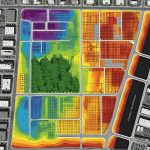
Our cities, those glittering metropolises of glass, steel, and concrete, once stood as triumphant symbols of human progress. Yet today, these concrete jungles have transformed into oppressive heat traps typical of our inconsistent modernity. The rampant colonization by impermeable surfaces, the relentless sacrifice of urban greenery, and an unmitigated dependence on artificial cooling have become components of the infamous urban heat island (UHI) effect. That is, a scenario where metropolitan nuclei boil at temperatures surpassing rural zones by up to 7°C (Oke, 1982). The infernal heat waves ravaging Europe and Asia in recent years have brought to light, with brutal clarity, not just the deficiencies in urban infrastructure but also the stark inequities that divide our societies. The imperative, then, is clear: transform these urban furnaces into climate-resilient sanctuaries. And herein lies the promise of climate-responsive retrofitting, emboldened by the puissance of AI-based urban simulation.

A Paradigm Shift: Neighborhoods as the Nexus of Resilience
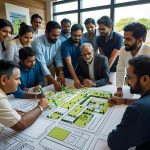
While previous efforts have obsessively focused on singular structures, such an atomistic approach often fails to achieve systemic resilience. Instead, the neighborhood — the intimate, interconnected scale where human life unfolds — emerges as the ideal locus for transformative interventions. By envisioning the city as an organic tapestry rather than a mere aggregation of inert structures, we can engineer holistic developments.

AI: The Cerebral Cortex of Urban Transformation
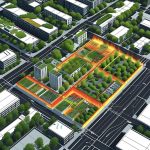
Artificial intelligence, often maligned as a sign of dystopian futures, contradictorily offers us a redemptive instrument to reimagine cities. AI-powered digital twins — virtual replicas that simulate microclimatic behavior in real-time — permit urbanists to forecast the complications of diverse interventions with great precision. The Cooling Singapore project stands as a paragon of this approach. Through its Digital Urban Climate Twin (DUCT), Singaporean planners integrate climatic, morphological, and socio-behavioral data to orchestrate optimal cooling interventions (Schweiker et al., 2022). It facilitates a preliminary composition of green roofs, tree canopies, cool pavements, and shade structures — much like a maestro fine-tuning a symphony before unveiling it to an expectant audience.
Botanical Ballet: Green Roofs and Vertical Verdure
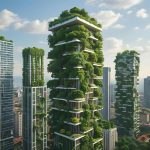
Vegetative interventions have transcended the realm of mere ornamental whimsy; they now stand as fierce buffers against urban climatic adversity. Green roofs, capable of reducing rooftop temperatures by up to 40°C, and vertical greenery systems, which sheath buildings in living foliage, not only ameliorate ambient temperatures but also sequester carbon, support biodiversity, and mollify urban noise (Oberndorfer et al., 2007). AI simulations discern the most strategic rooftops and facades by analyzing solar exposure, wind patterns, and thermal footprints — maximizing impact where it is most exigent.

Reflective Realms: Cool Pavements and Solar Albedo
Traditional asphalt, that universal black canvas of our cities, suspiciously absorbs solar radiation, aggravating heat retention. Enter cool pavements — high-albedo surfaces that reflect sunlight. Los Angeles’ pioneering Cool Streets initiative has demonstrated street-level temperature reductions of up to 10°C (Sailor & Dietsch, 2019). AI tools enable planners to evaluate potential glare effects, pedestrian comfort indices, and synergies with other cooling strategies, thereby ensuring a harmonized urban choreography.
Shade and Shadow: The Art of Cooling Canopies
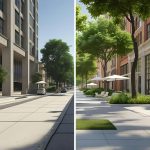
Urban shading, whether through stately arboreal canopies or kinetic architectural facades, constitutes a vital strategy for human-scale comfort. Properly positioned trees can reduce local air temperatures by 2–4°C, while dynamic facades respond to diurnal solar trajectories, optimizing shade and minimizing energy demand. Yet, urban tree planting is fraught with subterranean conflicts — roots battling utilities and constrained soil volumes. AI-driven spatial analysis creates a sophisticated solution, insightful, viable planting zones, and composes canopy configurations to yield optimal climatic relief and social dividends.

Equity and Empathy: Retrofitting with a Conscience
Beyond engineering feats lies the ethical dimension: retrofitting must prioritize the most vulnerable urban denizens. AI models can integrate socio-demographic data to ensure that interventions target heat-stressed, economically marginalized communities first — a climate justice imperative. Barcelona Superblocks, where traffic is restricted and public spaces are re-greened, exemplify how neighborhood retrofits can restore communal life and environmental equity. (Mueller et al., 2020).
Exemplars of Elegance: Milan and Beyond
Bosco Verticale of Milan, with its verdant vertical forest, has become a global emblem of green urbanity. Yet, the ambitions extend further: the ForestaMi initiative aims to embed urban forestry across the cityscape using AI to guide placement, species choice, and microclimatic impact (Comune di Milano, 2020). This integrative vision transcends isolated icons, weaving a continuous ecological fabric.

The Road Ahead: A Symphony of Science and Sentience
While financial, regulatory, and logistical challenges thrive, the synergy of AI and community co-creation offers a luminous pathway forward. Financial innovations such as green bonds, climate adaptation funds, and participatory design processes empower residents to become custodians of their microclimates. Ultimately, climate-responsive urban retrofitting represents not merely an infrastructural upgrade but a moral and philosophical metamorphosis. As we convert concrete jungles into climate havens, we reclaim the city as a locus of care, sociability, and collective flourishing.
References:
- Oke, T. R. (1982). The energetic basis of the urban heat island. Quarterly Journal of the Royal Meteorological Society, 108(455), 1–24. https://doi.org/10.1002/qj.49710845502
- Oberndorfer, E. et al. (2007). Green roofs as urban ecosystems: Ecological structures, functions, and services. BioScience, 57(10), 823–833. https://doi.org/10.1641/B571005
- Sailor, D. J., & Dietsch, N. (2019). The urban heat island mitigation impact of reflective pavements in Los Angeles. Urban Climate, 30, 100514. https://doi.org/10.1016/j.uclim.2019.100514
- Schweiker, M., et al. (2022). Cooling Singapore 2.0: A multi-disciplinary research project to mitigate urban heat. Energy and Buildings, 262, 111963. https://doi.org/10.1016/j.enbuild.2022.111963
- Mueller, N., et al. (2020). Changing the urban design paradigm: The health benefits of Superblocks. Environment International, 134, 105132. https://doi.org/10.1016/j.envint.2019.105132