Biomimetic Architecture involves the design of buildings inspired by elements found in nature. Not just aesthetics but natural environments, systems and species are studied in depth in this field. Biomimetic Architecture finds importance in sustainability, innovation and resilience of buildings. Biomimetic structures minimize environmental impact and promote ecological balance by imitating natural processes and structures. Nature has evolved over millions of years finding elegant and effective solutions to complex problems. Thus, inspiring novel designs and technologies that are both efficient and effective. Biomimicry also promotes resilient and adaptable structures.
Biomimetic Architecture can be broadly classified based on design approach as form-driven, function-driven, material-driven, behavior-driven and system-driven. The Gherkin Tower in London is inspired by organic shapes like shells and fruits, optimizing natural light penetration and airflow while reducing energy consumption. The Water Cube in Beijing follows a material-driven approach that mimics the fluidity and transparency of water, drawing inspiration from soap bubbles and protein structures to create an innovative design.

Why is Parametric Architecture Integral to Biomimetic Design?
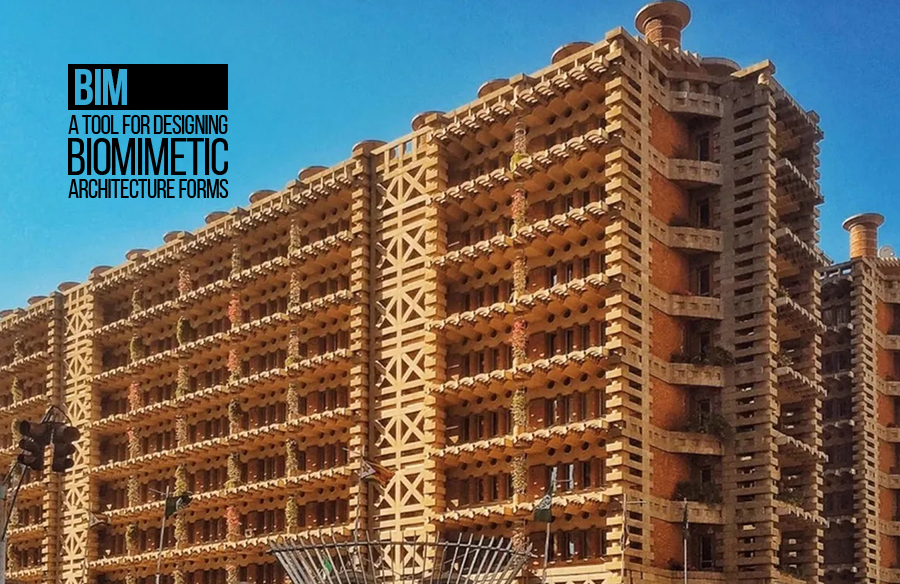
The Eden Project in the UK has taken inspiration from the structure of soap bubbles for the design of its biomes. To deal with extreme weather conditions, the Eastgate Centre in Zimbabwe takes inspiration from the passive cooling qualities of termite mounds. It is evident from these examples that biomimetic design is bound to result in organic forms in most cases. In such a situation parametric modeling can be taken into consideration. Parametric modelling in architecture is based on certain parameters which can be modified according to the project requirements. This modelling technique is widely used to develop complex organic forms. The various parameters make it easier for users to modify the forms as per requirement. \
Parametric modelling ensures efficient use of resources. Moreover, the integration of data from various sources like environment simulation and material information provides a holistic solution to any design problem. This is much like nature itself, deriving solutions from information gathered from its surroundings. Honeycomb structures, the petals of dahlias, anthills, and self-cleaning lotus leaves serve as inspirations for architectural designs. Architecture planning principles often take cues from natural phenomena, such as the intricate patterns found in spiderwebs and the branching of veins on leaves. Not only does biomimicry facilitate the design of environment-friendly and resilient structures but also taps into the inherent connection humans have with nature. The connection with nature will in turn enhance the quality of life and overall well-being of users.

What is BIM modeling?
BIM (Building Information Modelling) is an approach to design involving the generation and management of digital representations of the various characteristics of places. BIM software is widely used in Construction and design industries to facilitate accurate design using the collection of data. The design, structure, services and execution of the project can be done simultaneously by using BIM software like Autodesk Revit, ArchiCAD, Trimble Connect, Revizto and BIMcollab. Autodesk Revit is one of the best BIM software for architects. Its comprehensive capabilities, parametric modelling and collaboration tools make it stand out among others.

How Does BIM Enable the Creation of Organic Forms in Architecture?
BIM software allows the creation of parametric models that can easily manipulate and adjust geometric forms. Through multiple iterations the explorations of organic shapes and structures are possible. Some software uses generative design tools that leverage algorithms to explore a range of design options based on specific criteria. These plugins enable the user to use the parametric modelling features along with the main workflow. These tools can generate and evaluate complex geometries that mimic natural patterns. This software enables a multidisciplinary approach to design, facilitating collaboration among various teams by providing a centralized platform for sharing and coordination of design information. This collaborative approach allows architects, engineers, and other stakeholders to work together seamlessly to develop and refine organic forms that are both visually compelling and technically feasible. This team effort helps architects, engineers, and others to develop and refine organic shapes that are visually compelling and technically feasible.

What Is the Future of Biomimetic Architecture and BIM Software?
As the need for environment-friendly buildings increases, efforts will have to be taken in the direction of biophilic design. Buildings which are environment friendly and can adapt to extreme weather conditions. In the coming decades, BIM software is likely to evolve and incorporate more advanced simulation tools. Moreover, BIM is being incorporated into architectural practice and many firms are promoting the use of BIM software over CAD software. In conclusion, biomimetic architecture, powered by BIM software, brings together nature-inspired design and advanced digital tech. By embracing biophilic principles and using BIM’s capabilities, we can create buildings that mimic nature’s beauty and are resilient and sustainable.
References:
- My top 10 best BIM software programs (2023) Plannerly. Available at: https://plannerly.com/10-best-bim-software-programs/ (Accessed: 03 March 2024).
- Water cube (no date) WestChinaTour.com. Available at: https://www.westchinatour.com/beijing/attraction/water-cube.html (Accessed: 03 March 2024).
- Ansari, K. (2022) Biomimicry Architecture: Eastgate centre – harare, Zimbabwe –, archEstudy. Available at: https://archestudy.com/biomimicry-architecture-eastgate-center-harare-zimbabwe/ (Accessed: 03 March 2024).
- Amoloye, T. (2012) The Gherkin in London [5] | download scientific diagram, ResearchGate. Available at: https://www.researchgate.net/figure/1-The-Gherkin-in-London-5_fig1_325810394 (Accessed: 03 March 2024).
- Architecture (no date) Eden Project. Available at: https://www.edenproject.com/act/our-mission/about-our-mission/architecture (Accessed: 03 March 2024).