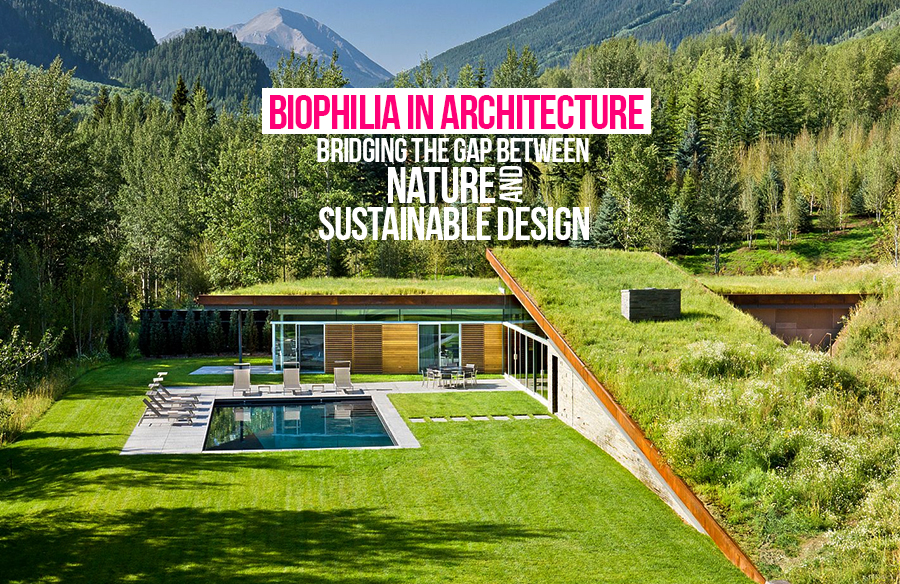
Social psychologist Rich Fromm defines biophilia as the ‘love of life’ that explains two fundamental tendencies of living organisms: sustaining life from death threats and the positive integration with each other. It was not until 20 years later that the proposed theory was widely received all thanks to the biologist and naturalist Edward Wilson who defined biophilia as the innate tendency to focus on life and lifelike processes and later raised its hypothesis to emphasise biophilia as the innately emotional affiliation of human beings to other living organisms, in which the ‘innate tendency’ represents the characteristics of ‘hereditary’; meanwhile, as a ‘learning rule’, it provides an enlightening perspective with which to understand nature.

Biophilic design and sustainable architecture are the two sides of the same coin. Before its mainstream popularity, the concept of imbibing nature into our designs has been in existence for as long as humans have built homes. Designers of the past have always sought to create a harmonious relationship between the built environment and nature. This is evident in vernacular architecture which has long merged biophilic elements as a natural response to local climates, materials, and cultural practices.

An Example of Biophilic Elements in Vernacular Architecture
Traditional Japanese Architecture: The subject of the history and theory of architecture would only be complete with the worthy mention of Japanese architecture. The Japanese are globally known for their philosophy towards every aspect of life, architecture inclusive. Only a few cultures in the world have mastered the art of blending the built environment with nature as harmoniously as Japan.
Japanese architecture is hinged on certain philosophies such as respect for the environment and the embrace of natural materials. Their architectural philosophy is centred around the belief of living in harmony with nature rather than dominating it. This attitude is mirrored in the choice of materials, construction techniques, and spatial design employed in traditional architecture. Japanese architecture is known for its seamless blend of indoor and outdoor spaces by incorporating elements such as gardens, water bodies, and open-air courtyards.
Shakkei or borrowed scenery is a design technique where distant landscapes are captured in garden settings to become part of the design. Traditional elements like shoji (sliding paper screens that were easily opened to tie the interior with the exterior space) were used to showcase their fluidity and openness to nature.
Japanese architects primarily used natural materials such as wood, stone, and bamboo for their projects. They employed traditional techniques such as shou sugi ban—the preservation of wood by charring it with fire and natural oils—to enhance the longevity of the materials used in construction.

Modern Interpretations of Vernacular Biophilic Design
Researchers have continued to explore several strategies in which biophilic designs support sustainability in architecture. Such diverse pathways include discussing biophilic design values on resilience in the face of climate change and comparing biophilic design patterns with sustainable development goals (SDGs). Modern architects keep going back in time to draw inspiration from vernacular practices to meet modern needs and standards such as the:


- Adoption of green walls and (sod) roofs found in Nordic cultures. These elements contribute to SDGs by providing insulation, reducing the urban heat island effect, and supporting biodiversity thereby forging a symbiotic relationship between architecture and nature. A modern testament to this is the ACROS Fukuoka Prefectural International Hall by Emilio Ambassz. The building features a series of garden terraces that ascend the building, effectively creating a green hill in the heart of the city.
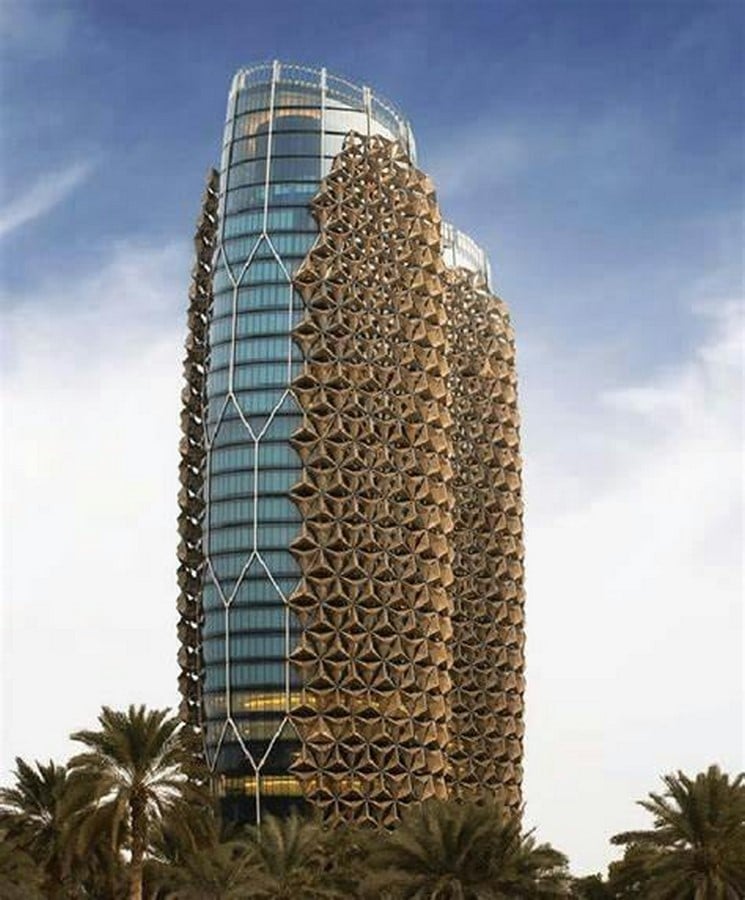
Al Bahar Towers_©researchgate.net - Harnessing traditional passive cooling techniques to adapt to modern designs like the Al Bahar Towers in Abu Dhabi, designed by Aedas Architects which has a responsive facade—that was inspired by the traditional mashrabiya screens. The geometric panels on the facade open in response to the sun’s movement, ergo, reducing solar radiation gain whilst utilizing natural light.

Biophilic Design is Sustainable Architecture

Vernacular architecture relies on locally sourced and renewable materials for construction which reduces emissions during transportation and boosts local economies. Architects like Diébédo Francis Kéré and Mick Pearce made use of locally sourced materials and combined them with modern technologies as such, the latter architect’s Eastgate Centre is praised for its innovative passive cooling system that emulates the efficiency of termite mounds, i.e., the building’s ventilation system relies on convection currents, allowing fresh air to circulate naturally.
The Step Well House in Jodhpur, India, designed by Abraham John Architects is another modern structure modelled after a biophilic design technique, the step well concept, one that enables water conservation whilst creating an aesthetic architectural feature.
Conclusion
As much as civilization has caused great damage to the ecosystem, there have been some notable and sustainable contributions such as biophilia. Past and present designers have one thing in common, the recognition of our species’ deep-seated need for connection with nature. By unionizing the indoors and outdoors, we can create designs that are more than aesthetics but nurture our physical and mental being and keep us connected to nature. Biophilic designs promise us a more sustainable and liveable world.
Works Cited:
Learn Japanese Language Course Institute in Delhi Nihongomax, “Harmony of Nature and Architecture the Japanese Design Philosophy | Best Japanese Language Institute in Delhi – Nihongomax,” Learn Japanese Language Course Institute in Delhi Nihongomax. Available at: https://learnjapanesedelhi.com/harmony-of-nature-and-architecture-the-japanese-design-philosophy [Accessed 13 July 2024].
Zhong, W., et al., 2022. “Biophilic design in architecture and its contributions to health, well-being, and sustainability: A critical review,” Frontiers of Architectural Research, 11(1), pp. 114-141. Available at: https://www.sciencedirect.com/science/article/pii/S2095263521000479 [Accessed 12 July 2024].