We were commissioned to undertake an architectural project in “Ilam”, a city on the western border of Iran. During an in-person meeting, the client expressed his need for a family apartment for himself and his brother. He was pleased to inform us that there are “no restrictions” on building on “the entire land” in Ilam, and he shared his requirements with our team enthusiastically.
Project Name: Bonlad
Studio Name: Mohat office
Project Location: Ilam, Iran
Completion Year: 2023
Gross Built Area (m2/ ft2): 1584 m2
Lead Architects: Mohammad Hdianpour
Photo Credits: Parham Taghioff

Ilam is a city that remains unfamiliar not only to us but to many Iranians and we were surprised to find out that there are no regulations governing the construction of buildings that shape the city’s physical structure. During our visits to Ilam to analyze the project site, we encountered numerous issues within the city, which had a complicated structure. The slow economic development of city, which is a consequence of the national economy weakened by international sanctions, and the low rates of economic growth due to its geographical location in the war-torn border region of Iran and Iraq, have rendered it as one of the most deprived urban areas in Iran. This situation has turned the houses into the capital goods, resulting in a densely-populated urban fabric characterized by the low-quality constructed buildings with minimal open or semi-open spaces.

This issue became even more significant when we realized that the city has the highest suicide rate in Iran. The National Institutes of Health (NIH) has reported that Ilam has the highest suicide rate in the world relative to its population size. We were talking about a city facing significant social prejudices and numerous incidents of violence against women due to social and emotional relationships. Additionally, the high-density construction in Ilam has resulted in smaller, more covered windows to maintain visual privacy in living spaces.
During our examination of the project site, we also encountered additional challenges stemming from the restrictions imposed by the project western neighborhood, notably the prohibition of “direct views” towards an important government building.
Our initial analysis of these issues highlighted how the architecture of a single apartment building in small scale can meet the needs of contemporary individuals in a deprived border region of Iran, and respond to the problems such as high suicide rate or social and cultural prejudices. By making major changes in Ilam’s existing housing patterns, we seek to advance the concept of “Spatiality” in “Persian House” culture, serving as a traditional-modern model for gradual transformation in the urban fabric.

Our critical approach to the typical low-quality apartments in the city, with nearly “100 percent” lot coverage without any livable space, led us to make this project as a platform for the realization of the idea of extensive and active semi-open spaces using the concept of “Spatial Border”. Instead of merely examining the functionality, our focus was on the set of behaviors and events within the residential spaces.
Therefore, the design process began with this question: How can we take the advantages of the “three-dimensional corrosive grid” (the void and corrosion as a spatial system) to address a “Spatial Border” in order to resolve the contextual issues?
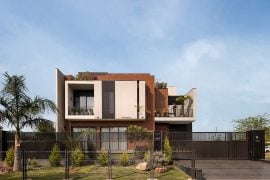
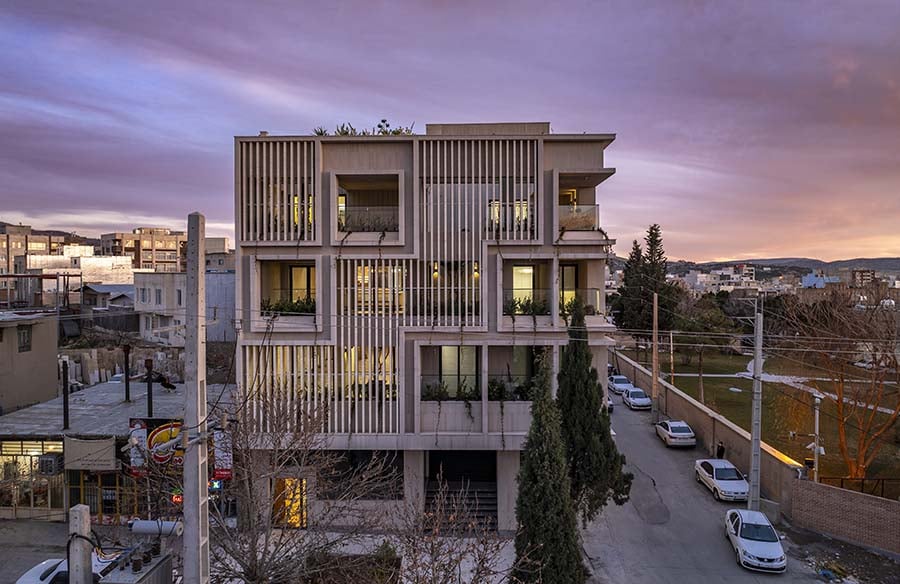
By creating sudden changes in the scale of terraces and using unusual dimensions (depths up to nearly 7 meters), as well as applying repeated vertical porosities in the peripheral grid, we were able to make the green, “non-center” yards around the residential core. If we accept that a Persian House has a “spatial” concept, these semi-open spaces, derived from a “border” tension between inside and outside, seek the same “spatiality.” These spaces are seeking to change the behavior of residents by creating vitality in apartment life and the livability capacity of semi-open spaces, moving towards the concept of “Hedonistic Sustainability”. Also, using vertical louvres, despite the use of large windows in the project, provides a sense of “visual privacy” in interior spaces, which is an urgent social need in the city of Ilam.

Bonlad is our experiment on the typology of apartments that have a non-identical formal language on their different sides. Accordingly, the restriction on views towards the west (the longest side) made us not to use direct and single-layer openings on all sides of the building as much as possible to create a “unified” form and prevent “heterogeneity” in the formal growth. Instead, we provided the openness and lighting through intermediate “negative boxes” and repeated setbacks.
Due to the use of large semi-open spaces in the project as well as the way we used the brick material, the project costs exceeded what was initially expected, so the proper functional organization of the project played an important role in advancing the project’s final goals. In light of this, we dedicated the ground and basement floors to the public or profitable uses of the project (commercial spaces and offices for the client). This decision was crucial, as it allowed the majority of the project costs to be covered by the sale of the commercial units of lower floors. Therefore, the spatial organization of the project follows a “dual” and “contradictory” (discrete – continuous) form, aiming to address contextual issues, client needs and reach the economic efficiency.

In this way, there is a dense arrangement of functions (commercials, offices and residentials) in various directions, with independent accesses and spatial separation. However, on the upper floors, planned for two brothers to live independently, this internal separation turns into a horizontal-vertical continuity. The two residential units, placed on three levels, (the first and second floors are a duplex unit) are connected through multiple voids, essentially revealing the project’s family nature. On the top level (roof), this connectivity opens up to the sky, simultaneously providing both units with this natural potential while emphasizing the project’s pixel-like role in a larger structure called the city, which is actually a statement about our urban future. The project incorporates semi-open spaces designed to balance the duality of “privacy” and “communication”. These areas, connected to the bedrooms, provide a sense of peace, privacy and seclusion.