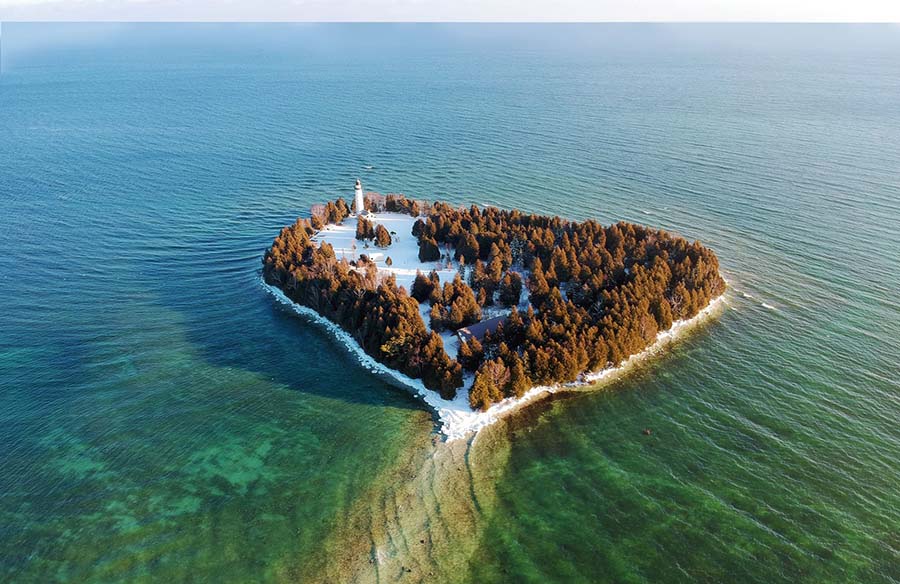
An island on the National Register of Historic Places, off the shores of Lake Michigan in Wisconsin, contains an 1869 lighthouse with an active 3rd order Fresnel lens.
Project Name: Cana Island Interpretive Center
Studio Name: Studio MAYO Architects
Area: 2000 SF.
Year: 2020
Location: Cana Island, Baileys Harbor, WI
Consultants:
MEP: Galileo Consulting Group
Structural: Meyer Borgman Johnson
Geotechnical: Intertek, PSI
GC: Immel Construction
Photography Credits: Jason Stockton Photography

The challenge was to design a building that was respectful of the past, while being authentic about our place in the story of the island. This required great restraint in the material palette and massing of the building. Although the building is only 2000 SF, this is more than twice the size of the largest building on the 8.7 acre island.

Great care was taken so that the building did not overshadow the lighthouse. Rather, timeless beauty, and sensitivity to context provide a source of pride for the community. After studying the historic buildings, we found a guiding language of materials, proportion and scale. We used this as a catalyst to celebrate the past while building for the future.

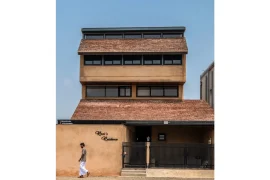
With the ‘Cream City Brick’ (common to the region) and textured metal cladding, the building is familiar in its historic context yet unexpected and decidedly modern as not to create a false sense of history. The minimal building is narrow and long so that the balance of the square footage can recess back into the forest while the familiar height-to-width presents itself at the street.

Along the length of the building, the eave is cut and the roof material engulfs the rear walls. The humble Interpretive Center allows the Maritime Museum to “Celebrate History, Preserve the Past, and Educate the Future”.