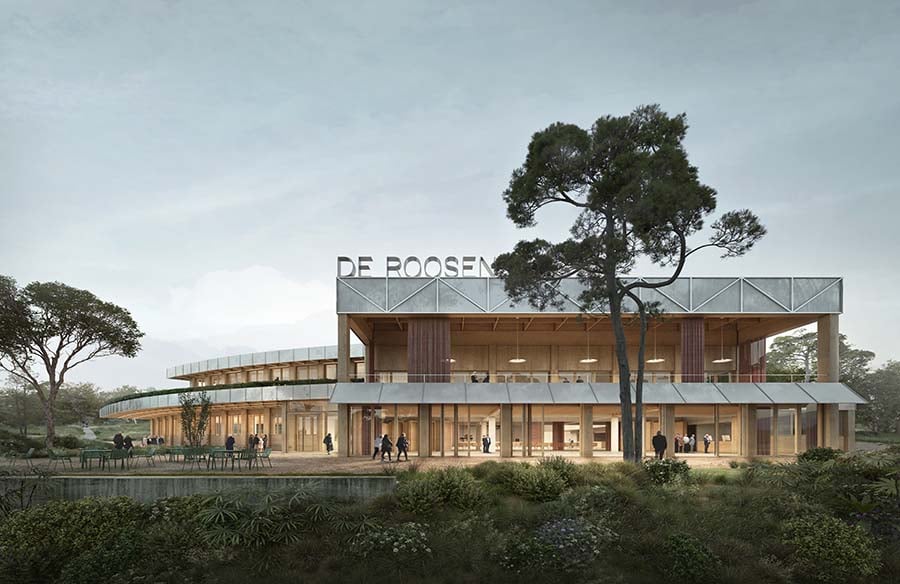
Henley Halebrown and WV Architecten have collaborated to transform the De Roosenberg Community Centre in Oud-Heverlee, Belgium, into a vibrant civic hub. This ambitious project builds on a longstanding partnership between the practices and their shared commitment to revitalising existing buildings.
Project Name: De Roosenberg Community Centre
Studio Name: Henley Halebrown architects
Location: Oud-Heverlee, Belgium
Appointment: 2024
Area: 2,860 m2
Client: Gemeentebestuur Oud-Heverlee

The redesign respects the 1990s structure by van Steenkiste and Bruggemans while unlocking its potential through minimal demolition and a sensitive reimagining of spaces.
Blending modern functionality with environmental stewardship, the project successfully integrates the building with its surrounding parklands, creating a welcoming “Palace for the People.”
Programme Highlights
At the heart of the redesign is the conversion of the library into a community “living room.” Relocated to replace the former café, the library is now a bright, open space featuring modular furniture and informal reading areas. Glass facades flood the space with natural light and frame views of the nearby ponds. Above the library, a new brasserie and terrace provide additional gathering spaces with scenic water views.

The original hall has been expanded with a south-facing foyer, enhancing flexibility for events. A retractable acoustic wall allows the hall and foyer to function independently or as one, while a terrace connects the interior to the landscape.
Central to the design is the “stitch,” a zigzag staircase that visually and physically links the entrance hall, library, events hall, and brasserie.

Simon Henley, co-founder of Henley Halebrown says,
‘The heart of the design is the “stitch.” This is the zigzag staircase in the entrance hall that literally threads the spaces together before your eyes. The stairs, bridges and landings physically and visibly connect all the functions around one central space while unlocking the potential of all existing spaces.’

Sustainable, Fabric-First Approach
The renovation emphasises sustainability by reusing existing materials and adopting a “fabric-first” approach. New materials, where needed, include low-carbon, bio-based options such as timber construction, timber cladding, and hemp insulation. The building’s vapour-open design promotes air quality, and recycled EPS granules in roof insulation further reduce its carbon footprint.

By retaining the original structure’s strengths and integrating new materials thoughtfully, the project minimises environmental impact while enhancing functionality and visual appeal. The design also allows for future adaptations, ensuring the building continues to serve its community for years to come.