Architecture acts as a timeline when viewed from a diachronic lens. The built world is a powerful empire, monumental in representing core values: cultural memory, societal shifts, and the human scale. It reminds us that structures, regardless of their age, can immediately speak to the spirit of both traditional and contemporary values. Architecture can be an era’s entire identity, all in one place. Long before history was written in books, it was built brick by brick from the ground up. From moving home, soaring skyscrapers, to observing the cosmos, preserving architectural memory matters because without the buildings, the stories and their core values risk being lost.
Fallingwater by Frank Lloyd Wright: A Timeless Innovation in Motion

In the mid-1930s, Pittsburgh department store owner Edgar J. Kaufmann commissioned American architect Frank Lloyd Wright for a retreat house on Kaufmann’s land southeast of the city. Although many at the time were concerned about Wright’s ability to realize this project due to his reaching retirement, he proved his innovative vision for organic architecture with Fallingwater. Wright did not just create a view of the natural waterfall from the house as Kaufmann had expected; he made it the emphasis and structured the building around it (hence the name). The home also includes cantilevered terraces, a unique design, and a philosophical statement about architecture coexisting with nature instead of conquering it. Materials such as the local sandstone and unpainted concrete root the structure to its site–reflecting the regional landscape and honoring the local materials.
“No house should ever be on a hill or on anything. It should be of the hill. Belonging to it. Hill and house should live together, each the happier for the other.” – Frank Lloyd Wright: An Autobiography.
The structure not only embodies the transcendentalist ideals of Thoreau and Emerson, but it also symbolizes America’s cultural shift that emerged in the early 20th century. Americans began realizing that nature is sacred and inseparable from the self, from the industrial growth and rapid urbanization that swept the nation. This example of early environmental consciousness set the precedent for today’s sustainability discourse. Fallingwater tells a story about America in the 1930s, grappling with the Great Depression and seeking a sense of grounding. There was also a rise in modernity: the rejection of European neoclassicism and ornamentation in favor of expressing the unique American identity tied to land independence and innovation. After Kaufmann’s death, the house was donated to the Western Pennsylvania Conservancy in 1963. Unfortunately, preservation challenges such as humidity and structural stress from the cantilevers showed how fragile architectural capsules, like Lloyd’s home, can be. But restoration work, such as 3D scans, helps retain its original story and prepare it for future admiration. In light of its legacy, Fallingwater is now a UNESCO World Heritage Site and museum, allowing modern audiences to walk through Wright’s philosophy in physical form.
The Chrysler Building by William Van Alen: A Roaring Height in Urbanization


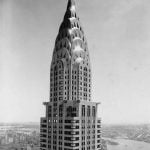
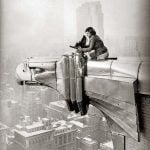
An Art Deco skyscraper over 1,000 feet tall (over 300 meters) located in the East Midtown neighborhood of Manhattan, the Chrysler Building took New York by storm in 1930 as it served as the world’s tallest building for eleven months (until the Empire State Building). In 1931, Walter P. Chrysler commissioned architect William Van Alen to design a personal legacy project for corporate branding and ego. The building has heavy Art Deco elements such as sleek lines, geometric patterns, and metallic finishes. Eagle Gargoyles protruding from its corners and radiator-cap ornaments reflect the Chrysler Corporation’s car designs, embedding the brand’s identity into the architecture. On top of all that, a Spire was secretly constructed inside the tower and then hoisted up for a dramatic reveal to “win the race to the sky” against the Bank of Manhattan building.
“I wish to do things original and not be misled by a lot of things that are being done by somebody else.” – William Van Alen.
Upon its completion, it received mixed reactions, from critics calling it a “stunt”/”flash” design, to an “insignificant” design, to praise for Van Alen as the “Doctor of Altitude.” Regardless, it’s crucial to recognize how the Chrysler Building pushed the vertical dream of pushing boundaries both physically and stylistically. It is a monument to the past spirit of the Roaring Twenties: a period marked by rapid industrialization, technological innovation, and American optimism. More importantly, it is an architectural time capsule of the Machine Age of the 1930s: rapid urbanization, corporate pride, and American modernity. In a moment of boundless faith in industry and capitalism (before the crash of 1929 and the Great Depression). The Chrysler Building celebrates New York City’s role as a cultural and economic epicenter of the modern world. In 1976, it was added to the National Register of Historic Places and designated as a NYC Landmark in 1978. Since then, preservation has involved careful restoration of its iconic stainless steel spire and interior details.
The Griffith Observatory by John C. Austin & Frederick M. Ashley: A Cosmic Wonder in Democratic Knowledge
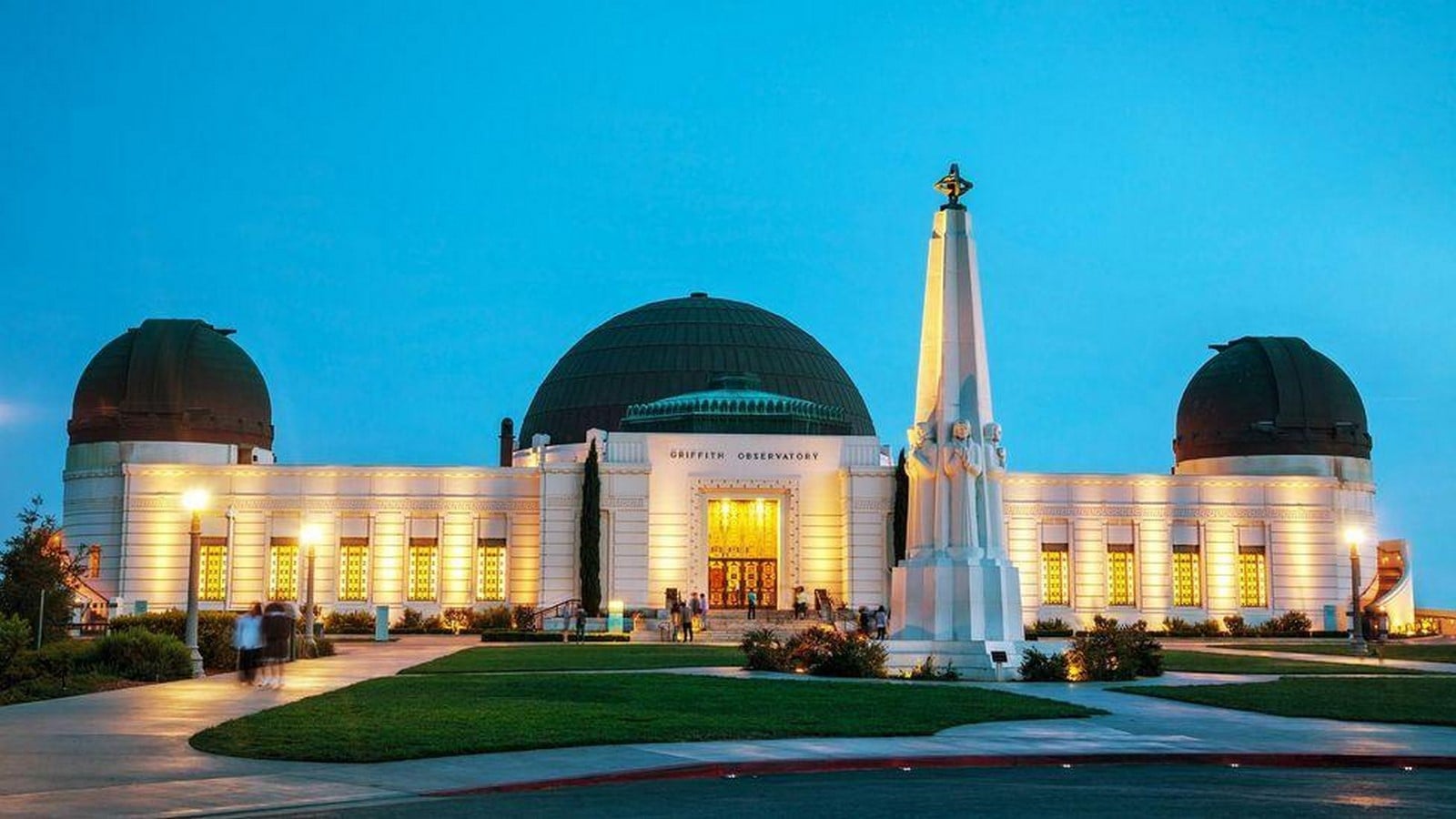
It dates back to 1896, when Welsh-born American industrialist and philanthropist Griffith J. Griffith, in his will, donated 3,015 acres of land in Los Feliz to the City of Los Angeles, along with funds to build a public observatory. Griffith’s dying wish was to make astronomy accessible to all, despite opposing the belief that such observatories should be restricted to scientists on remote mountaintops. The observatory opened to the public in May 1935, serving as the country’s third planetarium. Today, it is the world’s most-visited public observatory, welcoming over 70 million visitors. Architects John C. Austin and Frederic M. Ashley developed the design based on preliminary sketches by Russell W. Porter. Common in 1930s design, futuristic styles with Art Deco details and monumental symmetry are notable on the observatory’s exterior; it also embraces Modernist influences of the Beaux-Arts. The hilltop site overlooks Los Angeles, symbolizing its mission to help the public “look outward and upward.” Interior elements such as the Zeiss telescope, Foucault pendulum, and Tesla coil were designed as hands-on exhibits, a revolutionary addition for public science institutions at the time.
“I wish to pay my debt of duty in this way to the community in which I have prospered.” – Griffith J. Griffith, to the Los Angeles City Council.
The Griffith Observatory tells the story of America’s cultural shift in the 1930s, where science was seen as the future, belief in public access to knowledge, and architecture being used to inspire civic curiosity. Even when it was built near the end of the Great Depression, it embodies the push towards investment in public education and inquisitiveness during times of hardship. It reflects the American pursuit of accessibility in science for all, regardless of social status or personal background. This piece of architecture served as a gateway to modern thinking through encouraging ordinary citizens to engage with the universe. From 2002 to 2006, the observatory underwent a major restoration and expansion while still preserving the original design and adding underground galleries. It has appeared in multiple films (La La Land, Rebel Without a Cause, etc), and is prominent in Hollywood and cultural mythology. Fulfilling Griffith’s original vision as it remains free to the public, it functions today as both a living science museum and a historical landmark. Bridging science and design through purpose, the Griffith Observatory matters as a larger symbol of the democratization of knowledge.
Citations:
Bascomb, N. (2005) For the Architect, a Height Never Again to Be Scaled, The New York Times. Available at: https://www.nytimes.com/2005/05/26/garden/for-the-architect-a-height-never-again-to-be-scaled.html (Accessed: 23 July 2025).
Chrysler Building (2025) Britannica. Available at: https://www.britannica.com/topic/Chrysler-Building (Accessed: 23 July 2025).
Hansen, C., Wang, M. and Cook, A. (2021) History (1896 – 2002) – griffith observatory – southern California’s gateway to the cosmos!, Griffith Observatory. Available at: https://griffithobservatory.org/about/observatory-history/history-1896-2002/ (Accessed: 25 July 2025).
Zelazko, A. (2025) Fallingwater, Britannica. Available at: https://www.britannica.com/place/Fallingwater (Accessed: 23 July 2025).