Placing the story
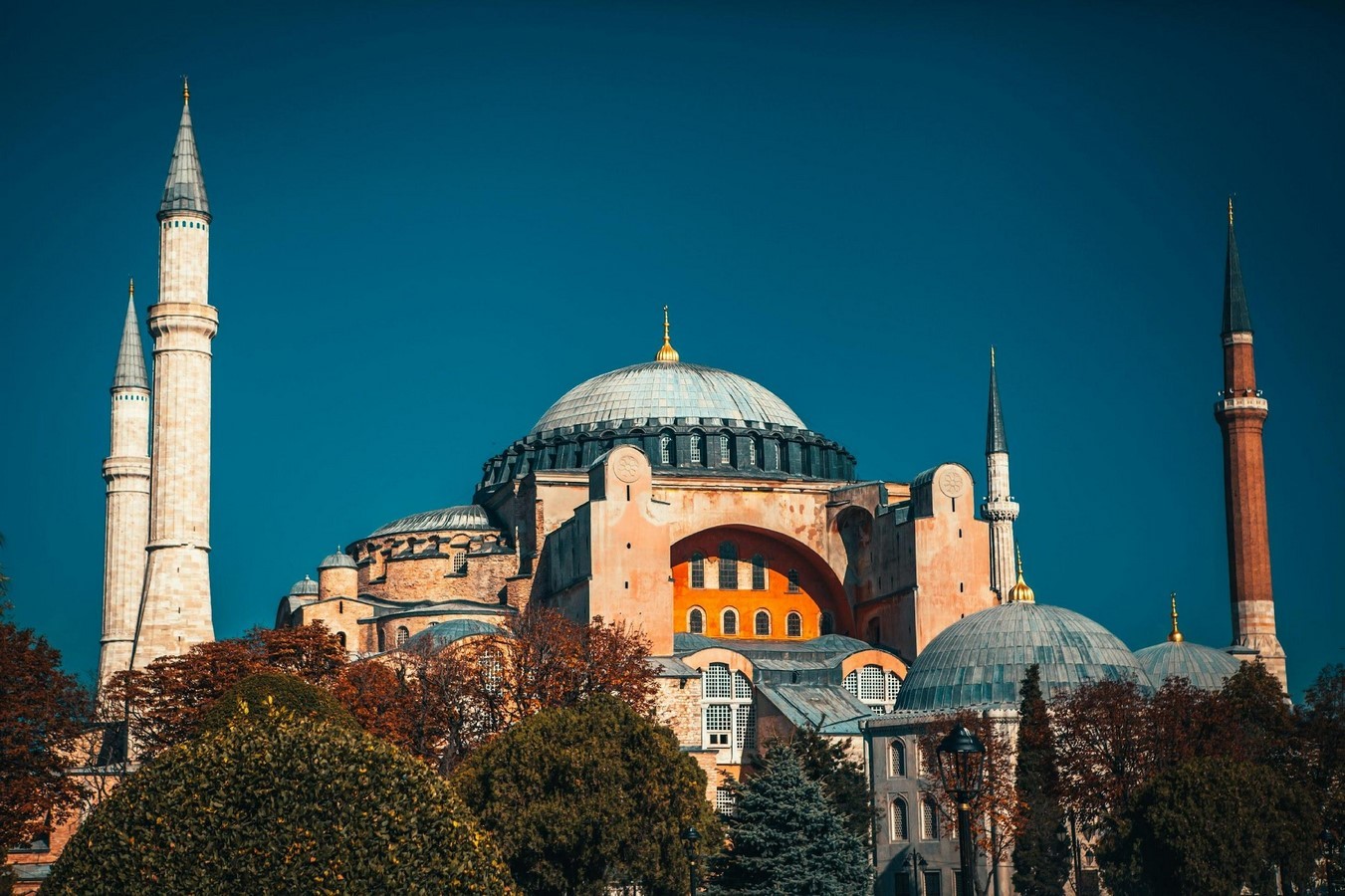
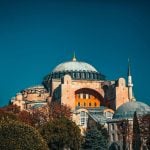
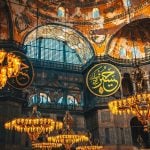
Located at the convergence point of two worlds, two continents tied together through sea and years of ideological, religious and land disputes, Hagia Sophia rises proudly, marking the skyline of Istanbul. It stands as living proof that its extraordinary architecture has been respected by various and opposing cultures that have yet not demolished it. Its past, marked by heavily bloody wars and political unrest, lies within its walls. Although it has long been transformed into a mosque from its Byzantine previous character, once inside, there can be Christian frescos observed on the old walls. Its story stretches through thousands of years of complex socio-geographic issues to the present day. It has never stopped being a controversial building, with the last conversion of its function in 2020 by the Turkish government, transforming it into a mosque after years of functioning as a museum since the revolution and the fall of the Ottoman Empire.
Name
Overlooking the Bosphorus where the Black and Marmara Seas converge, Hagia Sophia has international importance as a beacon of history, of the constant struggle between religions and how they have forever impacted the way the world works. Its name comes from Greek, meaning “Holy Wisdom’’, and it’s been adopted by the Turkish language—“Ayasofya’’. Its original name was “Megale Ekklesia”, which in Latin means “Great Church”.
Through years of unrest
Built between 532 and 537, it was the pinnacle of the Byzantine Empire and its capital, Constantinople. Although a sumptuous building and way ahead of its time, it had only taken the Byzantines five years to build it—a fact that has always posed questions about its esotericism and made it classified, as some say, as the 8th wonder of the world.
In 404 CE it burned down during political disputes due to its original wooden roof, and shortly after it was rebuilt in wooden structure by Roman Emperor Theodosius II in 415 CE, only to meet the same fate, leading to its second ignition during the Nika riots. In the Justinian era, the two architects Isidore of Miletus and Anthemius of Tralles were commissioned to rebuild it again as a church to express the grandeur of the Eastern Roman Empire. Although similar to its present form, it bears the mark of multiple emperors adjusting it to their liking. During the Fourth Crusade by the Western Roman Empire in 1204, it was briefly converted into a Catholic church. However, six decades later it returned to its initial Orthodox doctrine.
After the Byzantine capital was captured by the Ottomans and Mehmet II came into power following the fall of Constantinople, the region became an Islamic empire, and therefore no better way of proving the world the success of Mehmet the Conqueror than converting the church into an imperial mosque. To better show the Islamic religion, through time minarets, Arabic symbols, and a prayer niche were added to Hagia Sophia. After the country was proclaimed the Republic of Turkey by Mustafa Atatürk in 1923, the mosque was secularised and transformed into a museum to show the world the new position of the country as a political statement. However, under the current rule, it was reverted back to being a mosque in 2020, a fact that has raised loads of controversy regarding the views of the government.
Importance
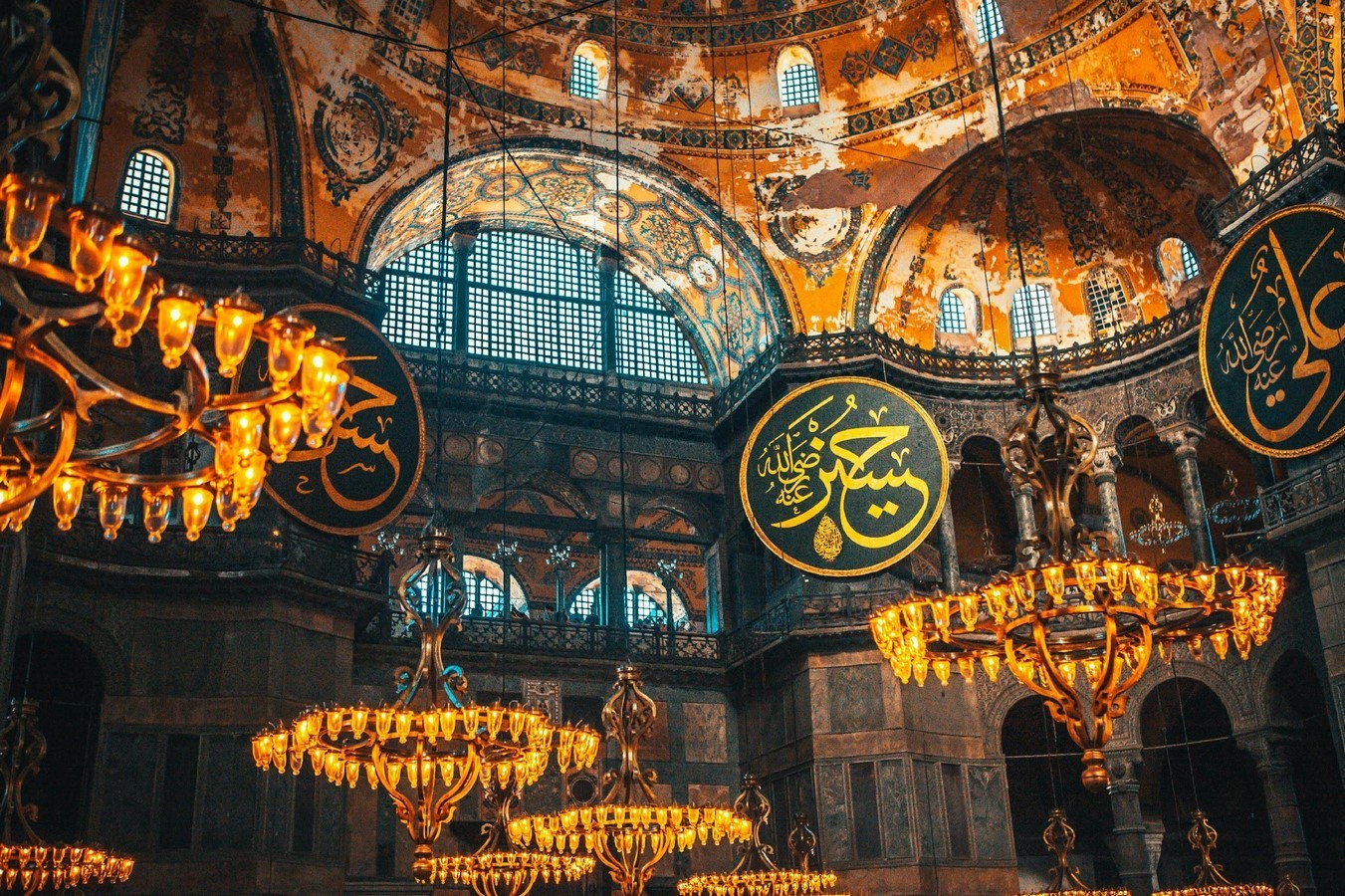
It is important to note that through all changes in political and religious faiths, the mosque has never been demolished but rather updated and refurbished, and stands as a testament to the ongoing changes the country has undergone. Grand design has always been used as a political tool to showcase the power of a country or empire, and it is important to understand the series of events that led to the current form of Hagia Sophia. The interior boasts a variety of contrasting elements such as Islamic signs and Christian mosaics that coexist and offer complexity to one of the most important historical buildings in the world.
There is a need to understand and preserve cultural edifices to be able to properly tell the history that has marked a certain area. Hagia Sophia is a great standing proof of the cultural exchange of different empires and ideological changes. It stands as a catalyst between two divided worlds, between Asia and Europe, and Christianity and Islam. Using it as a political tool to show power through exploiting spiritual beliefs shows that although thousands of years have passed since its first controversies, it is still used in the same manner. It ultimately becomes a mix of the two Abrahamic faiths, and the moment the visitor walks inside, they can easily realise it. The question that UNESCO poses is that, since its conversion back to a mosque from a museum, despite their disapproval for not respecting its World Heritage status by the Turkish government, it might not be able to accommodate both worshippers and large amounts of tourists, especially in case of an earthquake. This raises a big concern whether they should revoke its World Heritage status, leading to serious implications regarding the preservation of its storytelling character.
References:
Rosenstock, J., 2021. Protecting World Heritage: Paths for UNESCO Recourse and the Case of the Hagia Sophia. Michigan Journal of International Law. [online] Available at: https://www.mjilonline.org/protecting-world-heritage-paths-for-unesco-recourse-and-the-case-of-the-hagia-sophia/
Harvard University, 2020. Hagia Sophia. Whose Culture? [online] Available at: https://projects.iq.harvard.edu/whoseculture/hagia-sophia
Blue Mosque Tickets, n.d. Architecture of Hagia Sophia. [online] Available at: https://www.bluemosquetickets.com/architecture/
Unsplash, 2021. Gold and black chandelier inside building. [image] Available at: https://unsplash.com/photos/gold-and-black-chandelier-inside-building-uiLXI8d95Q8 [Accessed 13 April 2025].
Unsplash, 2021. Brown and white concrete building under blue sky during daytime. [image] Available at: https://unsplash.com/photos/brown-and-white-concrete-building-under-blue-sky-during-daytime-LsnAVYaFjSw[Accessed 13 April 2025].