“Architecture is a vehicle for the telling of the stories, a canvas for relaying societal myths, and a stage for the theatre of everyday life.”-Ar. Matthew Frederick in his book 101 things I learned in architecture school said that what resonates with one is how Architecture is literature, it’s poetry written in its form, and plays rehearsed in the most humane stages.
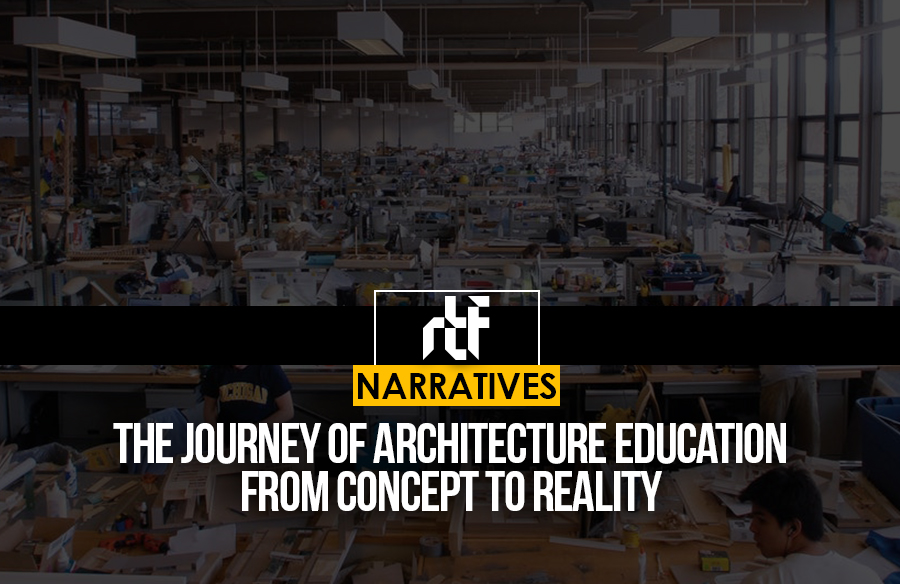
Entering the first year with a foggy idea that Architecture is the art of building, which is not wrong but merely discerns the glimmers of the fog that awaits and thus starts the basics and the hardships; minuscule details of sharpening a pencil, the importance of principles in design, and even back to alphabet writing.
‘Architecturally thinking’ one starts to reinvent oneself with Architecture and often inclines their thinking through the same lens. Thus, starting a journey of finding their ‘parti’ i.e., to have an intellectual stance behind designs. To always have concepts and ideas to generate, to always keep inspiring oneself through various methods to grow is also a step in learning architecture.
While in search of ‘good designs’, studying great designs is another step. From nit-picking the marvel of Frank O Gehry’s most absurd designs to finding sense in Prairie style with F.L.Wright and getting lost in the curves of Zaha Hadid’s style. Then comes the quest of finding a style that is surely yours, only to realize later how it is not about your own style but a style that becomes of people. ‘Architecture is empathy’, learning this through endless case studies and traveling, through places and books is what differentiates the complexity of Architecture with its simple need. Peter Zumthor’s Thinking Architecture is one such important book you learn from how to bring the humane approach to technical designs and that is all one needs to understand to grasp the idea of Architecture.
One another step in learning is understanding the depth of technicality that is required in Architecture. From the endless variety of software to understanding the physics of engineering and construction. To quote Ar. Matthew Frederick again: ’An Architect knows something about everything. An engineer knows everything about one thing.’ And that’s what makes them different. To design a hospital in the fourth semester, one has to walk in the shoes of a doctor, a nurse, a patient, and workers. This teaches the importance of being an empath in Architecture to create something that is of people in utmost comfortability before being an expression of an architect’s work.
Apart from all the philosophies, and technicalities, one another aspect is the theory and history of Architecture, where one learns the bigger picture like a human in a room, a room in the house, and then the house in a city. Concepts of Urban planning, Landscaping, Conservation, and many more starts to show up to make one understand that this all is just a part of a bigger picture that one has to see to step out in the world and create Architecture, and as much as its puts a huge pile of responsibility one has to conquer, it also opens whole new opportunities to learn. After all, humans are what they think.

The First day of class in Architecture, one barely gets to see a glimpse of what Architecture is through the fog, then slowly but surely the fog starts to uncover but it never is clear until you keep reinventing your perceptions with each learning. There are also many difficulties one comes across in this journey, from clashes of concepts to creative blocks to a load of finding something unique. Nonetheless, the journey doesn’t stop. To constantly adapt and learn is where the growth starts. As Ar. Christopher Benninger wrote in his book, Letters to a Young Architect, “Maybe one should be open to experiment just to know them, but then retreat to a middle path between boredom and hyper-excitement. That is where the good life lies, in the in-between-zone.”
The inspiration in architecture can be found anywhere. In this journey, one of the most important learning is through meeting people. The greatness of one’s mind is another one’s inspiration, and when you meet all kinds of people and clash your ideas and concepts, it helps in the growth that is bound to happen. To not limit oneself to greatness but to find it in the most mundane space is also a talent one can polish. To say architecture education is bound to the learning of its school would be juvenile. Architecture is learned from everywhere and from everyone.
Architecture is an education that goes on even after your college ends, it’s a never-ending process of learning, but you do get to choose your middle ground which is only ever yours. All in all, Architecture is a story-telling of our ideologies taking shapes in people’s minds through our designs and, learning it, is poetry.