The constant will to innovate and improve from the available resources has been the driving force behind centuries of architecture’s rich, complex, and abundant history. Presently considered the first manifestation of human-made architecture, Gobekli Tepe (Haklay & Gopher, 2020), built in 9000 B.C. (Centre, 2018), kicked off this fascinating journey of architectural evolution, and ever since, the human race has never looked back as the craft of building has touched all extremes, from the creation of the Pyramids at Giza to the Great Wall of China and the Colosseum to Dubai’s Burj Khalifa in modern times. As much as the craft of building has evolved, so has the science of materials, which has supported innovations and explorations. However, it only takes a short time to notice in history that there is one material that has stood the test of time and has remained relevant ever since the first experiment in architecture to the contemporary times: lime.

The Lime Cycle

Lime is mainly derived from nature, particularly from the rock formations of limestone that undergo the process of calcination in a kiln, which results in the formation of quicklime. This quicklime, under an exothermic hydration reaction, forms slaked lime, which, when mixed with sand and water, results in the formation of lime mortar. This lime mortar, when applied to the buildings, comes into contact with the carbon dioxide found in the natural environment, resulting in a carbonation process to again harden and form limestone, which now holds together the building elements (Sarda & Virmani, 2020).
Innovations and Adaptations of Lime across ancient Civilizations

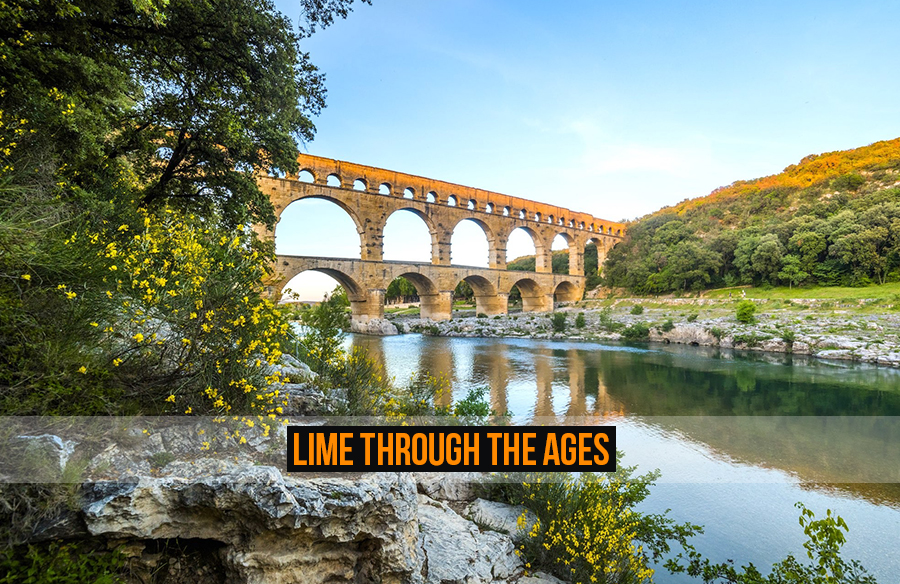
Ancient archaeological findings from various civilizations have consistently shown the widespread use of lime in construction. The methods, compositions, and applications of lime varied among different cultures and regions (Carran et al., 2012), encompassing activities such as flooring, wall infill, plastering, finishing, and waterproofing inside water conduits (Conservation, 2024). The innovation of Roman engineers is of great importance when we talk about the widespread use of lime, as they went on to develop advanced mixtures with lime, famous as Roman cement, that had increased strength and waterproofing capacities. These mixtures have been used for building timeless monuments like the Pantheon, the Colosseum, and the famed aqueduct Pont-du-Gard.

Similar to the Romans, every society around the world that has worked with lime has its own set of local additives to develop special mixtures for their respective purposes. In the Indian peninsula, many locally available additives like Gur, Gugal Gum, Methi, Egg Whites, Sea shells and many more have been used to improve its workability and water-proofing properties (Sarda & Virmani, 2020). A similar locally developed, improved mixture of lime could be found in use in China, where sticky rice soup was mixed with slaked lime to form a stronger mortar for binding the bricks of the Great Wall of China (Yang et al., 2010).
The Introduction of Cement in the Construction Process

The will of innovation to always improve the properties of lime mixtures resulted in the creation of another building material that eventually almost substituted lime. Portland Cement is the result of an effort to achieve quick setting time and comparable strength by fusing certain proportions of limestone and clay at high temperatures. First patented by Joseph Aspdin, cement started to gain popularity as the word about its strength and setting time spread very swiftly, eventually leading to the replacement of traditionally used lime mortars and mixtures in the construction process by this new industrialised product. Unfortunately, the quest for innovation disregarded the negative impacts of cement on buildings and users, such as breathability issues, a lack of self-healing properties, excessive rigidity, and high energy consumption during manufacturing (Sarda & Virmani, 2020).
In the context of growing environmental concerns, architecture and construction fields are turning back to the use of lime. At present, the construction industry produces up to 37% of all carbon emissions (Dyson et al., 2023), and a majority of these are accounted for by the production of some of its basic materials, such as cement or steel, which are incredibly energy- and emission-intensive. It is imperative to reduce and improve on these numbers, beginning with reintroducing traditional materials like lime into the construction process.
Revival in the Contemporary times

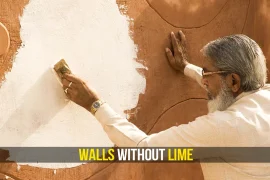
The way cement has become integral to our daily lives, it may not be possible to completely avoid the material. However, on a feasible scale, we can certainly make use of the properties of lime, which outperform those of cement. For example, lime offers delayed setting time, providing improved plasticity and workability, increased strength and longevity, and improved breathability. Today, there is a slow and steadily increasing use of lime for exterior finishes as it allows more breathability while preventing the development of microorganisms. It is also increasingly being used as a stabiliser in the construction of rammed earth walls as well as for the finishing process.

The turn towards sustainable materials is surely one to embrace, but there is still a long way to go when it comes to attaining a balance between the usage of cement and the re-introduction of lime in the building process. We need to increase awareness on two fronts simultaneously, the first being the stakeholders who are directly responsible for the material selection process, while the second front includes the new-age architects and designers who have the power to encourage a shift towards more environmentally friendly alternatives. Awareness and thoughtful decision-making are important factors that will play a role in the full-scale revival of this century and civilization’s old building material into contemporary times.
References:
Carran, D. et al. (2012) ‘A short history of the use of lime as a building material beyond Europe and North America’, International Journal of Architectural Heritage, 6(2), pp. 117–146. doi:10.1080/15583058.2010.511694.
Centre, U.W.H. (2018) Göbekli Tepe, UNESCO World Heritage Centre. Available at: https://whc.unesco.org/en/list/1572/ (Accessed: 11 July 2024).
Conservation, C. (2024) A brief history of lime plasters, historical development, Core Conservation. Available at: https://www.coreconservation.co.uk/technical-page/history-of-lime-plasters/ (Accessed: 11 July 2024).
Dyson, A. et al. (2023) Building materials and the climate: Constructing a new future. Nairobi, Kenya: United Nations Environment Programme.
Haklay, G. and Gopher, A. (2020) ‘Geometry and architectural planning at Göbekli Tepe, Turkey’, Cambridge Archaeological Journal, 30(2), pp. 343–357. doi:10.1017/s0959774319000660.
Sarda, K. and Virmani, S. (2020a) ‘Advent of Cement’, in Hunnar of Lime. Bhuj, Gujarat: Community Empowerment Unit, pp. 44–44. Available at: http://www.hunnarshala.org/uploads/2/5/9/5/25955121/lime_booklet.pdf (Accessed: 12 July 2024).
Sarda, K. and Virmani, S. (2020b) ‘Lime Mortar’, in Hunnar of Lime. Bhuj, Gujarat: Community Empowerment Unit, pp. 28–32. Available at: http://www.hunnarshala.org/uploads/2/5/9/5/25955121/lime_booklet.pdf (Accessed: 12 July 2024).
Sarda, K. and Virmani, S. (2020c) ‘What is Lime and Lime Wash?’, in Hunnar of Lime. Bhuj, Gujarat: Community Empowerment Unit, pp. 24–26. Available at: http://www.hunnarshala.org/uploads/2/5/9/5/25955121/lime_booklet.pdf (Accessed: 11 July 2024).
Yang, F., Zhang, B. and Ma, Q. (2010) ‘Study of sticky rice−lime mortar technology for the restoration of historical masonry construction’, Accounts of Chemical Research, 43(6), pp. 936–944. doi:10.1021/ar9001944.