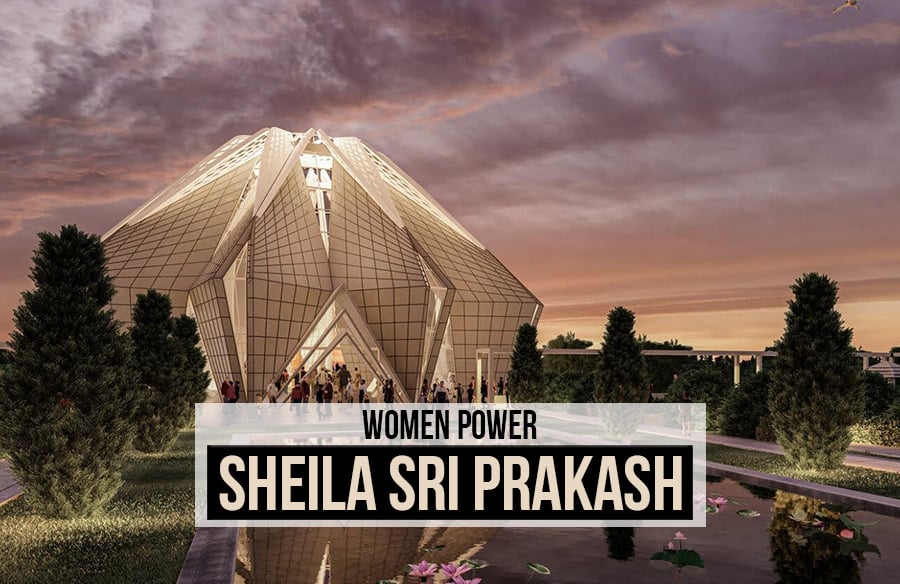
In the vast landscape of Indian architects and their oeuvre, few names resonate with as much impact and transformative depth as that of Sheila Sri Prakash. Recognised as the first woman in India to establish her own architecture firm, her achievements, accolades and contributions to society are widely discussed and celebrated. To read more about her awards, firm – Shilpa Architects and her projects here. This article, however, aims to discover the artist behind the architect, the spaces that tell stories and a legacy that continues to inspire.
Artistic Expression in the Built Form
In Sheila Sri Prakash’s life, before architecture, there was dance. Thus, she derived her architectural vision from her deeply rooted artistic beginnings. She is trained in Bharatanatyam, an Indian classical dance form. In addition to commanding a rigorous discipline it also instilled in her an acute understanding of balance, rhythm, symmetry, flow and spatial dynamics. The dance demands and emphasizes a certain narrative in its work. Such are the qualities that have evidently influenced and enhanced her thought processes as a designer. Thus, she not only designs buildings; but also choreographs experiences. With an attention to detail, her architecture integrates the fluid movements of dance into the organic flow of spatial design.
For example, this choreographic sensibility is reflected in the Silver Falls Resort in Kodaikanal. The layout unfolds like a musical performance. The cottages and pathways transform organically along the contours of the site; that govern the design planning. The movement through the space is deliberate and meditative, with transitions designed to engage visitors emotionally.

Each space offers a unique interaction with its surroundings, from the cascading waterfalls that gave the resort its name to the natural winding path with circular domes that have punctures to let light in; allowing a dynamic space owing to the play of light.

Spaces That Tell Stories
Another distinct attribute of Sheila’s work is her ability to blend traditional Indian art into contemporary architecture. Her designs are often marked by intricate carvings, geometric patterns, and cultural motifs. These are not merely ornamental but also act as agents for storytelling. This can be further understood by examining the interiors of a Private Villa designed by her firm.

The space features colourful patterned flooring that immediately draws one’s attention with its bold geometric designs. Inspired by traditional Indian tile work, these designs not only enhance visual interest but also support the local craftsmanship and heritage of the place.
A brightly lit and well-ventilated corridor runs along the residence and is framed by wooden railings and columns. Its semi-open nature allows for ample sunlight to filter through, creating a seamless connection between the indoor (closed) and outdoor (open) spaces. Moreover, the use of visually lightweight, neutral schemes with minimalist forms, furniture, provides a nuanced intimacy without taking away from the intricacy of the surroundings.

Additionally, there exists a central courtyard crowned with a glass roof, birthing a naturally lit up central space during the day. The tree planted in the middle stands as a living focal point, a thoughtful integration of nature into the residence. Moreover, the tapering granite columns that support the wooden roof are reminiscent of traditional South Indian architecture. They frame the courtyard, lending it a sense of timeless elegance. Embellished with a wooden swing that is adorned with rich, ornate cushions, the setting evokes nostalgia for a bygone era while serving as a space for relaxation and reflection.
Overall, the usage of natural materials like stone and wood, alongside the intended interplay of light and shadow, creates a serene yet dynamic ambiance. Thus, this design successfully and seamlessly balances cultural heritage with modern sensibilities, offering a retreat rooted in tradition designed for the present.
Sustainability Before Its Time
Much before sustainability became a global mandate, Sheila Sri Prakash championed the cause of environmentally conscious design. Her philosophy is not merely about reducing carbon footprints but about reviving age-old practices that celebrate a harmony of the built with nature. From incorporating courtyards for natural ventilation to using locally sourced materials, her projects reflect a deep respect for India’s vernacular traditions.
Additionally, her recommendations to the United Nations 2012 Rio+20 Summit in Brazil, have been adopted in the mandate for Sustainability presented to heads of nations. The sustainability matrix titled “Reciprocal Design Index” prescribes parameters and metrics surrounding sustainable design to factor in environment, sociology and economics. Based on her research, she has spearheaded the “Reciprocity Wave” movement, which uses art to create awareness about social and ecological issues that need immediate attention. (Architect Sheila Sri Prakash, Shilpa architects planners …)
A Legacy That Inspires
Sheila’s work is a testament to the belief that art is not a separate entity from architecture but in its essence. Her projects breathe life into spaces, offering more than utility—they provide cultural context, an emotional connection and story, and an aesthetic fulfilment.
The Shirdi Sai Baba Temple, designed by her, stands as a symbol of devotion, spirituality, and architectural ingenuity. The temple’s design respects the sanctity of traditional Indian temple architecture while suiting the needs of its modern worshippers.

Its layout is meticulously planned to manage large crowds seamlessly. With a thoughtful approach for a spiritual experience in the integration of open courtyards, shaded walkways, and natural ventilation, the space provides visitors with a serene environment to ponder, reflect and pray.

The temple features intricate carvings, sculptures, and motifs that tell stories from Sai Baba’s life, fostering a deep spiritual connection for his devotees. Thus, through aesthetic elements, the temple pays homage to Indian traditions. Additionally, locally sourced materials and eco-friendly construction practices were employed in the making of the temple, aligning the temple’s physical presence with Sai Baba’s teachings of simplicity and harmony with nature.
Alas, the Shirdi Sai Baba Temple embodies Sheila Sri Prakash’s vision of architecture as a medium for community and cultural preservation. By creating a space that inspires spirituality and celebrates heritage, she has left a legacy that continues to resonate with millions, proving that architecture can elevate faith and enrich lives.
List of References:
- Architect Sheila Sri Prakash, Shilpa architects planners … (n.d.). http://shilpaarchitects.com/wp-content/uploads/2014/05/1401083184mgsarch.pdf
- Chaudhary, S. (2022, December 16). Sheila Shri Prakash India’s first woman to establish her own architectural practice – rethinking the future. RTF | Rethinking The Future. https://www.re-thinkingthefuture.com/know-your-architects/a648-sheila-sri-prakash-indias-first-woman-to-establish-her-own-architectural-practice/#google_vignette
- Sheila Sri Prakash (Shilpa Architects): Life, works and philosophy. WhereIsTheNorth. (n.d.). https://www.whereisthenorth.com/article/sheila-sri-prakash-shilpa-architects-life-works-and-philosophy
- Sheila Sri Prakash. Shilpa Architects. (2019, February 19). https://shilpaarchitects.com/sheila-sri-prakash-bio/