Architecture firms like any other companies are subject to the rules of the market, thus the branding of an architecture studio can dictate the firm’s success or failure. A good brand means the firm is recognizable, distinguishable, and capable of forming and maintaining a reputation. The ability to rebrand and adapt to changes in the market are also necessary qualities for any company that aspires to be long-lasting. In 1935 the firm Perkins & Will was founded in Chicago, they became a well-known architecture studio after designing hospitals and schools. In 1986 they became a subsidiary of Dar Al-Handasah, and today they are recognized as a global brand.
Greenwashing or Poor Branding?

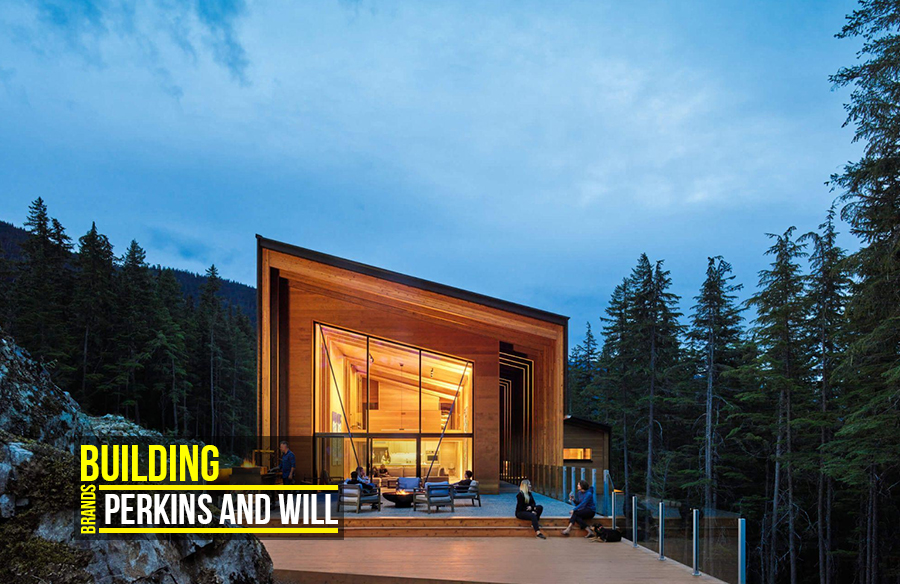
If you buy a carton of milk the container will likely have an illustration of a cow on a grass field, when in reality that product probably comes from an animal that has been locked in for its entire life. This is Greenwashing: the portrayal of a false ecological/sustainable identity as a marketing strategy. Architecture Studios are no stranger to these tactics. According to a Dezeen article, Perkins & Will described one of their projects (a timber house in Canada) as ‘beyond carbon neutral’ (Bernstein, 2021), in the article Bernstein suggests that Perkins & Will are justifying this statement due to the fact that timber is a resource that comes from trees which do absorb carbon dioxide. The article implies that Perkins & Will accounted for trees to be planted to substitute the ones getting chopped. This theory would suggest that all architecture produced by timber would be excused of carbon emissions if they simply planted trees afterward. It does not come as a surprise that this article sparked some dissatisfaction. Climate change is a major issue, and the building industry is under constant stress to become more sustainable.
Ironically, the source of the controversy lies in a simple statement, the truth is timber is in fact a more sustainable material than its substitutes, especially when it’s locally sourced. This would be a good example of poor branding since Perkins & Will claim was easily picked apart. As of today, on Perkins & Will’s website the building is described as having ‘Net Positive Energy Performance’, this is justified through a ‘solar energy system with a hydrogen fuel cell as a back-up source’. Either Perkins & Will re-branded the project, or the claim was never there. Regardless, it is apparent that Perkins & Wills is no stranger to controversies, especially when it comes to sustainability. According to chicagobuissness.com, the Rush University Medical Centre was planning to sue Perkins & Will for design errors that cost the hospital 8 million $ this was allegedly caused by a ‘miscalculation in the amount of cool air needed to offset the heat generated by the 42-inch flat-screen TVs in each patient room’ (Schorsch, 2012). These two incidents would be enough to raise questions about Pekins & Will’s claim as a sustainable brand.

Does a firm survive on Branding?
Compared to its rivals Perkins & Will better navigated the 2008 recession, a likely reason for this is the stable revenue from institutional clients that was made possible through the firm’s success as a designer of hospitals and schools. The possibility of a Rush University Medical Centre suing the architecture firm would be a direct hit on Perkins & Will reputation as hospital designers, heavily impacting their brand which helped them navigate the tumultuous 2008 crisis. As of today, the firm is still standing, the industry has not experienced a setback such as the 2008 recession, except for the 2020 pandemic. Only time will tell what industries will be able to survive any future recession as devastating as the one that crashed the construction industry in 2008, and whether or not that survival is based on reputation alone.
The key is in the Media.
It should be noted that to fully understand the impact of these incidents on a brand the unmistakable measuring system is the Google search bar. By simply googling the name of the firm you will not encounter these incidents, nor will you encounter other potentially negative information. To find these controversies it is necessary to dig a little deeper into the internet, meaning the firm Perkins and Will have successfully been able to brand themselves above the controversies that hinged their reputation. Their projects, awards won, consistent work and media presence have kept the firm in business. Perkins & Will appears to be well above the issues that they have faced in the past.

It can also be argued that today’s fast-paced media consumption leads to social amnesia. This effect is caused by the overconsumption of news and content, architecture firms like other companies are safe from being the subject of controversy for long periods of time as each day the media discovers a new subject of attention, however, this is not only the case for negative stories but positive news. This means that a firm’s success is also short-lived, to sustain a brand is becoming more difficult every day, and the value of having a strong reputation is being substituted by having relevance. Among all industries, brands are fighting for the spotlight, and among architects, sustainability is a must-have to stay on brand, and it better not just be an illustration of a cow on a grass field.
Bernstein, F. (2021). Taking credit for trees planted elsewhere is a whole lot of embodied irony. Dezeen. Available at: https://www.dezeen.com/2021/06/18/carbon-negative-solo-house-perkins-will-fred-bernstein-opinion/ [Accessed 19 September 2024].
Schorsch, K (2012). Rush sues architects and engineers over the new hospital. Crain’s Chicago Business. Available at: https://www.chicagobusiness.com/article/20120329/NEWS03/120329710/rush-sues-chicago-architecture-firm-perkins-will [Accessed 19 September 2024].
(2020). ‘SoLo,’ an Off-Grid Mass Timber House, Earns Passive House Certification. [online]. Available at: https://perkinswill.com/news/solo-an-off-grid-mass-timber-house-earns-passive-house-certification/ [Accessed 19 September 2024].