The Mahakumbh
History’s largest gathering of humankind ever, a divine celebration that can even be captured from space, and an event that will only repeat after 144 years. The Mahakumbh Mela of 2025 at Prayagraj remains an intensely moving experience, attracting a verified range of visitors from the devout to the curious.
Linked to the “pauranik” tale of the Samudra Manthan, four drops from the pot filled with the elixir of immortality called the “amrut” are said to have fallen on Earth when the Gods and the devils fought for it. The locations where these drops fell were Prayagraj, Haridwar, Nashik, and Ujjain. These are the cities that host the Kumbh Mela which is also governed by the astrological positioning of the Sun, moon, and Jupiter. Out of these, the Kumbh in Prayagraj is considered to be the most sacred since it lies at the “sangam”, the merging point of the three noble rivers Ganga, Yamuna, and The Saraswati. It is believed that bathing or taking a dip in the confluence of these rivers dissolves the sins of humankind, even more so this year because of the most favourable positions of celestial bodies. The Maha Kumbh occurs only after 12 Purna Kumbhs (complete Kumbhs), which themselves happen only once in 12 years, which means that the next Maha Kumbh Mela after 2025 shall take place in 2169 CE.
The Spatial and Urban Planning
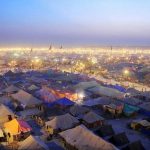
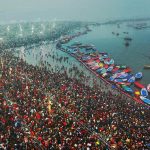
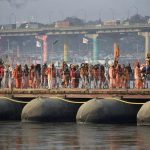
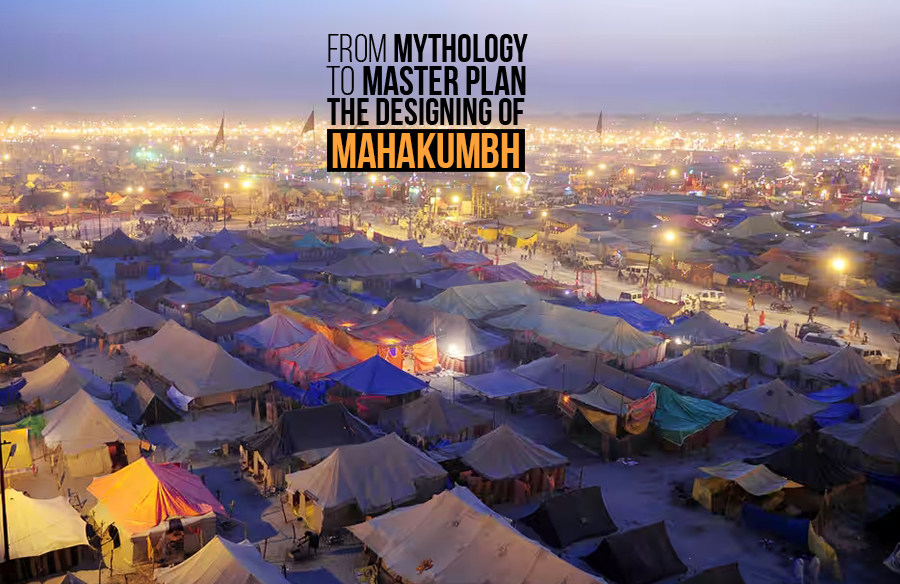
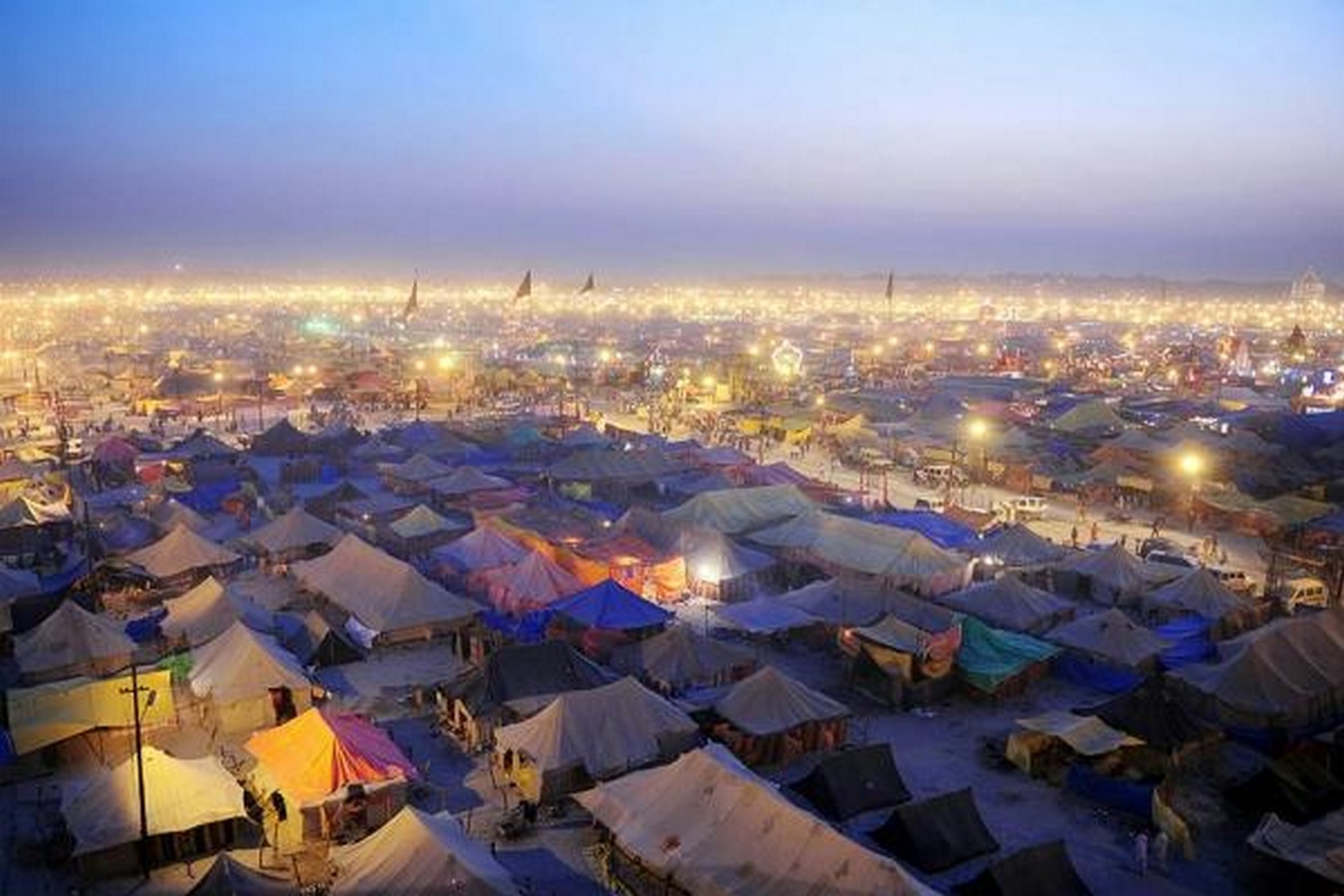
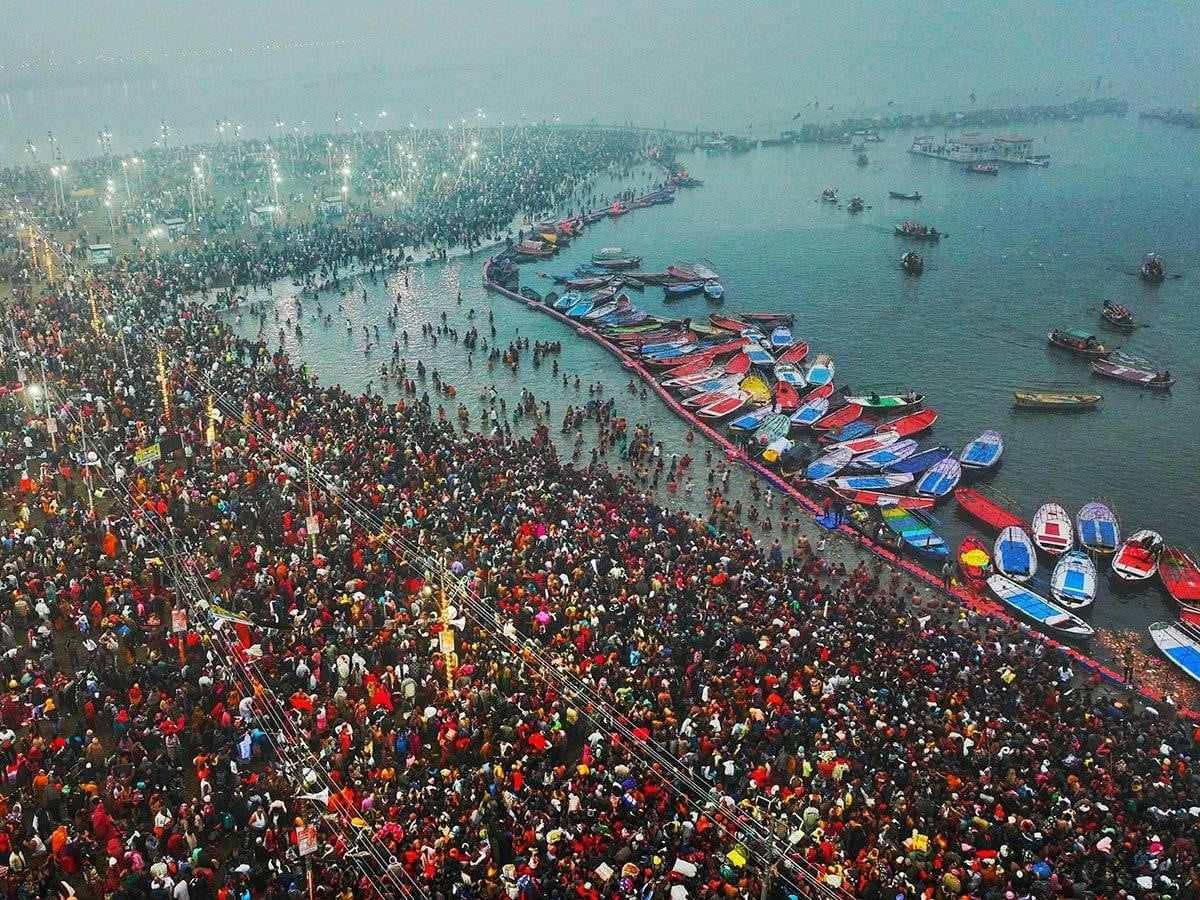
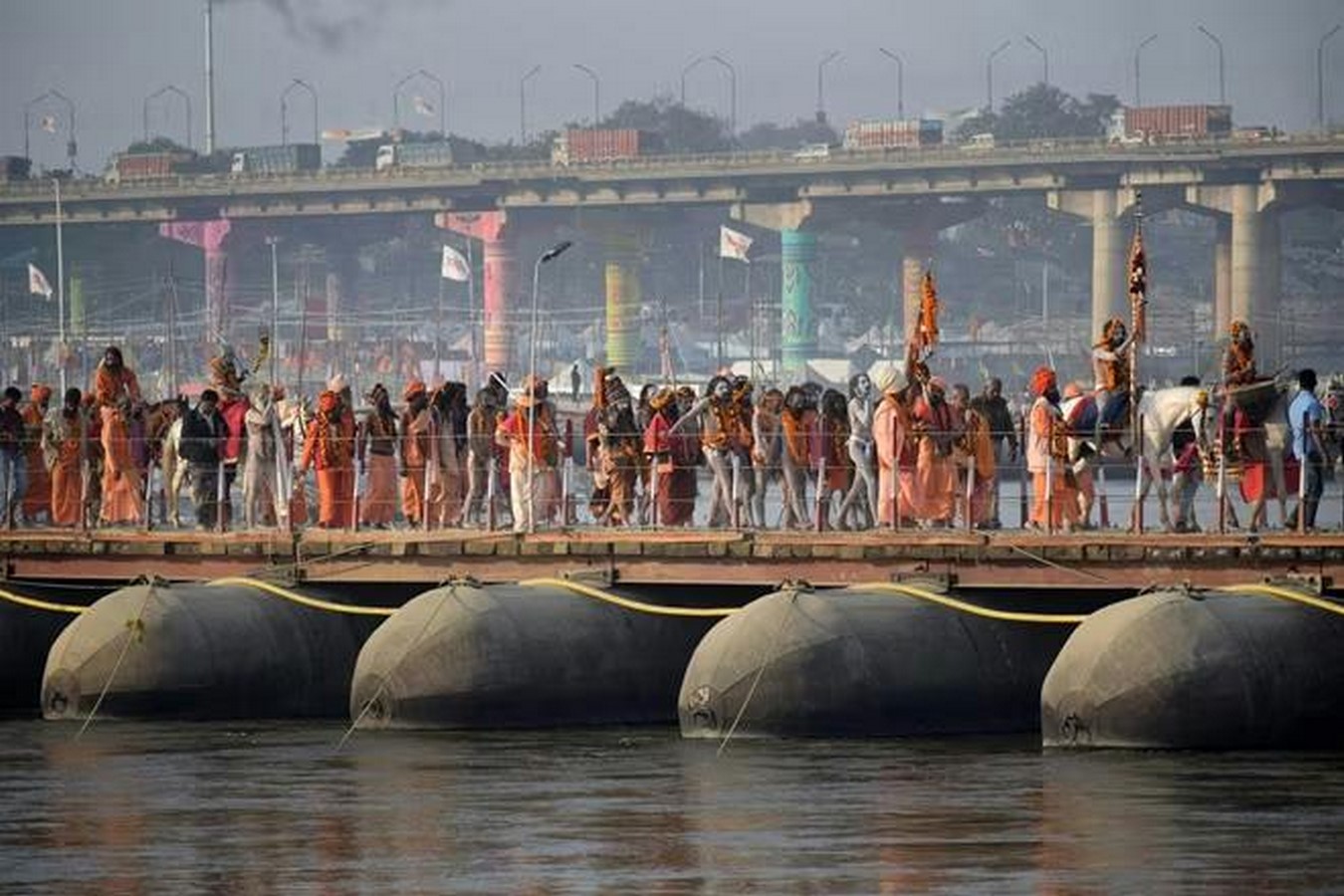
Exponentially increasing in size each year with each celebration, the Kumbh Mela this year is expected to receive approximately 40 crore visitors over the period of seven weeks. To cater to the huge crowd, an entire temporary city stretching over 10,000 acres is erected on the banks of the river, finished with planned streets and numbered sectors, over 30 floating pontoon bridges, campsites that are mini townships in themselves, and community spaces for various other purposes. From the point of view of an architect or an urbanist, it’s fascinating to study the scale, functioning, and the effectiveness of this pop-up “tent city”.
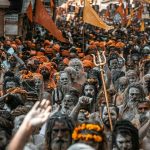
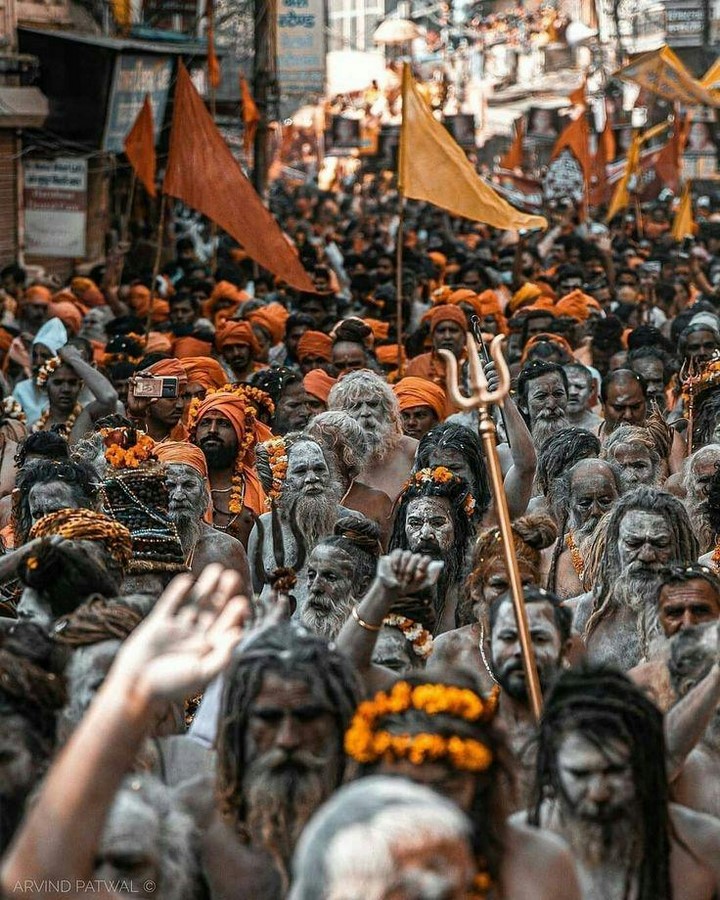
Prayagraj’s unique geography amplifies its spiritual significance. The city is situated at the confluence of the Ganga, Yamuna, and the mythical Saraswati, a meeting point known as the Triveni Sangam. Known to be believed as the holiest of river unions, this sacred juncture transforms into the core of the Kumbh Mela. Here, grand processions of saints, sadhus, and devotees march toward the river with ceremonial grandeur, chanting hymns and shlokas and performing rituals. The journey culminates at the ghats, where pilgrims offer prayers, sing devotional songs, and immerse themselves in the divine waters.
River-front Development
At the national level, the honorable Prime Minister has launched large-scale riverfront projects. These projects primarily focus on reinforced ghats, stabilization of riverbanks, and enhancing accessibility while at the same time protecting the Ganga’s ecological integrity. These efforts aim to improve the experience of millions of devotees while ensuring long-term sustainability.
At the state level, the Yogi Adityanath-led government is developing a 15 km riverfront, inspired by Mumbai’s Marine Drive, stretching from Dashashwamedh Ghat to Phaphamau. These developments aim to avoid congestion, create employment opportunities, and enrich the pilgrim experience through scenic views, dining options, and recreational spaces.
The 15 km long riverfront being constructed along the Ganga has helped the mela police in regulating traffic and enhancing visitors’ experience during the Maha Kumbh when about 40 crore people from all over the world are expected in the Sangam city. Apart from widening the roads, both inside and outside the city, this newly built alternative route has significantly facilitated movement for visitors during the Maha Kumbh. This riverfront is significantly different from normal roads. It features interlocking surfaces and boulder crate construction, with slope pitching for even more stability. The road is developed as a model pathway, with benches at regular intervals installed along the sides and several selfie points have been created for visitors.”
At the environmental level, the Uttar Pradesh Pollution Control Board has implemented a strategic plan to temporarily shut down industrial units that discharge waste into the river. This initiative is extremely vital for ensuring that untreated and chemical infused water does not pollute the Ganga during the Mela, aligning with the goal of a “Swachh and Nirmal Ganga.”
Urban Design
Other than the riverfront development, planning for Kumbh Mela 2025 also addressed various urban design challenges such as sanitation, mobility, transport, and surveillance. Significant steps included improving road connectivity, building pedestrian pathways, and construction of overbridges to ease traffic flow. Enhanced waste management systems and sewage treatment plants were installed to maintain cleanliness.
To enhance the water management system and civic infrastructure, initiatives like water treatment plants, sewage treatment facilities, and water supply networks with significant improvement in the existing sewerage and water supply system of Prayagraj have been implemented. The infrastructure will not only benefit the tent city but also new projects across the city.
To keep the precinct well-lit and to ensure energy efficiency, over 65,000 LED streetlights have been installed across the city and the mela precinct. Besides High and Low Tension lines, many power substations have also been erected. This comprehensive electrical infrastructure ensures reliable and efficient power supply throughout the Mela area and the city at all times.
Coming to the cultural transformation and tourism development, the renovation of historical and ancient temples and development of tourist facilities have also been included. The cultural perspective was enhanced through various initiatives like the establishment of a constitutional gallery and special displays and exhibitions showcasing India’s rich culture and heritage. The beautification of the city emerged as a key focus area, with extensive landscaping, installation of thematic lighting across and façade lighting at different strategic locations.
The digital technology infrastructure showcases a modern approach to managing this ancient gathering. A sophisticated digital surveillance system is implemented for cyber security along with control centres for effective crowd management. The authorities have developed a comprehensive Project Management Information System to monitor and keep a track of over 500 projects efficiently.
Digital surveillance and crowd control technologies are being incorporated to ensure safety as well. These measures focus on ensuring a smooth, organized, and safe experience for the millions of pilgrims.
Hosting The Kumbh Mela brings along numerous obstacles that must be tackled for its successful execution. Managing the huge influx of pilgrims requires efficient coordination of temporary facilities and set-ups like resting areas, food stalls, and public washrooms. Ensuring safety amid overcrowding, controlling excessive noise, and mitigation of unpredictable activities is also critical.
Provision for adequate accommodation and transportation for millions of attendees is a logistical struggle. Limited availability of infrastructure and narrow roads further complicate the movement of people and access to essential services. Maintaining order amidst the chaos is essential to ensure smooth functioning during the event.
Ritual bathing and offerings further contribute to the contamination of holy water, increased waste, and leads to reduced levels of oxygen, further affecting aquatic life and disrupting the ecosystem. Balancing spiritual needs with environmental preservation is crucial for sustainable management of the mela.
References:
Bhatia, K. and Payne, S. (2025). 2025 Prayagraj Kumbh Mela: What to do, where to stay, and how to navigate through crowds. [online] Architectural Digest India. Available at: https://www.architecturaldigest.in/story/2025-prayag-kumbh-mela-what-to-do-where-to-stay-and-how-to-navigate-through-crowds/
Banda, K.B. (2024). Urbanising the Sacred: Design Challenges at Kumbh Mela 2025. [online] RTF | Rethinking The Future. Available at: https://www.re-thinkingthefuture.com/city-and-architecture/a13557-urbanising-the-sacred-design-challenges-at-kumbh-mela-2025/
ArchDaily. (2015). Kumbh Mela: Designing the World’s Largest Gathering Of People. [online] Available at: https://www.archdaily.com/624425/kumbh-mela-designing-the-world-s-largest-gathering-of-people.
The Times of India. (2024). Riverfront to ease traffic, enhance visitors’ experience – Times of India. [online] Available at: https://timesofindia.indiatimes.com/city/allahabad/new-riverfront-in-prayagraj-set-to-transform-traffic-flow-and-visitor-experience-for-maha-kumbh/articleshowprint/114598887.cms
The Times of India. (2025). Setting new paradigms of urban infra with Maha Kumbh – Times of India. [online] Available at: https://timesofindia.indiatimes.com/city/lucknow/setting-new-paradigms-of-urban-infra-with-maha-kumbh/articleshowprint/117064556.cms