“Mughal” When we hear this word all we can recollect are our school history books or the royal jewels, palaces, food, war, and whatnot all of us will have a small time travel trip to the historical period. The theme of Mughal posturizes a single theme or origin pattern but not many people know that Mughalism was built by four different regions and traditions influenced together. The fusion cultural influence of Mughalism results from Persian, Islamic, Indian, and Turkey. Together this created a unique and distinctive style that flourished throughout the Mughal empire in India during the 16th-18th centuries. This fusion reflected not only architectural aesthetics but also the cultural, religious, and artistic amalgamation of the time.

Introduction of larger Domes and Iwans: Persian Influence
There was a cultural tie between India and Persia from the pre-Islamic period; it was further delighted with the advent of Islam in India. Persian architecture, consisting of Seljuk, Ilkhanid, Timurid, and Safavid traditions, became the main source of mediaeval Indian architecture. Persian architectural elements were introduced by the early Mughal emperors, especially Babur and Humayun. However, Humayun’s stay in Persia for over a decade, made him understand and love the Persian culture and art which influenced his perspective towards his architectural work, India.

Hence, Humayun’s mausoleum, such an excellent monument distinguished by Mughal features, was constructed during Akbar’s reign. Strongly influenced the Persian style of architecture. The triple dome and single-aisle mosque form was already developed during the reign of Lodhis at the close of it and further continued and developed by the Mughal’s. Key features such as Iwans (grand entrance halls), Domed Chambers, Double Dome, Squinches, Point Arch, Mosaic Faince, Intersecting Arches, Arch-Netting, and intricate tile work originated from Persian architecture. Gardens (like the Charbagh layout) were also Persian-inspired, emphasising symmetry and harmony with nature.


Introduction of Calligraphy: Islamic Influence
The Islamic influence on Mughal architecture is a key component of its distinctive style, originating from the Mughals’ deep cultural and religious ties to Islam. The Mughals were a lineage of Timur and Genghis Khan, and their Islamic faith blended with the Persian and Central Asian architectural traditions played a great role in defining the aesthetic and structural elements of their buildings. Features like calligraphic characters, geometric patterns, minarets, and mosque formations characterised Islam’s representative faith of the rulers. Recurring arches, domes, and vaulted spaces made up other definitive features of Islamic design that defined Mughal architecture.
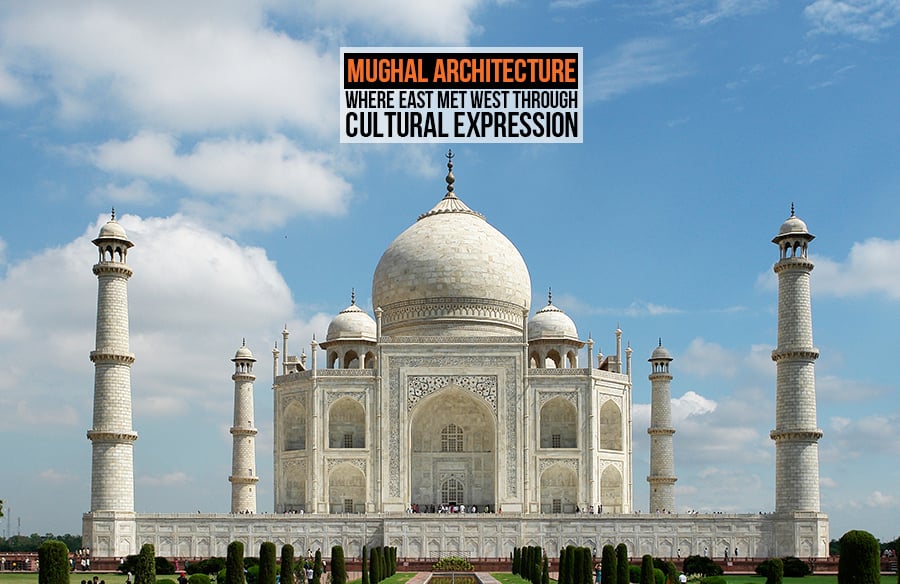
“Taj Mahal”. The whole mausoleum, plinth, and the four minars are worked in white marble with pietra dura in semi-precious stones, and there is a tall white marble dome, surrounded by four marble chhatris; the dome is slightly bulbous. In addition to floral motifs, the Taj Mahal is adorned with Islamic calligraphy, especially verses from the Qur’an, inscribed in black marble around the entrance and on its walls.

Introduction of turquoise accents:Turkey influence
Generally Ottoman Empire was renowned for its Blue and turquoise tiles all over their mosques as well as palaces, whereas the Mughals didn’t use these ceramic tiles, Barbur introduced this Turkish touch by pietra dura (stone inlay) and surface treatments. Turkish mosques and palaces have largely been focused on expansive courtyard spaces. Lahore, Pakistan’s Wazir Khan Mosque was built in 1634-35 during the reign of Emperor Shah Jahan. The mosque is known for its widespread use of flashy kashi-kari (tilework) – intricate designs in bright turquoise and blue, along with many other colors. It was inspired by the Turks but, in an adaptation by Moghuls, shows their bright tile work used in their houses of worship.


Introduction of Jharokhas :Indian influence
Mughal architecture was deeply enriched in so many ways by indigenous Indian architecture, particularly from the Hindu and Rajput traditions. Chhatris (an elevated, dome-shaped pavilion), jharokhas (overhanging enclosed balconies), and red sandstone as a building material all were native to Indian architecture. The intricate jali (latticed screens), carved from marble or sandstone, are a hallmark of Mughal architecture, with roots in Indian temple design. The use of red sandstone, often seen in Akbar’s constructions, such as the Agra Fort and Fatehpur Sikri, was inspired by the palaces and forts of Rajasthan.

Citation:
- Burton-Page, J. (2008) Indian islamic architecture: Forms and typologies, sites and monuments. Leiden: Brill.
- Saquib, M. and Ali, A. (2023) ‘Persian architecture: A source of inspiration for Mughal imperial mosques in North India’, Journal of Islamic Architecture, 7(4), pp. 744–749. doi:10.18860/jia.v7i4.21013.
- Vh, S. (2014) Architecture of India and Turkey, Academia.edu. Available at: https://www.academia.edu/8514591/Architecture_of_India_and_Turkey (Accessed: 20 October 2024).