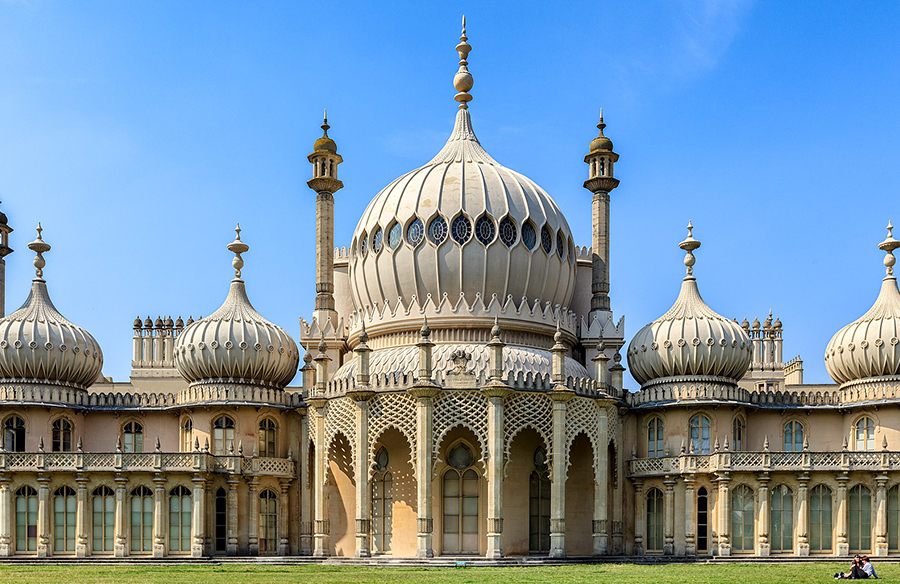
This article aims to show the adaptations of Indo-Saracenic motifs and Chinoiserie used with the respective exterior and interior construction of The Royal Pavilion, located in Brighton, Sussex. The underlying intention for using such motifs in the structure is due to the need to display status and wealth. The Pavilion was built in stages, from 1787 to 1822, for the Prince Regent, George IV, where the initial Neoclassical villa was constructed by Henry Holland, followed by John Nash, who extended and transformed the structure using Mughal motifs (Cavendish, 2024).
The Significance of Status & The Exterior Eclectic Mixture of Styles:
Amongst the aristocrats and people of significant royal status, displaying one’s ‘exoticized eclecticism’ (Partington, 2015) was extremely prominent and something that needed to be assimilated into. However, coupling this with Nash’s admiration for The Picturesque, a movement that associated both the ‘pictorial values of architecture and landscape’ (Britannica, 2013), this resulted in an indescribability of the amalgamation of ‘Moorish, Tartar, Gothic and Chinese’ (Partington, 2015) in the exterior façade and the structure. For example, Queen Victoria, who visited the Pavilion five times between 1837 to 1845 believed that this eclectic mixture of styles overpowered the context of the site, as she stated that it was ‘tantalising’ (Conrad, 2023, p.220) to be close to the sea and ‘not to see more of it’ (Conrad, 2023, p.220) when inside the Pavilion.

The inclusion of minarets and the central ‘turquoise onion-shaped Mughal dome’ (Partington, 2015) into the design of the Pavilion is an example of Thomas Metcalf’s view of the Indo-Saracenic style as an ‘exercise in British dominance over India’s cultural past’ (Arnold and Robb, 2013, p.135), acting as a tolerance over its colonies.

As seen in the illustration of the Pavilion above, the sectional drawing emphasises the eclectic mixture of culture, style, and the contrast between the interior and exterior, with ‘its Chinese interiors encased in an Indian shell’ (Barczewski, 2017, p.187).
The Significance of Interior Odes to Chinoiserie:
British cosmopolitanism acted as the key factor in the reasoning behind the grand display of wealth and status within royal and aristocratic structures like The Royal Pavilion. An in-depth knowledge of different cultures and locations, especially colonial ones, acted as an indicator of status (Barczewski, 2017, p.181). In the case of the patron of the Pavilion, George IV, a visual language was created by assigning rooms with an identity of culture. For example, the Pavilion’s Music Room appeared to be a tribute to Romanticism and Orientalism, through the incorporation of pagodas: physically and painted on the wallpaper (Blakely, 2018, p.209), as seen below.

Dedicating rooms with these identities of China, and, in general, Asia, not only acted as a symbol of wealth and status but allowed the aristocrats and people of royal status to experience a sense of escapism. This is a consequence of the fact that only a few Europeans had connections with China, hence, becoming the ‘land of fantasy’ (Winterbottom, 2008, p.704) for those who had not been. These connotations that related to China were, perhaps, a reflection of George IV’s whimsy and his lavish lifestyle. Furthermore, the socio-political influence that the incorporation of Chinoiserie had on grand structures like the Pavilion inherently highlighted the imperialism in the respective locations the items had been obtained from. This was due to the general view that Chinoiserie acted as a criticism of the contemporary government (Barczewski, 2017, p.182)
The Pavilion’s Impact on The Social Fabric – Then & Now:
Currently, the Royal Pavilion allows visitors to experience the space as George IV had intended to, open as a public regency museum (Royal Collection Trust, n.d). However, in the principal time that the Pavilion was being used, many negatively alluded to the structure, one even suggesting that the Pavilion appeared like a ‘mad-house’ (Pasquin, 1796, p.16). This was, perhaps, due to the assertive contemporary notions that suggested that the styles used in the interior and exterior of the Pavilion were ‘unfamiliar and in some ways as inferior’ (Barczewski, 2017, p.190).

Regarding the landscaping, the contemporary trend towards elements of Chinoiserie in Regency Gardens was ‘out of favour since the 1760s’ (Conner, 1986, p.44). Contrary to the contemporary opinion, the current notion of the Regency Gardens of the Pavilion appreciates the idea behind ‘rejecting [the] formal layout’ (Brighton & Hove Museums, n.d), as it lends itself to celebrating The Picturesque Movement, as the planted shrubs follow a natural path. Gardens of Chinese styles had the pre-conceived contemporary notion that regarded them as ‘whimsically irregular’ (Jacques, 1990, p.187). However, the gardens of the Pavilion underwent restoration in 1982, with ‘colourful and fragrant varieties’ (Brighton & Hove Museums, n.d) of shrubs being planted close to the curving paths, accentuating them. The stark contrast of opinion between the contemporary period that the Pavilion was constructed in and now, perhaps, is a reflection of how society has moved from appropriation and simply assimilation to appreciation.
In conclusion, the structure of the Royal Pavilion is composed of an eclectic mix of cultures, marking the status of a world traveller. Acting as a ‘pleasure palace’ (Royal Collection Trust, n.d) for a whimsical Prince Regent, the Pavilion now informs its current visitors about the history behind the incorporation of Indo-Saracenic motifs and Chinoiserie into its structure.
References:
- Arnold, D. and Robb, P. (2013) Institutions and Ideologies: A SOAS South Asia Reader. Surrey: Taylor & Francis.
- Barczewski, S. (2017). Country houses and the British Empire, 1700–1930. Manchester, England: Manchester University Press. Available at: https://doi-org.abc.cardiff.ac.uk/10.7765/9781526117533 [Accessed 19th October 2024]
- Blakely, K. (2018). Domesticating Orientalism: Chinoiserie and the Pagodas of the Royal Pavilion, Brighton, Australian and New Zealand Journal of Art, 18(2), pp. 206 – 223, Available at: DOI: 10.1080/14434318.2018.1519873 [Accessed 19th October 2024]
- Brighton & Hove Museums. (n.d) Garden [online] Available at: https://brightonmuseums.org.uk/visit/royal-pavilion-garden/what-to-see/garden/ [Accessed: 19th October 2024]
- Britannica, The Editors of Encyclopaedia (2013) Picturesque, Encyclopaedia Britannica, [online]. Available at: https://www.britannica.com/art/picturesque. [Accessed 19 October 2024].
- Cavendish, R. (2024). Royal Pavilion. Encyclopedia Britannica. [online] Last Updated 9th October 2024. Available at: https://www.britannica.com/place/Royal-Pavilion [Accessed 18th October 2024]
- Conner, P. (1986). The “Chinese Garden” in Regency England. Garden History, 14(1), pp.42–49. Available at: https://doi.org/10.2307/1586816 [Accessed: 19th October 2024]
- Conrad, S. (2023) Queen Victoria’s Life in Brighton and the Royal Pavilion 1837–1845, The Court Historian, 28(3), pp. 220–236. doi: 10.1080/14629712.2023.2270834. [Accessed 19th October 2024]
- Jacques, D. (1990). On the Supposed Chineseness of the English Landscape Garden. Garden History, 18(2), pp.180–191. Available at: https://doi.org/10.2307/1586940 [Accessed 19th October 2024]
- Partington, M.J. (2015). John Nash, Royal Pavilion, Brighton. [online] Available at: https://smarthistory.org/john-nash-royal-pavilion-brighton/ [Accessed 18th October 2024]
- Pasquin, A. (1796) The new Brighton guide; Involving a complete, authentic, and honourable solution of the recent mysteries of Carlton house. By Anthony Pasquin, Esq.’, London: Printed for H.D. Symonds, Paternoster Row; and T. Bellamy, King Street, Covent Garden, 5th ed., Available at: https://link.gale.com/apps/doc/CB0126758163/ECCO?u=ucw_itc&sid=bookmark-ECCO&xid=cbc2d883&pg=16 [Accessed 19th October 2024]
- Royal Collection Trust. (n.d). Brighton Pavilion: The Making of a Pleasure Palace [online] Available at: https://www.rct.uk/collection/stories/brighton-pavilion-the-making-of-a-pleasure-palace [Accessed 19th October 2024]
- Winterbottom, M. (2008). Chinoiserie in Britain. Brighton. The Burlington Magazine, 150(1267), pp. 704–705. Available at: http://www.jstor.org/stable/40479927 [Accessed 19th October]
Image URLs:
Image 1: https://brightonmuseums.org.uk/discovery/history-stories/a-right-royal-entrance-the-north-gate-of-the-royal-pavilion/
Image 2 : https://brightonmuseums.org.uk/visit/royal-pavilion-garden/our-history/
Image 3 : https://www.rct.uk/collection/stories/brighton-pavilion-the-making-of-a-pleasure-palace/pavilion-music-room
Image 4 : https://brightonmuseums.org.uk/regency-garden/