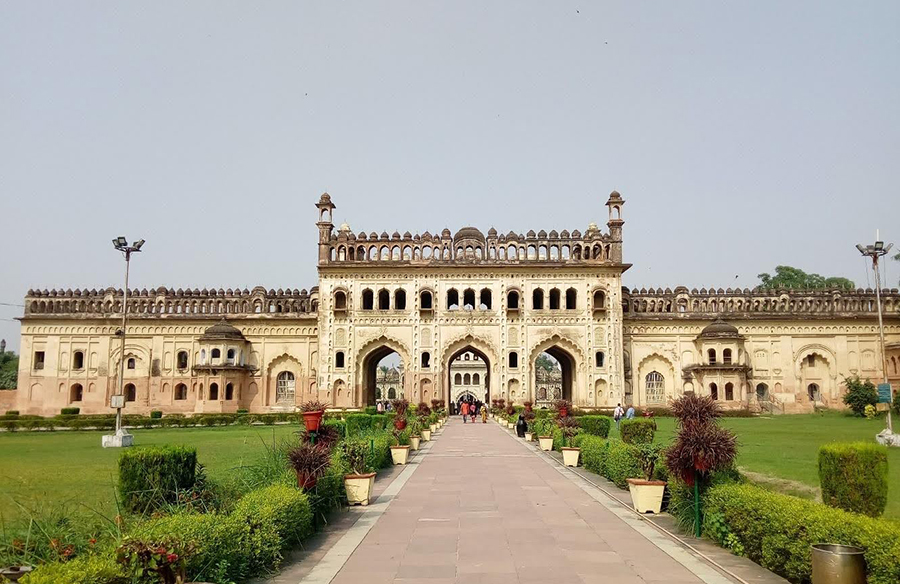
Bara Imambara is a piece of architectural engineering completed at the capital of Uttar Pradesh, Lucknow. This structure brings out the architectural look of the Mughal Empire as well as the grace of Indian civilization. The building is situated in Lucknow in Uttar Pradesh; it was begun in 1784 by Nawab Asaf-ud-Daula, a period when there was acute famine back in the nation and so, it had religious and employment functions also.

Historical Context
The construction of Bara Imambara was carried out after a dreadful famine in 1784 in Lucknow, Avadh Region. Nawab Asaf-ud-Daula, the fourth Nawab of Awadh, had only this vision to restore the employment issue to the famine-affected people through such a grand project. With the construction of Bara Imambara, the suffering and grief of the populace were not the only things addressed besides attempting to make a lasting architectural statement. This structure was constructed by an architect Hafiz Kifayatullah, who, according to some sources, was influenced by Persian architecture.
Architectural Features
Bara Imambara is an architectural marvel, primarily due to its unique design and intricate detailing. The monument is of several predominant features and every part reflects the glory of the Mughals and Persian architectures. The use of Lakhnawi bricks (small-size bricks) and lime plaster was mainly used for the construction of the entire complex.

The Central Hall
The central hall of Bara Imambara is one of the largest arched constructions which measure about 150 feet in length and about 45 feet in height from floor to dome. Notably, in this hall what Organova built did not have any beams or pillars; thus, it is one of the great architectural wonders associated with early engineering. Among the arts done in stucco work, some are evident in the hall establishing the fact that the work was done by artist masters. It was also possible to have a central hall with no bearing beams or pillars through arrangement through the installation of bricks on other bricks. This coupled with the usage of such light materials stretched and created a large expansive hall that is still stable.

Bhul bhulaiya
One of the most fascinating features of Bara Imambara is the Bhul bhulaiya which is a labyrinth of narrow corridors and passages which leads to various chambers within the monument. The following structural complexities were added to the castle as a way of warding off any attacker: These structures formed a confusing network to any attacker as the inhabitants of the castle knew very well. The Bhulbhulaiya is full of several dark-appearing passages, many of them have their dead ends while many others lead to several other secret chambers as well as stairs. In the periods of war, it was possible to get lost in the maze thus presumably confusing the attackers, during the time of peace the complex was used as a source of entertainment and fun for the people.

The Asfi Mosque
Adjacent to the central hall is the Asfi Mosque, which adds to the spiritual and cultural significance of Bara Imambara. The mosque itself is very magnificent having domes and tall minarets which are representative of Mughal architecture. The construction of the mosque also has orthodox Islamic stylistic motifs, the focus on the prayer niche and the pulpit are adorned with floral and geometric ornamentation. There are three large domes and four minarets that greatly distinguish the silhouette of the building. The dome is the central pavilion in particular, which is the exposition of successful accomplishment of architectural brilliance due to its fabulous select work and the expansive interior space.

The Bowli
The Bara Imambara complex also includes a stepwell, known as the Bowli, which served as a source of water for the residents. The Bowli is a piece of architecture in as much as the structure of the building combined with its functionality. A stepwell also known as a Bawdi is a traditional method of water storage and conservation in the areas of India. One of the most complex designs in Bara Imambara is located in the form of ‘Bowli’, which has several deep as well as sophisticated stairs to reach the water level. The structure also fulfilled practical purposes, but the execution also showed the amount of hydraulic knowledge that the Mughal architects possessed. The interior areas of The Bowli were cool and they were used as refuges, particularly during summer.

Cultural and Religious Significance
Bara Imambara has a rich history and social importance for the Muslims of Lucknow and especially for the Shia sect. From a religious point of view, the monument is significant as it is visited during Muharram, the first month of the Islamic calendar, which is devoted to the memory of Imam Hussain, the grandson of the Prophet Muhammad. Every year, especially during Muharram, one can see thousands of people, religious devotees at Bara Imambara to be a part of tazias (procession) and other ceremonies to symbolise the martyrdom of Imam Hussain and his followers.
Muharram is one of the important mourning and remembrance occasions followed by Shia Muslims, where Bara Imambara becomes the place of mourning. The centre is the central ground or the large prayer hall and additional open-air spaces; activities include maatam or self-mortification, majlis, or religious assembly. The monument also speaks about the Artistic, Cultural, and religious patronage of the Nawabs wherein the syncretic culture of Awadh reaches its zenith.
Influence on Architecture and Urban Planning
Thus, it can be said that Bara Imambara’s architectural impacts are not only limited to its existence but also helped in shaping the further advancement of architecture in Lucknow and other places. The design features of the monument for other architectural designs include large arched spaces, skillful use of stucco work, and fusing of functional and design work. The other few structures, for instance, the Rumi Darwaza and Chota Imambara that have also been built by the Nawabs of Awadh also have similar architectural features. Together, they form part of the architectural puzzle of Lucknow that is defined by the adaptation of Mughal and Persian styles with local characteristics.
The impact of Bara Imambara can also be observed in the urban design and layout of the city of Lucknow as well. The location of the monument and further planning of the territory were chosen and designed to form a single organism of the city. The parallel arrangement of streets and the location of public spaces, the use of water elements, and the integration of water elements – all these aspects indicate that there is a rather high level of understanding of such principles of urban planning as orientation, configuration, and boulevard.
Bara Imambara is not just a structure but rather it is rich with the history, pride, and talent of the locals. Built at a time when there was a famine in Delhi, the construction of the monument provided work for thousands and is now an iconic landmark of Mughal architecture. In this regard, while acting on the restoration and development of this historical site, Bara Imambara will certainly continue to be a landmark to inspire visitors in the future. Bara Imambara represents the fact that nothing is impossible in the world because human beings can create wonders. In addition, the cultural importance of structures and the importance of quality architecture cannot be underestimated. This crown symbolises the history of the state and becomes a source of inspiration and hope for the future population.