
La Mamounia Hotel began as a 13-hectare garden dedicated to hosting celebrations, belonging to Prince Al Mamoun, thanks to a gift from his father, Sultan Alaui Sidi Mohammed Ben Abdallah in the 18th century. Two centuries later, the hotel project emerged through the Compagnie des Chemins de Fer du Maroc society in 1923, led by architects Henri Prost and Antoine Marchisio. The architects utilized the flora of Prince Al Mamoun’s garden and complemented it with a building that represented the richness of Moroccan architecture through fusion with the Art Deco style, which was flourishing at the time. What was initially a space dedicated to hosting celebrations transformed into the world’s finest hotel located in Marrakech, renowned for showcasing the best of Arab architecture and Moroccan traditions in a luxury palace, according to Conde Nast Traveller (2018).

The preservation of cultural heritage as luxury architecture
The hotel is characterized by its luxury architecture that preserves the history and tradition of Moroccan architecture influenced by Berber, Islamic, and Spanish architecture under the language of Art Deco style. Among the main architectural elements are the geometry of the arches, the contrasts of decorative tiles, the warmth of the interior courtyards, and the ornamental details of Moroccan craftsmanship such as carved wood, mashrabiyas, sculpted plaster, and zelliges, combined with the interplay of lights, texture combinations, and materials that elevate the experience to a luxury journey through time.

Designing experiences through the architectural program
Following the motto, ‘The exceptional experience of an unforgettable stay”, undoubtedly reflects La Mamounia’s attention to detail in service. Due to the configuration of a diversified architectural program aimed at creating exclusive experiences of calmness and tranquility. Firstly, the hotel boasts 135 rooms, 71 suites with 1 to 3 bedrooms, and 3 riads. From the entrance to each room, carved doors with knockers, the scent of date-based perfumes, feather pillows on plush beds, lighting designed according to the time of day, and accessories to complement activities such as pool sandals or yoga mats stand out.

Furthermore, a stay at La Mamounia includes access to an international gastronomic offering distributed across five restaurants: L’Asiatique par Jean-Georges, L’Italien par Jean-Georges, Le Marocain, Le Pavillon de la Piscine, and Le Brunch. Additionally, it features two tea rooms, Le Menzeh par Pierre Hermé and Le Salon de Thé par Pierre Hermé, and four bars: Le Bar Majorelle, Le Club, Le Bar de la Piscine, and Le Churchill. Moreover, La Mamounia has updated its architectural program with a series of exclusive spaces with cinema-themed lounges, gardens, wine cellars, and games, named L’Œnothèque, Le Cinéma, Les Jardins, Les Lanternes, and Le Dîner Éphémère.

Additionally, La Mamounia also offers well-being experiences through the hotel spa, which features 2 traditional hammams, 1 private hammam, 10 multi-treatment cabins, a relaxation room with catering service, a hairdressing salon, barber shop, a manicure salon, sports room, indoor pool, and outdoor pool, spread across 2500m2. Although all spaces are designed with the utmost rigor of luxury architecture, the two main elements of La Mamounia’s spa are the hammams and the indoor pool. Hammams are known as steam baths in countries with a Muslim tradition in the Middle East and North Africa, to establish a ritual of cleansing, purification, relaxation, and well-being in a social space where interaction with others occurs. La Mamounia’s hammams are designed with mosaics, pale marble, and soft lighting to create the ideal atmosphere of serenity. Like the hammams, the indoor pool also evokes tranquility and relaxation. However, the main feature of this area is the white Almohad horseshoe arches with pillars covered in zelliges in shades of green and blue that frame the pool, making it an iconic space of the hotel.

The Riads: Traditional Moroccan Houses
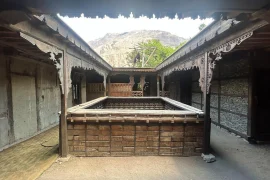
Riads are typologies of traditional Moroccan homes characterized by a central garden or courtyard with a pool, where privacy, tranquility, and disconnection from the city prevail. Due to the significance of this type of housing in the region, La Mamounia built 3 luxury Riads amidst the hotel gardens of 700m2 each with private access to ensure the utmost discretion for guests. The capacity of the Riads accommodates a maximum of 6 people. The architectural program includes 3 bedrooms with dressing rooms, 3 bathrooms with a bathtub and shower, a courtesy toilet, a living room, a dining room, and a kitchen in the interior. Also, a dining area, heated pool, and terrace on the exterior. Additionally, it enhances the experience with additional services such as a 24-hour butler, private transportation between the hotel and the airport, parking, and others.

In short, the luxury palace La Mamounia is one of the best hotels in the world recognized for preserving the heritage of traditional Moroccan architecture and the legacy of Prince Al Mamoum. The fusion of elements such as geometric arches, mosaics, tiles, as well as the integration of hammams, Riads, and gardens, transform the hotel stay into a luxury experience and a journey through time.
References:
La Mamounia Marrakech (2023). La Mamounia Marrakech Official website [online]. Available at: https://mamounia.com/es/ [Accessed 03 April 2024].