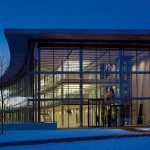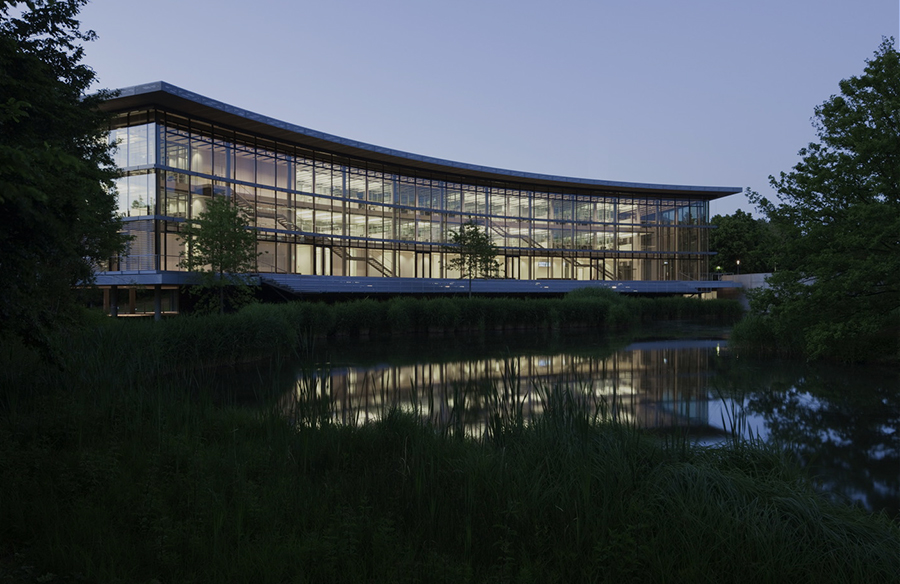
Heinrich-Heine University in Düsseldorf now has a new landmark thanks to Ingenhoven Architects’ Oeconomicum building, which is located between the medical school and the university library. A three-story faculty building with a large glass front overlooking the university lake is part of the development. Due to its gently curving design, the entire new structure is angled toward the nearby waterscape. Designing for transparency was crucial because it expresses the shared understanding between education and research regarding the effort, interchange, and synergistic consequences of science.
Planning and approach
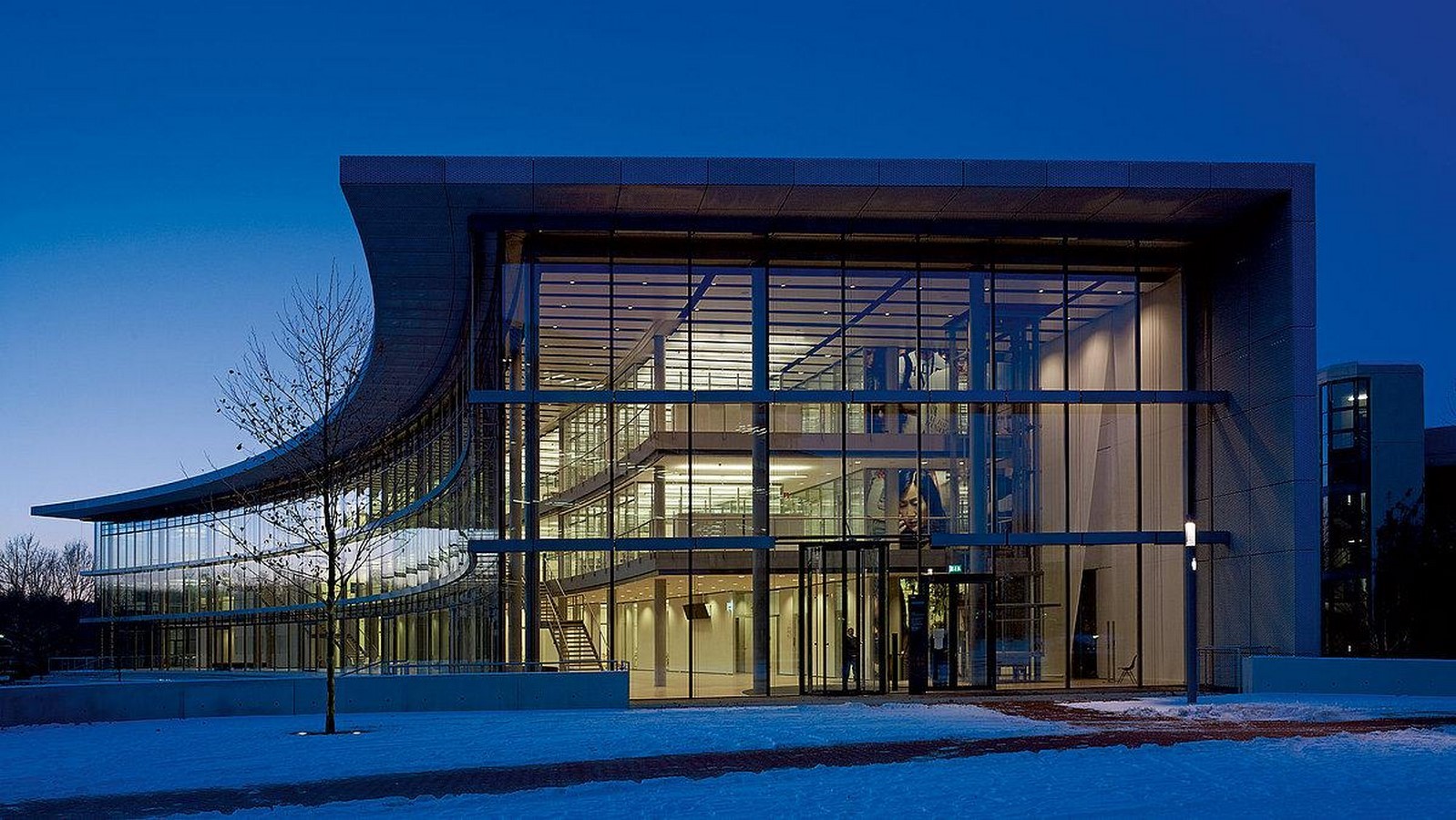
The building features its distinctive curved shape along the East-West axis, overlooking the existing lake. This aspect also plays a role in reducing the heat island effect for the building campus. The main design idea is to provide flexible spaces both for collaboration and socialization.
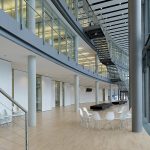
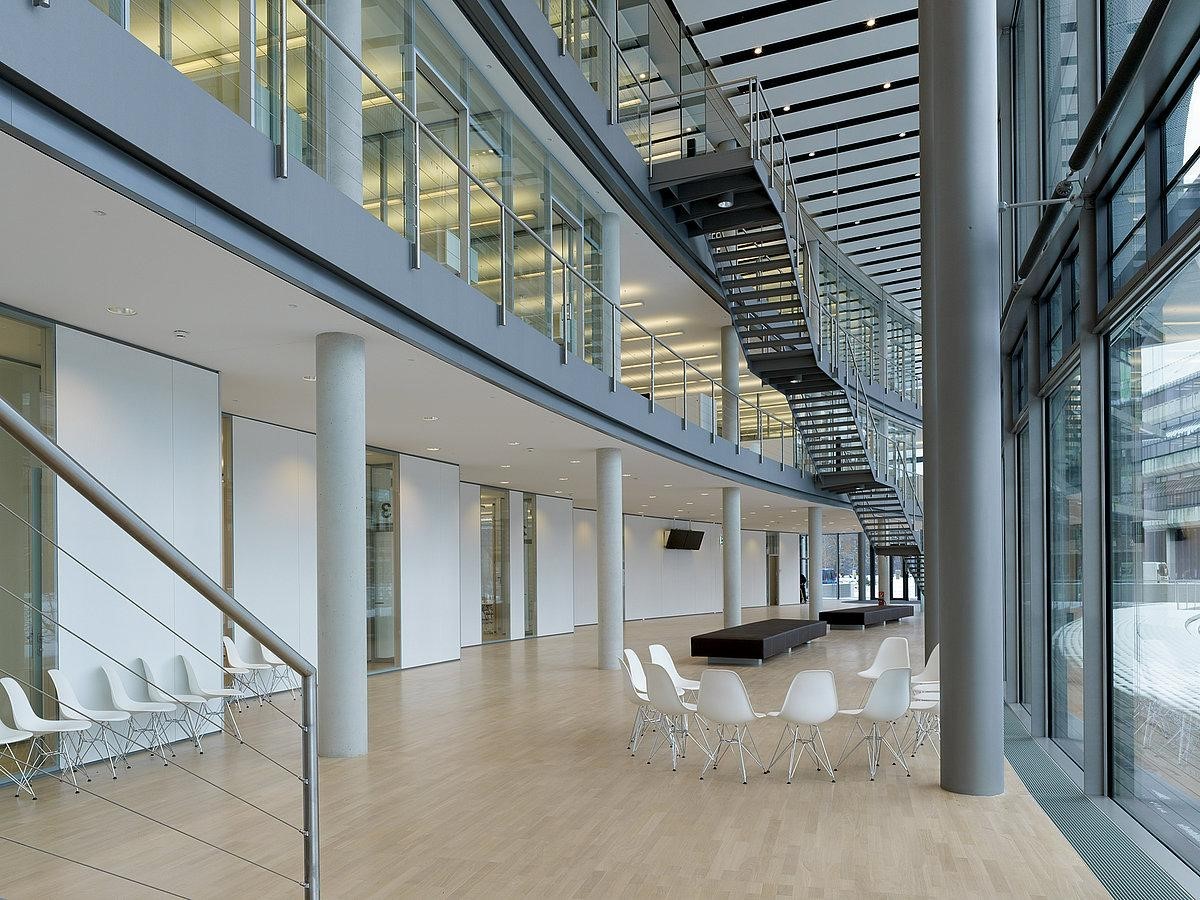
A spacious atrium area with a glass facade ensures that maximum free space is provided, along with ample daylight and a panoramic view of the lake. The arrangement of workplaces allows for flexible work and meeting spaces. The spaces are intended to provide scientists and students with areas that support collaboration, as well as quiet reflection.
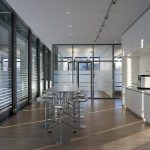
To enhance collaboration and provide open access to natural light and the panoramic view, single and enclosed team offices have been placed in the north, with glass walls facing the open plan spaces in the center. The atrium along the south façade connects the common areas and ground floor classrooms with the offices of the particular chairs on the upper floors.
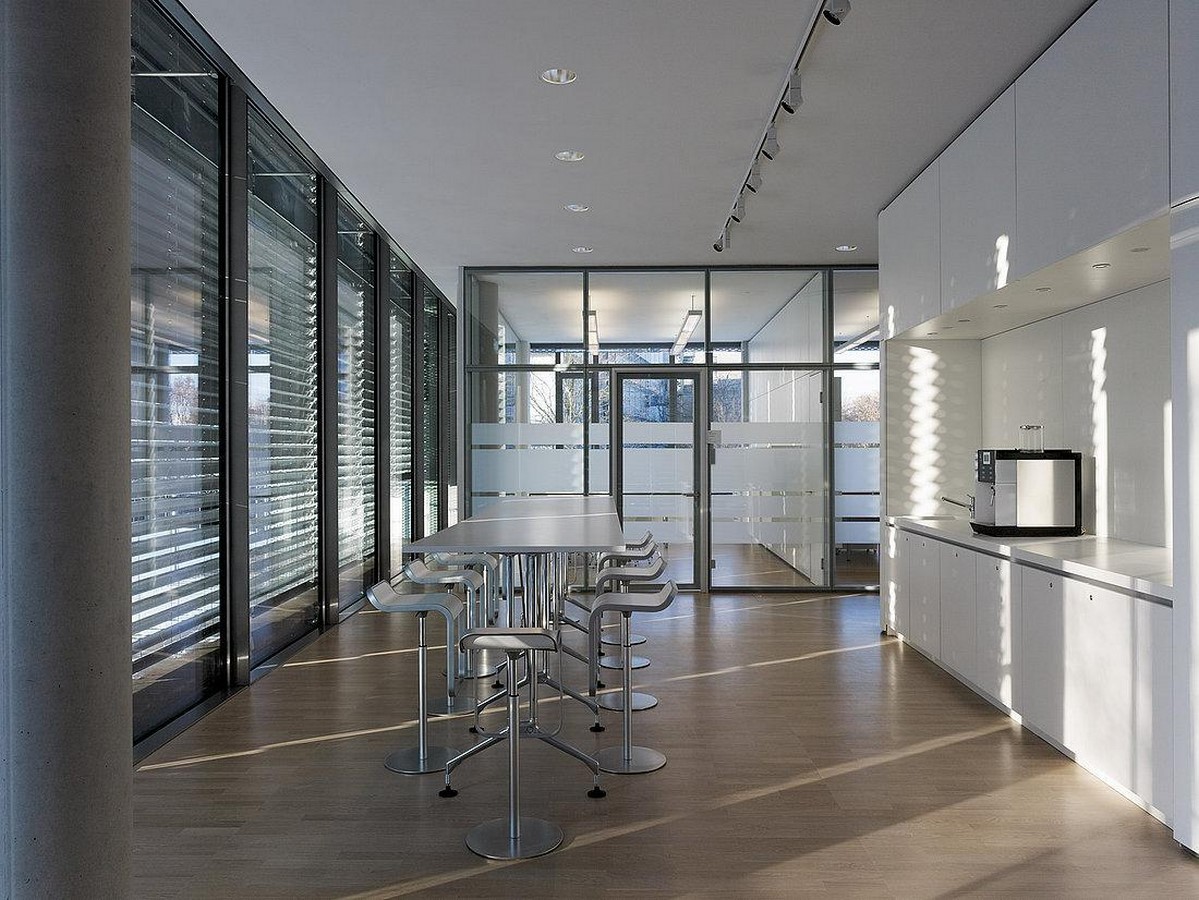
The classrooms and office areas have been designed to offer flexibility, accommodating various sizes of work and meeting spaces. A large single-flight staircase is placed alongside the East-West stretch of the building, serving to complement the building plan and introduce an intriguing element to the overall design.
On the west side, Oeconomicum was initially intended to undergo an expansion of more than a third. An additional section was later incorporated when the original west facade was dismantled. Octatube was responsible for constructing both the façades and the roof. Achieving a seamless match between the new component and the existing structure presented a challenge for Octatube. Variations exist between the two sections. In the current portion, there is a landing, whereas in the new portion, the floors extend all the way to the facade (“Oeconomicum”).
The south-facing windows permit the enjoyment of an expansive vista. At the southern end of the structure, one can find the lake and the wooden deck. In fact, the terrace serves as a popular gathering spot for the entire school. On the north side, near the glass barriers, the team offices are located, providing the opportunity to also take in the view.
Materials, construction, and sustainability
The building’s energy usage and operating costs have been minimized. The compact structure exceeds current energy-saving regulations by harnessing geothermal energy, collecting rainwater, and utilizing natural ventilation. To create a robust structure that will benefit generations of students, materials were chosen with a focus on environmental responsibility. These criteria encompassed recyclability, energy efficiency, and longevity (“ingenhoven architects – Düsseldorf Oeconomicum”). The north side and roof are adorned with extended metal cladding. These extended metal sheets must precisely match the structure. The steel framework for the façade, consisting of T-profiles with sharp edges, was intended as an architectural element. Subsequently, they were lacquered, providing a smooth finish to the welded joints. Thermal considerations influenced the façades, which are more open to the south and more enclosed to the north. The building minimizes energy consumption and maintenance expenses. The small structure employs geothermal energy, rainwater collection, and natural ventilation to surpass the requirements of existing regulations. Materials were chosen with an eye on longevity, integrated energy, and recyclability, ensuring a robust and responsible structure that will serve generations to come (“!!”).
Internationally acclaimed for his sustainable architectural designs, Christoph Ingenhoven developed an ecological concept for this building to achieve minimal energy consumption through cutting-edge technology (“Oeconomicum Düsseldorf”). High-performance 1x70W high-pressure discharge lamps were utilized for the uniform illumination of the 10-meter-high atrium. The downlights are placed directly on the cable conduits beneath the concrete ceiling. The bottom edges of the downlights are precisely fitted to the suspended ceiling components to create a visually seamless connection with the ceiling. This enhances the opacity of the installed downlights’ casings. The arrangement of the downlights positioned beneath the landings ensures even lighting on the floor below. The downlights’ housings are painted in RAL 9007 to match the staircase’s hue. The planar assembly technique is employed to flush-mount the downlights in the hallways into the ceiling (“Oeconomicum Düsseldorf”). Due to its comprehensive consideration of various sustainability aspects, the Chicago Athenaeum Museum of Architecture and Design awarded the Lanserhof at Lake Tegern, designed by Ingenhoven Architects, the GREEN GOOD DESIGN Award in 2015. Established in 1950 in Chicago, this award remains one of the world’s oldest and most significant accolades for sustainable design.
The building stands as a trailblazer for contemporary architecture, exemplifying site-specific design that simultaneously integrates flexible spaces for collaboration and green design principles. It serves as a model of sustainable, cutting-edge architecture for the educational sector. This project showcases the firm’s commitment to creating architecture that not only fulfills utilitarian needs but also aligns with broader objectives of sustainability and academic excellence.
Reference:
“!!” !! – Wiktionary, https://www.japan-architects.com/en/ingenhoven-associates-dusseldorf/project/oeconomicum. Accessed 6 August 2023.
“ingenhoven architects – Düsseldorf Oeconomicum.” Ingenhoven Architects, https://www.ingenhovenarchitects.com/projects/more-projects/oeconomicum/description. Accessed 6 August 2023.
“Oeconomicum.” Octatube, https://www.octatube.nl/en_GB/project-item.html/projectitem/100-oeconomicum. Accessed 6 August 2023.
“Oeconomicum Düsseldorf.” Schmitz Wila, https://schmitz-wila.com/en/applications/oeconomicum-duesseldorf/. Accessed 6 August 2023.