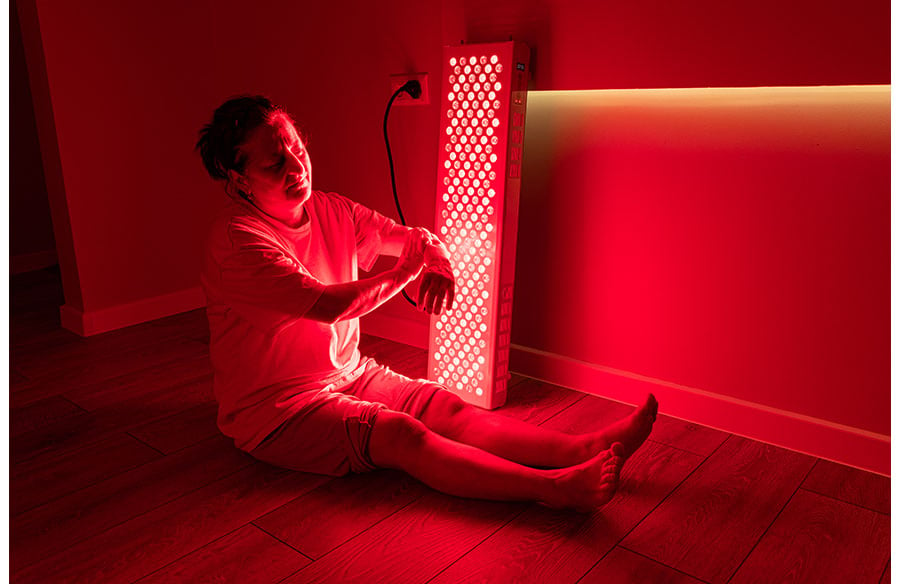
Written after several weeks of before-work and after-work sessions.
Pros
- One whole-body session covers you shoulder to shin, so no mid-session repositioning
- The motorized electric stand adjusts to your height and gets you dosing in under a minute
- Deep tissue penetrating wavelengths to reach the tendons
- No blue light makes it usable even at night time
- Voice control, tri-beam optics, and three separate custom modes
- Backed by a 3-year warranty and a 60-day risk-free trial
Cons
- At $2,799 this is a substantial commitment
- The panel weighs 39.6 pounds, so it is a stay-put fixture, although it can be moved with the stand because it has wheels
If your calendar is already overloaded, the thing that quietly kills an at-home wellness habit is friction. You buy a small red light panel, you love the concept, and then within a month you abandon it, because every session has turned into an errand. The Helio Blaze is engineered around the opposite assumption. It is a full-length, whole-body panel on an included electric stand, and the whole proposition is that it respects your time. I tested it with that reader in mind, the professional whose schedule leaves no room for setup theater. The busy one.
Here is my review of the Helio Blaze for the perpetually time-pressed.
What is the Helio Blaze Panel?
The Blaze is a whole-body red light panel that you can stand in front of or lie under. Because the panel measures 64.3 inches tall, a single position lights you from roughly shoulder to shin, which is the geometric argument behind this review. Within the Helio range it sits above the mid-size Glow and below the largest Nova, which makes it the logical selection for buyers who want real full-body coverage without escalating to the biggest available unit.
It arrives with a 360-degree rotating, height-adjustable electric stand, which is the component that matters most for the time-economy angle, and I will return to it shortly.
Inside, the panel houses 480 LEDs rated at 5 watts each, with a stated lifespan above 100,000 hours. The Blaze is the only panel in the Helio Cure catalog that mixes single-chip and dual-chip 3535 LEDs in the same array. It runs six wavelengths, specifically 630, 660, 810, 830, 850, and 1064 nm, a spread that addresses red light at the skin surface alongside near-infrared and deep near-infrared energy for the tissue beneath it.
Why the Time Math Favors One Big Panel
This math is the heart of the recommendation. A small panel can only light a small area at once. Say you want to cover your back, both shoulders, both knees, and your hips. You aim at one zone, wait out the timer, stop, reposition or unclip the panel, aim at the next zone, and reset the timer again. Repeat that across four or five separate body regions and you have effectively spent thirty minutes babysitting a device. The dosing itself is perfectly adequate, but the logistics are what defeat you.
Helio Blaze dissolves that repetition. Because the panel is full length, you stand once and the whole front of your body gets exposure at the same time, and then you turn around and do your back. Two positions, done, with no clipping, no re-aiming, and no repeated timer resets. For a professional squeezing a session in before a nine o’clock meeting, that difference is the entire reason to size up.
The electric stand compounds the advantage. You press a button and the panel rises or drops to your height on a motor, so there are no thumbscrews to loosen and no bracket to wrestle. From walking up to standing correctly in the light, I was consistently ready in under a minute.
The Specs That Matter for This Use
You do not need every figure, but for a time-first buyer, these are the numbers that actually influence the decision.
| Spec | Helio Blaze |
| Coverage | Whole body, stand or lie |
| Panel size | 64.3 x 11.8 x 3 in |
| Weight | 39.6 lb |
| LEDs | 480, 3535 single/dual-chip, 5 W |
| Wavelengths | 630, 660, 810, 830, 850, 1064 nm |
| Irradiance (mfr spec) | 71 mW/cm2 at 6 in, 75 at 12 in |
| Stand | Electric, 360-degree rotating, height-adjustable |
| Modes | 5 presets + Full Spectrum + 3 custom |
| Warranty / trial | 3 years / 60 days |
Features You Actually Notice
A few Blaze features stood out during weeks of testing.
- Voice control. The Blaze takes spoken commands as well as the touchscreen. When your hands are wet after a shower or occupied with a coffee, speaking the command instead of tapping the glass is legitimately convenient.
- Tri-beam optics. The panel runs three beam widths together, 15, 30, and 60 degrees, none of them switched on or off by you. The narrow ones concentrate the light onto smaller spots while the wide ones spread it across more of your body at the same time.
- Three custom modes. Every other Helio Cure panel gives you one custom slot, whereas the Blaze gives you three, which let me preserve separate setups for mornings and for post-workout evenings.
- Presets. There are five presets, namely Face and Skin, Pain and Inflammation, Weight Loss, Brain Health, and Hair, plus a Full Spectrum option. Pulsing runs 0 to 5000 Hz, and the EMF reads 0.0 uT at six inches and beyond.
None of these features do the underlying work for you. They simply remove the fiddling, which for this buyer is the whole value.
What Does the Research Say?
Red light therapy, more formally called photobiomodulation, exposes tissue to red and near-infrared wavelengths. The prevailing hypothesis holds that certain wavelengths reach the mitochondria, the energy-generating structures inside your cells, and support their ordinary function. It operates as an aid rather than a cure, and the evidence remains a developing picture. Here is what a couple of studies have actually reported.
In a 2016 pilot study of injured university athletes, 830 nm LED phototherapy was associated with an average return-to-play of 9.6 days, against a historically anticipated 19.23 days under conventional care (p=0.0066), and about 78.5 percent of surveyed students described themselves as very satisfied or satisfied. That is a promising signal on recovery. The limitation is substantial, because the study had no control group and depended on subjective, VAS-based outcome measures, which means the finding needs controlled confirmation before anyone treats it as established.
A 2014 placebo-controlled human trial examined delayed onset muscle soreness, the ache that shows up a day or two after strenuous exercise. Applied immediately after a damaging eccentric-exercise bout, 630 nm LED phototherapy produced significantly less muscle-strength impairment than placebo across the 24 to 96 hour window after exercise (group by time interaction p=0.01). The catch is a small sample and a single-session design, which limits how broadly that recovery benefit can be generalized.
Taken together, the research gestures toward recovery support, with the usual caveat that the studies are early and modest in scale. The Blaze cannot guarantee you any of these outcomes, and I would be wary of any panel that claims it can.
My Experience Living With It
I ran the Blaze on most weekday mornings for several weeks, mostly as ten-minute standing sessions before work. What I can offer you is a soft, personal impression, not a clinical conclusion.
The first thing I noticed was the absence of hassle. I stopped dreading the setup, because there was almost none to dread, and the whole preparation collapsed into a button, a height adjustment, and go. On days I lifted, I selected my evening custom mode and stood facing away to treat my back afterward. Did I feel a difference? I felt less stiffness in my lower back, calves and shoulders. I also felt I was sleeping much better at nights than earlier. I also noticed that I looked forward to the sessions, and I found the warmth pleasant and easy to sit with. Whether that reflects recovery or just ten quiet minutes away from my inbox is something I cannot separate. What I can say is that the routine stuck, and with home wellness gear, that is most of the battle. I must also say that the consecutive days on which I skipped the sessions, I felt something was missing.
Setup and Ergonomics
The panel weighs 39.6 pounds and stands over five feet tall on an iron construction, so it is not a travel piece and not something you will move between rooms. Pick a spot and leave it there. Once it is assembled onto the stand, though, day-to-day use approaches effortless, because the 360-degree rotation lets you angle the panel without disturbing the base, and the motorized height adjustment lets anyone in the household set their own level within seconds. Typical power draw is 850 watts.
The Blaze is FDA Registered and it also carries CE and RoHS marks.
Is the Helio Blaze Worth It?
For the time-pressed professional specifically, I believe it is, and the lens matters here. At $2,799, this is genuinely top-tier home equipment, and the value argument rests on two pillars. First, whole-body coverage that ends the panel-shuffling a smaller unit imposes on you. Second, an electric stand that reduces each session to a sub-minute affair. Most of the other brands do not come with a stand included, but Helio Blaze includes the 360-degree rotating stand. If the reason you would abandon a smaller panel is the daily friction, the Blaze is built to resolve exactly that.
The 3-year warranty and the 60-day risk-free trial, which includes no restocking fee and free US shipping, remove much of the financial anxiety. You get two months to decide whether the habit holds before you commit for good.
Who should skip it? If your budget is tight, or you mainly want a compact face or joint panel, then this is not your device. But if you value your minutes and you want full-body dosing without the setup tax, the Blaze earns its position. It cannot promise you a single health outcome. What it can do is make the session so frictionless that you keep showing up.