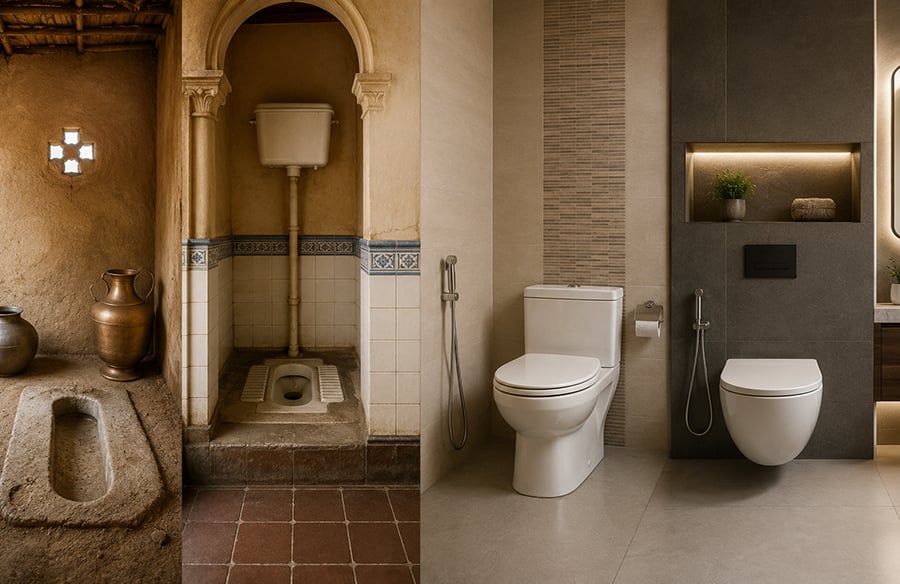
Indian bathrooms have changed significantly in the last two decades. A generation ago, the standard Indian toilet was a floor-level ceramic pan. Today, most urban homes feature western commodes, while wall-mounted commode options are becoming increasingly common in premium residential projects. Vivek, a retired professor in Chennai renovating his independent house, replaced the Indian toilet pans in two bathrooms with wall-mounted commodes. The improvement in comfort, especially for his knees, was immediate.
The Indian toilet: still relevant, still practical
The floor-level Indian toilet has not disappeared, and there are practical reasons for its continued use. It remains common in many Indian households and is still preferred in several new homes, especially in tier-2 and tier-3 cities.
Where it still works
- Homes where family members prefer squatting for cultural or personal reasons.
- Service bathrooms and utility toilets where a simple, durable fixture is sufficient.
- Rural and semi-urban homes with floor-level plumbing already in place.
Indian toilet pans are compact, use less water and generally have lower installation costs. For many households, keeping one Indian toilet in the home remains a practical choice.
The western commode: now the preferred choice
In most new urban apartments and villas, the western commode has become the standard bathroom fixture. Builder-installed two-piece models are commonly used as the starting option in budget and mid-range projects.
Why did the shift happen
- Ageing demographics: Seated toilets are easier for elderly family members, who may find squatting difficult.
- Lifestyle changes: Longer bathroom routines and the preference for seated comfort have increased demand for western commodes.
- Accessibility needs: People with knee, hip or back discomfort often find western toilets more convenient.
- Real estate trends: Premium residential projects increasingly include western commodes as a standard feature, shaping expectations across housing segments.
Wall-mounted commode: the next stage of bathroom design
The wall-mounted commode represents the latest evolution in toilet design. The bowl is fixed to the wall, the cistern is concealed inside the wall cavity, and the floor below remains completely open.
Why is it gaining popularity
Easier cleaning: With no base touching the floor, mopping becomes simpler, and dust does not collect around the commode.
Better space utilisation: In compact bathrooms, the floating design creates a lighter visual appearance and improves floor visibility.
Minimal design: Only the bowl and flush plate are visible, creating a clean, streamlined bathroom look.
Custom seat height: The seat height can be adjusted for user comfort, making it suitable for households with diverse needs.
Vivek selected wall-mounted commodes with a 450mm seat height for his renovated bathrooms. The additional height compared to standard models made standing and sitting more comfortable for him and his wife.
Choosing the right toilet for different bathrooms
A home with multiple bathrooms does not need the same fixture in every bathroom. The best approach is to select a toilet based on how each space is used.
| Bathroom | Suitable fixture |
| Master bathroom | Wall-mounted commode or one-piece western commode |
| Guest bathroom | Standard or one-piece western commode |
| Children’s bathroom | Standard height western commode |
| Service/utility bathroom | Indian toilet pan |
| The elderly use the bathroom | Wall-mounted commode with comfort height |
This approach worked well for Vivek’s home. The master and guest bathrooms now have wall-mounted commodes, while the utility bathroom behind the kitchen retains its original Indian toilet pan, which the household helper prefers.
Installation considerations for wall-mounted commodes
Wall-mounted commodes require planning before installation.
Wall strength: The support frame must be anchored securely to a suitable wall. Hollow block walls may require reinforcement.
Concealed cistern planning: The cistern frame is installed inside the wall or a false wall, so it should be planned before tiling work begins.
Plumbing route: Wall-mounted commodes generally use a P-trap connection through the wall. Existing S-trap plumbing may require modifications.
Maintenance access: The flush plate should remain accessible so internal components can be serviced without breaking the wall.
Common mistakes when switching to wall-mounted commodes
- Installing a wall-mounted commode without checking wall strength and support requirements.
- Selecting a commode before confirming the existing plumbing configuration.
- Setting the seat height too low when comfort height is the priority.
- Ignoring flush performance and choosing only based on appearance.
Choosing fixtures built for Indian conditions
Bathroom fixtures in India need to withstand frequent use, humidity and varying water conditions. High-fired vitreous china with durable glazing helps maintain the surface finish, while features such as anti-bacterial glazing support easier cleaning.
For example, brands like Simpolo Tiles & Bathware offer wall-mounted commode options with features such as rimless flushing, dual-flush systems, and antibacterial glazing. These designs combine practical hygiene benefits with durable ceramic construction suited for everyday use in Indian bathrooms.
Conclusion
Vivek’s home now has bathrooms designed around different users. The renovated spaces feature wall-mounted fixtures for improved comfort and easier maintenance, while the utility bathroom continues with a familiar Indian toilet pan.
Good bathroom planning is not about choosing one solution for every space. It is about selecting fixtures that match the needs, layout and usage of each bathroom.