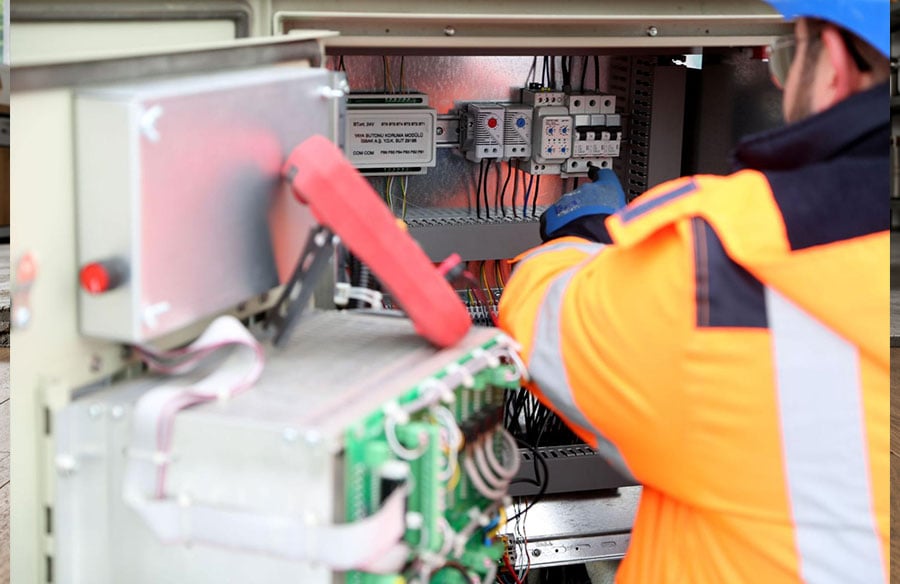
A lot of electrical failures in commercial buildings don’t announce themselves. A switchboard can run hot long before anyone notices, and by the time there’s a visible sign, such as a tripped breaker or a scorch mark, the fault has often been developing for some time already. That gap between when a problem starts and when it becomes obvious is where much of commercial electrical risk actually lives.
Electrical safety strategy is less about big infrastructure decisions and more about which maintenance approach actually catches problems early. Here’s how the main strategies stack up, and where each one fits.
Why Reactive Maintenance Costs More Than It Saves
Reactive maintenance means fixing equipment once it’s already failed. The bill for that approach tends to run higher than planned maintenance would have, once repair costs are added to the downtime a breakdown causes.
Visual inspections help, but they only catch what’s already visible. They miss the thing that actually precedes a lot of electrical failures, which is heat building up inside a connection or component long before it shows on the surface.
Preventive Maintenance: Scheduled Inspection as the Baseline
Preventive maintenance works on a calendar rather than a crisis: regular inspection, cleaning, and testing on a set schedule aimed at catching wear before it becomes a failure. Inspection frequency for commercial electrical systems in Australia is generally set by the building owner or facilities manager rather than a single fixed rule, often guided by insurer requirements and weighed against how heavily a site’s electrical system is used.
A service such as a Thermal Scanners electrical thermography inspection is built around exactly this: reading the heat signature of live equipment on a set schedule, picking up issues such as loose connections or overloaded circuits before they progress further. A clear line of sight to the components being scanned, panel covers off where needed, is one of the factors that makes a reading genuinely useful.
Condition-Based and Predictive Approaches
Beyond fixed schedules, more advanced strategies base maintenance timing on the equipment’s actual condition rather than the calendar. Condition-based maintenance triggers action once a monitored reading crosses a defined threshold, with an alert sent once it’s reached. Predictive approaches go further again, using accumulated data about a component’s history and operating conditions to estimate when it’s likely to need attention before it fails outright, rather than waiting for a fixed date or a threshold breach.
Thermal imaging can support either approach: because it measures a live, real-world signal rather than a scheduled guess, a reading can act as a condition-based trigger or as one input into a broader predictive program. The core metric is delta T, the temperature difference between a component and either a comparable component under similar load or the surrounding ambient air. A small, stable delta T is generally read as normal, and tracking it across successive inspections is one way facilities teams watch for a developing problem before it becomes urgent.
Access, Labelling and Documentation as Part of the Strategy
Access matters as much as detection. A board buried behind storage, or cabling routed somewhere hard to reach, makes any future inspection more difficult to carry out properly.
Accurate circuit identification matters just as much. On a complex commercial site, tracing which breaker actually feeds which outlet or fixture typically means working from the panel schedule and riser diagrams first, then confirming physically, circuit by circuit, before any isolation or repair work begins. That confirmation step helps prevent the wrong circuit being worked on.
Reading the Signs Before They Become Failures
A common root cause behind electrical faults is resistance. As a connection loosens or a component degrades, resistance rises and heat follows, often well before it shows up as any visible symptom. Loose connections and failing components are a well-documented cause of the hot spots that show up clearly in a thermal image.
Load isn’t constant either. Demand peaks, whenever they occur for a given site, put connections and components under greater strain, which is also when a delta T reading is measured against a real, active load rather than an idle system.
Documentation and Compliance as an Ongoing Strategy
An inspection is only as useful as the record it leaves behind. Under Australian Work Health and Safety law, duty holders are required to take reasonably practicable steps to identify and manage hazards before they escalate. A documented inspection history is a practical way of demonstrating that this kind of hazard identification is actually happening, not just assumed. Overseas, a similar expectation has already hardened into a firm rule in some respects: the US NFPA 70B standard moved in 2023 from a recommended practice to a mandatory one, now requiring documented delta T readings performed by qualified personnel as part of any electrical maintenance program.
A defensible position isn’t built from a single inspection. It’s built from a consistent record: asset identification, load conditions at the time of scanning, and clear documentation of anomalies and their resolution.
Building the Habit, Not Just the Checklist
None of these strategies work in isolation. Access without a schedule means faults still go unnoticed. A schedule without documentation leaves nothing to show for it when it matters. The buildings that manage electrical risk well tend to treat inspection as a recurring part of how the building operates, layering preventive, condition-based, and documentation practices together rather than relying on any one of them alone.