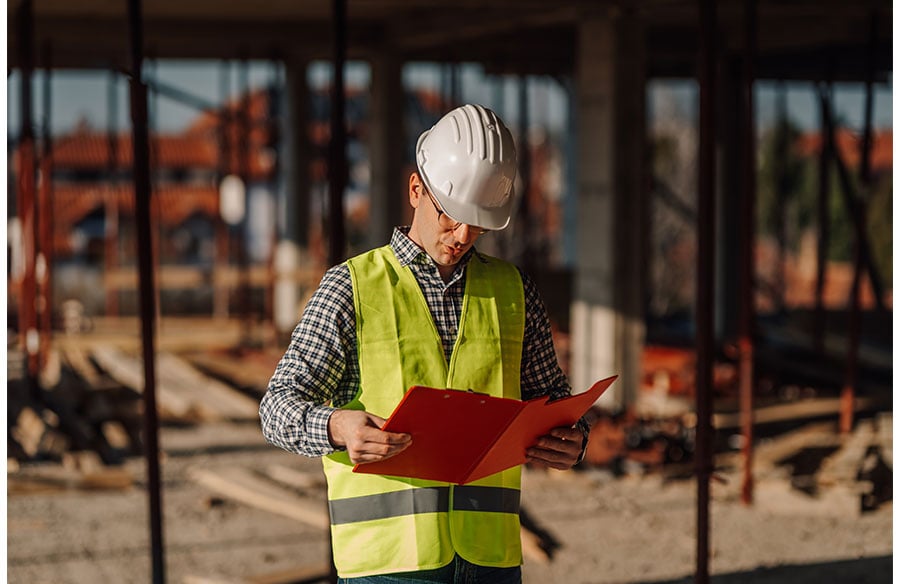
Imagine the following situation: a worker is walking through the construction site looking for a tool. Stepping on a pile of rubble, he injures his foot on a nail, loses his balance, and falls, hitting his head – an accident that will keep him off work for several days due to his injuries.
Unfortunately, scenes like this are common behind the construction barriers. But, at the same time, they are a real lesson in improving safety on construction sites and reducing accidents.
First, the debris shouldn’t have been there. The second lesson is: where was the worker’s protective equipment, such as a helmet and safety shoes? And the third, was he aware of the importance of using them?
As you can see, just as important as designing, budgeting, and planning the construction of a project is taking care of the physical integrity of all professionals who will be working on it and ensuring safety on the construction site – according to the latest Statistical Yearbook of Social Security, the construction industry is the fifth economic sector with the highest number of accidents and the second most lethal for workers.
To avoid statistics like these, it’s necessary to create a workplace safety plan even before construction begins. In this post, you’ll find items you can’t leave out of this plan. Check it out:
Tip #1: The planning itself
Projects, schedules, budgets, and other management tools are essential for monitoring construction daily reports and ensuring the physical integrity and safety of all professionals working at each stage; workplace safety planning is therefore essential. To this end, each project must first undergo a risk assessment so the construction company, in partnership with field specialists, can develop a prevention strategy best suited to the specific situation.
Tip #2: Proper use of appropriate protective equipment.
According to the National Confederation of Workers in the Construction and Furniture Industry (Contricom), the high number of workplace accidents in the sector is mainly related to the lack of use of Personal Protective Equipment (PPE) and Collective Protective Equipment (CPE). Hence, it is important for construction companies to provide devices appropriate to the risk of each activity, require their use and be attentive to replacements and maintenance.
Tip #3: Compliance with safety regulations
Did you know that there is a Regulatory Standard that requires the use of PPE (Personal Protective Equipment) on construction sites? In addition, there are many other safety standards that construction companies must comply with to ensure safer conditions and avoid fines.
Tip #4: Raise awareness, train, and monitor.
The reasons why a worker might not exhibit safe behaviour can be numerous, including a lack of awareness of the risks involved in their work. This is why awareness campaigns should be conducted regularly to highlight hazards, and training should be provided to guide workers on the proper use of equipment and prepare for critical situations that may arise. Furthermore, the construction site should be constantly monitored to encourage the adoption of safe practices.
Tip #5: Cleaning and organization
Another very important guideline that should be addressed in campaigns and training sessions is the cleanliness and organization of the construction site. Debris, tools, bricks, sand, planks, and other objects cannot be left scattered on the ground for a simple reason: to avoid situations like the one mentioned at the beginning of this post. Therefore, whenever necessary, these materials should be collected to avoid obstructing passage and prevent accidents.
Tip #6: Support from subject matter experts
Because safety isn’t the primary focus, it might be difficult for a construction company to define the most appropriate protective equipment, instruct and supervise teams, and even create a construction site layout more conducive to cleanliness and organization. Therefore, rely on construction safety technicians specializing in civil construction to develop your project to improve safety on the construction site with excellence!
Tip #7: Preventive maintenance
One extremely important benefit of performing preventive maintenance on construction equipment is worker safety, as it allows workers to utilize all the equipment’s features without worrying about accidents due to malfunctions. Therefore, it’s worthwhile to develop a preventive maintenance plan for all machines and equipment owned by the construction company to keep them in perfect working order.
Tip #8: Rely on technology
Implementing an excellent workplace safety project requires organization from the construction company to ensure deadlines are met and actions are properly monitored. A specialized technological solution for the construction industry is the perfect ally for this mission, as it helps monitor worker health, control protective equipment, and record and integrate data from regulartory standard documents – among many other functionalities!
Bonus Tip: Explore technology solutions
The occupational safety technician has civil and criminal liability for everything that happens on the construction site in terms of accidents and occupational diseases. That’s why it’s so important to document all procedures in reports. This is where technology plays a crucial role. Good specialized software can keep labor and technical documents under control and facilitate resource management. Other tasks can also be optimized, such as the delivery and return of PPE, the organization of work checklists, and follow-up actions, training, and capacity building.
For occupational safety management, as in other areas, the introduction of this type of technology directly impacts the company’s financial management, reducing losses and ensuring greater cohesion in preventive actions. The use of software also allows for the analysis of goals and the standardization of processes, such as the adoption of training routines and the measurement of results. It is also possible to allocate content and offer integrated distance learning training, sectorized and available 24/7.
Another excellent benefit is the integration of databases. Occupational safety management and Human Resources, for example, can share information useful to both sectors. What should not be shared remains inaccessible. With modules that manage various levels of permissions, the software allows restricting access to strategic information and confidential reports only to those who should have knowledge of this type of data. Technology that simplifies processes also contributes to occupational safety being perceived as a more professional area, where improvisation is not acceptable.