In October, Milan hosted the 75th International Astronautical Congress (IAC), organised by the International Astronautical Federation (IAF). From the 14th to the 18th of October, the event brought together over 11,000 space specialists from 120 countries, breaking records in attendance. Following the IAC, the 6th Space Architecture Symposium took place on Saturday, 19th October, at Politecnico di Milano, organised by the AIAA Space Architecture Technical Committee, breaking another attendance record.
And as space architecture gains more interest — following the advancements in construction methods, design methods for extreme environments, and even dedicated educational programs — this year’s congress and symposium were especially important as it underscored the discipline’s growing role in designing for outer space.

IAC 2024: Highlights
The IAC is an annual event held in different locations worldwide, serving as a platform for private professionals and space agencies to showcase the latest research and advancements in the space industry. This year’s edition focused on “Responsible Space for Sustainability”, promoting inclusivity and diversity in the global space sector. With over 7,200 abstracts submitted from 106 countries, 1,800 were presented. The event featured a record-breaking 530 exhibitors, showcasing cutting-edge technologies and interactive displays.
A major highlight was the opening IAF Global Space Leaders Summit, which brought together 60 heads of space agencies and organisations. This meeting facilitated high-level discussions on space cooperation, governance, and sustainability, breaking yet another record as it was the largest gathering of leaders from established and emerging space nations to date.

Research and Architecture for Space
The IAC 2024 was packed with an agenda featuring various panel discussions and technical sessions covering a wide range of topics, from space systems, communications, and the economy to habitability, manufacturing, and design. While space agencies and private companies showcased their products and advancements, architects, researchers, and designers gathered to discuss habitability, presenting concept designs and life-supporting systems, addressing key issues such as human health, comfort and well-being.

On Monday, there was a technical session dedicated specifically to Space Architecture, which featured research and design proposals for habitats, habitability, and bases. Throughout the congress, there were other sessions related to space architecture that covered a wide range of other topics such as resources and in-space manufacturing; space structures and materials for extreme environments; bioreactors and biological systems; as well as various crop production systems and analogues – among others.
Particular emphasis was placed on designing for human well-being in space. Some researchers focused on medical care for humans in space, while others tackled subjects like life support systems and crop production for long-term sustainability. These discussions underscored the critical intersection of technology, sustainability, and design needed for future space habitats. Other researchers presented their design proposals, featuring various types of extraterrestrial habitats as well as methods addressing human health. Presentations also included models for base planning, infrastructure and construction strategies, while others focused on the potential of using lunar pits and lava tubes, outlining the necessary steps to establish a successful base in such environments. Additionally, new software for the AEC (Architecture, Engineering and Construction) industry was presented, which generates lava tube models based on the data, providing an invaluable tool for space architects and scientists allowing further research.
Meanwhile, Interactive Presentations (IP) were happening on 80 interactive screens in the main IP room, where more of the accepted abstracts were presented daily, showcasing various research fields.

Product Design for Space
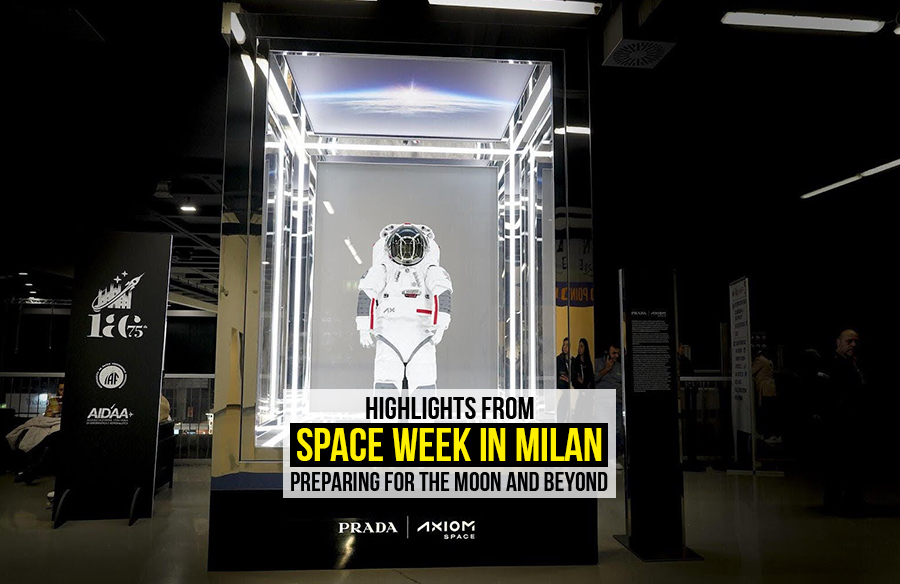
On Wednesday, a spacesuit design resulting from a collaboration between Axiom Space and Prada was unveiled. Designed for the Artemis III mission, this spacesuit incorporates advanced materials and enhances mobility. The involvement of Prada demonstrates that the space industry opens opportunities for disciplines beyond traditional products and architecture, welcoming innovative contributions from fields like fashion.
The exhibition also showcased other products, including an adjustable, inflatable, cloud-like duvet. This sleeping system by VAST is a pending patent designed for comfort and support in zero gravity.


Space Architecture Symposium: Highlights
A day after the IAC, the 6th Space Architecture Symposium brought together a group of experts involved with, or interested in Space Architecture, to delve into the challenges and opportunities within the field. Participants engaged in discussions and working sessions that explored the meanings and futures of roles such as explorers, workers, visitors, and settlers, as well as the employment and education pathways.
The symposium also covered the role and results of the Decadal Survey of Space 2025-2034, which outlines research priorities for the coming decade. As interest in space exploration and space architecture grows, the discussions highlighted the importance of designing for psychological comfort, safety, and sustainability in extraterrestrial environments.
During breaks, participants explored a student poster exhibit featuring diverse habitat proposals that showcased innovative approaches to extraterrestrial living and underscored the symposium’s commitment to forward-thinking solutions.

Space Architecture: preparing for the Moon and beyond
As humanity prepares for the return to the Moon through programs like Artemis, discussions around how humans will live and thrive in space are increasingly important. The Artemis mission will test the advancements and possibilities on the Moon that will enable future exploration of Mars and beyond. In this context, space architecture emerges as a cornerstone for success, translating visionary concepts into real solutions. As new collaborations and technological advances propel us toward this next frontier, space architecture will play a crucial role in establishing sustainable habitats and ensuring human comfort and well-being in extraterrestrial environments.