Introduction
The case histories of industry sectors prove that over 60% of custom architectural metal projects – staircases, curtain wall nodes, art installations, furniture frames – are suffering from unplanned on-site reworking mainly because of tolerance drift. Due to such reworking the cost goes way beyond double the planned cost. These traditional methods of saw cutting + manual welding + field adjustment cannot maintain an assembly accuracy of ±0.1 mm for unusual joints, multislot assemblies, or hidden-connector systems.
Only when a prototype is scrap do some team realize they had selected a process incompatible with materials and that was a mistake. In this article, we will see how precision cnc milling offers a safe base for the production of complex metals by matching the design intent and material choice with the production process, determining the quality through tolerances, selecting the suitable surface finish.
Why Do Custom Architectural Metal Components Require High-Precision CNC Milling?
Metal architectural components are being produced with such highly geometric features that the use of folding and bench-fitting no longer keeps up within the tolerance limits specified for such fabrication processes. Two completely different component types have resulted, and only one is able to function smoothly without undergoing some changes.
Challenges of Complex Joints in Architectural Fabrication
Project archives indicate a ~35% year-over-year increase in custom staircases, perforated art screens, and curtain wall finishing parts tagged as fabricated via CNC workflows. Key drivers include:
- Manually assembled parts with irregular moldings and snap-fit hidden connectors are more prone to error accumulation.
- Pre-drilled hole arrays that require positional repeatability in more than ±0.1 mm.
- Multi-face splice nodes, spiral center tubes and seat hinge-embeddings, all these parts require forming other than bending.
Expanding cnc milling applications inside the fabrication pipelines have changed the alignment of design manufacture from an early option to a mandatory one, In particular in locations where either a marine environment or a high safety level leaves a zero chance for on site adjustment.
What Precision CNC Milling Delivers That Laser Cutting Cannot
Precision CNC milling is a multi-axis subtractive process using rotating cutters to reproduce 3D geometries via CAD/CAM toolpaths—distinct from laser’s 2D-contour limit.
Its advantages include:
- Single setup for machining deep cavities, undercuts, and threaded features.
- Repeatability 0.025 mm. Accuracy with probe compensation.
- No secondary bench work for hole drilling or tapping.
The tender documents should have three things locked in before their release i.e. The assembly datums, the critical dimension chains, and the surface – continuity rules for the spliced interfaces. Getting these right at the drawing stage will eliminate most of the rework on the complex nodes.
What Are the Tolerance Ranges for CNC Milling, and How Should Design Teams Specify Requirements?
Tolerance is not a single number but a graded system shaped by axis-count, probe compensation, material springback, and feature geometry. Specifying blindly either inflates cost or guarantees site failure.
Industry Baseline Tolerances and Material Influence
Mechanical 3-axis machines are accurate with a steady-state of 0.1 mm. 4-axis machine tools with probe compensation can reach 0.025-0.05 mm precision on stable parts. Each material dictates the lower limit, e.g. 6061 aluminum remains dimensionally stable, 316 stainless high spring-back, brass moderate, whereas all deep cavities thin walls or slender rods can not be accurately predicted by general rules and must be individually evaluated.
Recommended grading for architectural specs:
- Non-mating faces: ±0.2–0.3 mm
- Positioning hole arrays: ±0.05 mm
- Assembly interference faces: 0.1 mm/side reserve for final finish
Understanding cnc milling tolerances at this granular level prevents both over-spec cost spikes and under-spec rework.
Certification Benchmarks for Selecting High Precision Milling Vendors
Workshops consistently holding ±0.05 mm usually carry ISO 9001; aerospace-grade components call for AS9100D, automotive IATF 16949. These four certifications act as pre-filter for high precision milling vendors. The advantages of cnc milling—rigidity, deep-cavity reach, drill/pocket/contour in one setup—directly reduce bench labour and cumulative drift.
In the selection of precision mill providers, the alignment of tolerance grades at the beginning will help narrow down the supplier list and the estimate of manufacturing cost. ISO (International Organization for Standardization) standards as well as ASME (American Society of Mechanical Engineers) standards have been the main standards referred to in this assessment.
How Does Single Setup Versus Multiple Flipping Affect Project Cost?
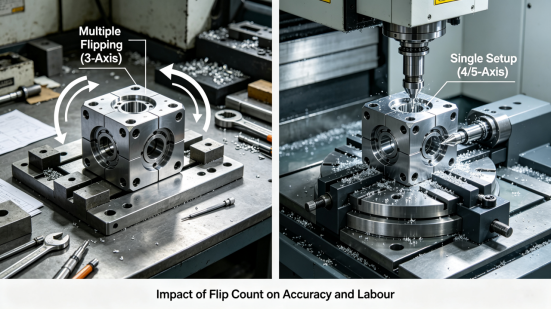
Setting up a strategy is generally the low-cost aspect of the process that few people are interested in. There is a big price gap between three-axis and four-axis machine parts, even though they both take one setup only.
Six-face nodes on 3-axis need three re-flips; each time, re-indicating and adding to bench time and error. Four- or five-axis in one setup finishes: the machine part is more costly but total cost is lower, in particular for the 1-20 piece batches that form the main body of most custom architectural orders.
The full cnc milling process chain is: programming blankprep rough pocket semi-finish finish mill deburr surface (brush/anodize/blast/PVD) CMM. Showing this to customers will help them understand why programming accounts for 10, 15% of a low-volume quote.
How Does Material Selection Affect CNC Milling Results and Cost?
Four metals dominate architectural custom work, each carrying a different milling signature and cost curve.
- Aluminum 6061-T6 – stable, anodizes clean, indoor/outdoor versatile.
- 304/316 stainless – coastal choice, but work-hardening spikes tool wear; cost fluctuates with alloy batch.
- Brass C260 – warm tone for high-end furniture/bars, raw material 2–3× aluminum.
- Bronze – art-installation grade, densest, costliest.
Coastal curtain-wall nodes are advised to replace brass with 316 stainless; However, bronze is an option for indoor screens seeking for a patina. The strength of custom cnc milling lies in toolpath transferability across materials – the artists change the material without having to redo it all.
ISO 14001 certified shops which practice chip recycling and coolant recycling would be preferred as partners. Material choice dictates what high precision milling can physically hold.
What Should Design and Manufacturing Teams Align Before Order Placement to Ensure Zero Rework?
Most changes originate from unconscious assumptions in the initial stages – numbers left out, quantity unclear, and quality not explained. A good pre-bid questionnaire will identify the areas where you need more detailed answers.
- Mark critical dimension chains; relax non-critical faces.
- Specify assembly datum planes; never let the mill guess.
- Define surface continuity—will welded/spliced interfaces follow milling, and is allowance reserved?
- State batch size (1 proto / 5 pcs / 50+); 50+ justifies 4-axis + fixture to drop unit cost.
- Lock inspection scope—CMM report, material cert, RoHS.
End-to-end precision milling services are not restricted to the working hours, and it ranges from the drawing checks till the ultimate visual examination. Fixing to tolerance levels plus using precision cnc milling at tender stage eliminate well over half of all rework causes.
Conclusion
The construction of metal structures through architecture is changing its method – away from the cutting of metal sheets + fixing at site to the digital way of work centered in precision cnc milling. When the three main things of design teams are coordinated – tolerance grading, material selection and assembly datum – they are able to get rid of reworks and hidden costs. If you want to have advice on process splits at the drawing level and quotations for specific customized nodes contact LS Manufacturing.
FAQs
Q1: How much milling allowance should be reserved for on-site finishing of custom architectural metal parts?
A: A milling allowance of 0.1 mm/side for faces involved in the interface of the parts is sufficient but non-critical faces can mill straight to tolerance. If you over-reserve the allowance, site sanding will break the original surface-treatment colour match, adding repair cost instead of saving it.
Q2: What drives the unit-price gap between CNC milling aluminum vs. bronze?
A: Apart from the raw material cost difference (3-5x), the density of bronze increases tool wear and forces slower feeds, thereby machine-hour and tool-change costs go up. You can compare quotes by making separate line items for the material and machining fees.
Q3: Is 5-axis justified for 5–10 piece small-batch irregular nodes?
A: Feature complexity is the major deciding factor. Three or more holes or curves on a face will make 5-axis a single setup work better than a flipping 3-axis, total cost usually lower despite the higher hourly rate. 2.5D-only features can’t justify it.
Q4: What do ISO 9001 and AS9100D mean for an architectural project?
A: Most building works will be covered with traceability from the tolerance system that ISO 9001 brings. AS9100D-certified shops will be an advantage if your airport or landmark projects are under audit. IATF 16949 belongs to the automotive supply.
Q5: Can CNC-milled surfaces go straight outdoors on a curtain wall?
A: Post-mill anodizing or PVD coating of aluminum is necessary for outdoors; passivate 316 stainless before installation or tool marks may yellow. Surface treatment should be clearly laid down in the tender document.
Leila Wu
Leila Wu, CNC process lead at LS Manufacturing, with 10+ years managing 3/4/5-axis milling lines, responsible long-term for process splitting and tolerance review across architectural metal components, high-end furniture hardware, and automotive/aerospace precision parts.