The Hidden Waste Problem in Exhibition Design
Trade shows are often described as temporary cities. For a few days, venues across the world are transformed into dense landscapes of temporary exhibition architecture designed to represent brands, attract visitors and communicate key messages.
But once the show closes, much of this temporary architecture disappears as quickly as it was constructed.
Behind the spectacle lies a long-standing industry practice often referred to as the “build-and-burn” approach to exhibition construction. Stands are designed, manufactured and installed for a single event, only to be dismantled and discarded days later. Materials such as timber, MDF, paint, laminates and foam PVC are commonly used in traditional stand builds. While visually effective, these materials are typically fabricated for a specific design and footprint, making them difficult to reuse once the exhibition ends.
Many of these materials are also bulky and inefficient to transport, and are often custom-cut or finished for a particular stand design. This makes storing or adapting them for future events impractical, meaning large portions of exhibition structures are disposed of immediately after the show closes.
This model creates several sustainability challenges for the exhibition industry, including:
- Waste generation from dismantled stand structures
• Carbon footprint associated with repeated manufacturing and transport
• Repeated rebuild costs for exhibitors attending multiple events
The impact becomes even more significant when considering the cyclical nature of exhibitions. Many companies participate in the same trade shows year after year, meaning the process of designing, building and dismantling stands is repeated continuously.
As sustainability expectations rise, organisers, venues and exhibitors are increasingly questioning whether stand design should continue to follow a linear cycle of build, use and discard, particularly when companies exhibit across multiple events each year.
Unlike traditional timber or MDF builds designed for single use, modular exhibition stands are engineered for repeated deployment across multiple events, significantly reducing material waste from the outset. Their structural frameworks remain consistent while graphics, layouts and features can be adapted to suit different exhibition footprints.
This approach also supports sustainable scalability, allowing brands to expand or refine their exhibition presence over time without rebuilding entire structures for every event.
As a result, the industry is gradually shifting toward reusable exhibition stand infrastructure built on modular design principles and circular construction methods.
What Are Modular Reusable Exhibition Stands?
Modular reusable exhibition stands represent a fundamental shift away from the traditional “build-and-burn” model of exhibition construction. Rather than creating bespoke structures for a single event, modular systems are designed as adaptable frameworks that can be assembled, dismantled and reconfigured across multiple exhibitions.
Importantly, modular infrastructure does not limit design expression. Reusable structural frameworks can support bespoke architectural elements such as custom joinery, feature lighting, product displays or branded installations. This creates a hybrid approach to exhibition architecture, where a reusable structural system forms the foundation of the stand while smaller bespoke elements provide visual individuality. Compared with fully fabricated custom builds, this hybrid approach significantly reduces the amount of new material required for each exhibition.
In practical terms, a modular exhibition stand is built from a kit-of-parts system, typically consisting of lightweight aluminium frames, interchangeable wall panels, integrated lighting systems and replaceable graphics. Because the structural elements remain consistent, the same system can be reconfigured to suit different stand footprints, spatial layouts and exhibition formats.
Many exhibitors are now adopting modular reusable exhibition stands as a way to reduce waste while maintaining the flexibility required to participate in multiple events throughout the year. Instead of constructing new stands for each exhibition, companies can reuse the same structural framework while updating graphics and layout elements to suit different environments.
Modular systems are also designed with transport and storage in mind. Components can be packed efficiently into wheeled transport flightcases, reducing both logistical complexity and the environmental impact associated with moving large stand structures between venues.
Modular Design in Practice
The adaptability of modular systems becomes particularly clear when a single structural kit is used across multiple exhibition formats.
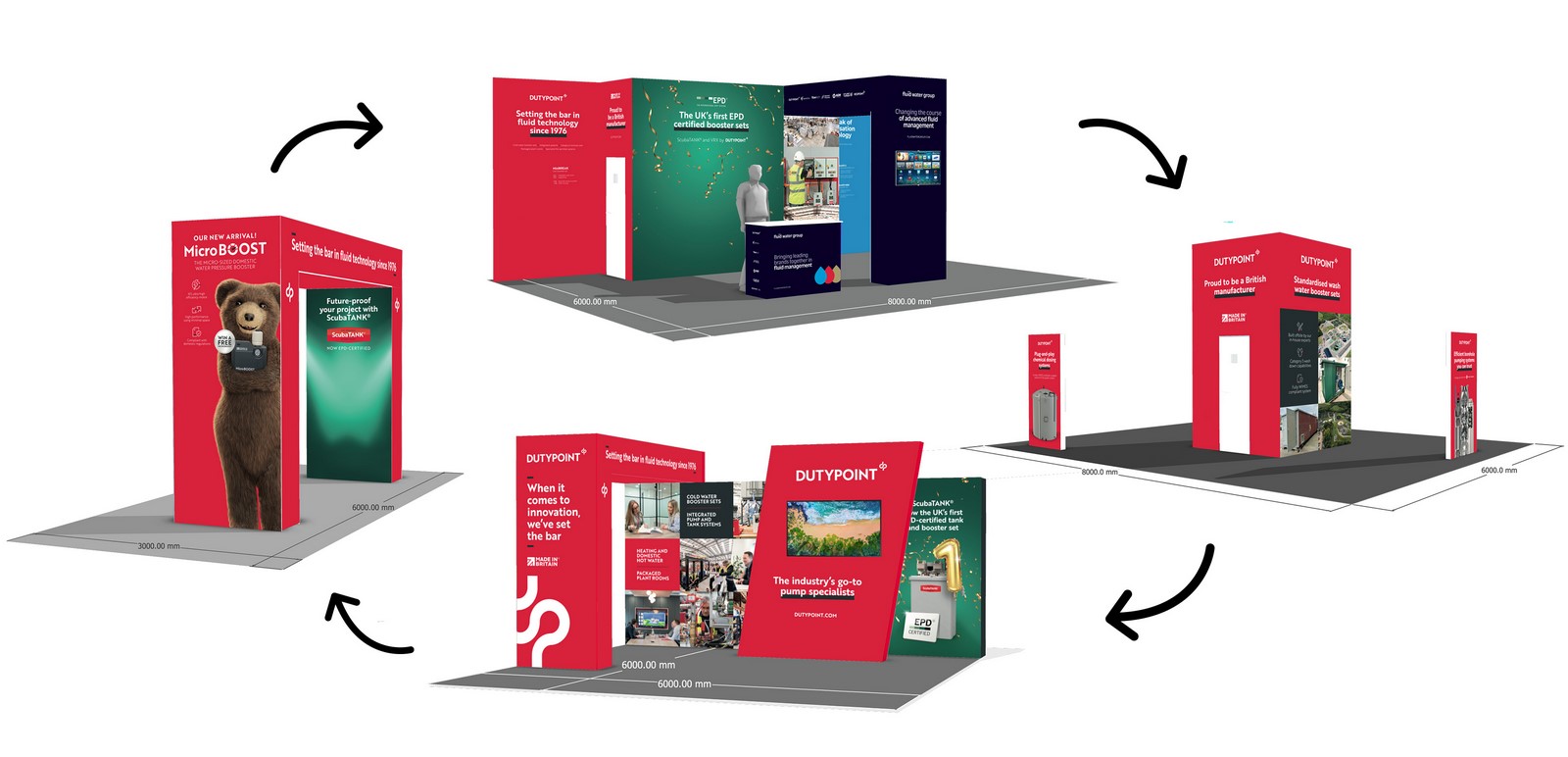
In this example, the same modular stand system is adapted into several distinct exhibition layouts, ranging from compact configurations to larger exhibition environments. Each version uses the same structural components while adjusting wall placement, display elements and graphics to suit different stand footprints.
This ability to evolve without rebuilding from scratch is what distinguishes modular systems from traditional exhibition stand construction. Instead of producing new structures for every event, exhibitors can develop a flexible stand infrastructure that adapts over time.
Across multiple exhibitions, this approach reduces material waste while allowing companies to scale their exhibition presence as their marketing strategy evolves.
Circular Design Principles in Exhibition Architecture
The growing adoption of modular exhibition stands reflects a broader shift toward circular design thinking within the built environment. Rather than treating exhibition structures as short-lived installations, modular systems apply principles increasingly shaping sustainable architecture: designing components to remain in use for as long as possible while minimising waste and material consumption.
At the core of this approach is design for disassembly. Instead of producing bespoke elements that are discarded after a single event, modular exhibition systems rely on durable structural components that can be assembled, dismantled and reconfigured repeatedly without damaging the core framework.
Several circular design principles underpin this approach:
Design for disassembly ensures stand components can be installed and removed without destructive processes such as cutting, painting or permanent fixing, allowing structures to remain reusable across multiple events.
Material longevity is achieved through durable systems such as aluminium frameworks and reusable graphic solutions, extending the lifecycle of exhibition infrastructure beyond a single installation.
Transport efficiency is another important factor. Modular systems are designed to pack efficiently into wheeled flightcases, reducing both shipping volume and the environmental impact associated with transporting structures between venues.
Adaptability and scalability allow exhibitors to expand or reconfigure stand layouts over time without commissioning entirely new builds.
Across the events industry, the environmental impact of temporary exhibition construction is becoming increasingly visible. The global trade show sector is estimated to generate over 600,000 tonnes of waste annually, with much of it linked to short-life stand materials and temporary installations.
Industry initiatives such as the Better Stands initiative are helping accelerate the transition toward reusable exhibition infrastructure by encouraging organisers, suppliers and exhibitors to move away from disposable stand construction.
The Financial and Operational Advantages of Reusable Exhibition Stands
While sustainability has become an important consideration in exhibition design, practical operational factors are also driving the adoption of reusable stand systems.
For many organisations, exhibiting is not a one-off activity but an ongoing marketing strategy. Companies often participate in several trade shows each year, frequently across different venues, stand sizes and exhibition formats. Under traditional stand construction models, this typically means designing and manufacturing new stand architecture for each event.
Modular exhibition systems change this dynamic by introducing a reusable structural framework that can be deployed across multiple exhibitions. In this sense, modular stands introduce a lifecycle approach more commonly associated with permanent architecture, where structural frameworks support multiple spatial configurations over time rather than being replaced after a single use.
Instead of rebuilding for each event, exhibitors can retain the same structural infrastructure while updating graphics, layouts and display elements to suit different venues.
This approach provides several operational advantages:
- Reduced rebuild costs across multiple exhibitions
- Longer lifecycle for stand infrastructure
- Faster installation and dismantling times
- Simplified storage and transport logistics
As a result, reusable systems allow companies to scale their exhibition presence more efficiently while maintaining a consistent architectural identity across events.
In addition to ownership models, reusable exhibition infrastructure is also increasingly being delivered through stand hire and shared resource models.
Stand Hire and Shared Exhibition Infrastructure
While some organisations invest in owning reusable stand systems, an increasing number of exhibitors are adopting exhibition stand hire models as a practical alternative. This approach allows companies to access modular exhibition infrastructure without the need to purchase, store or manage permanent stand structures.
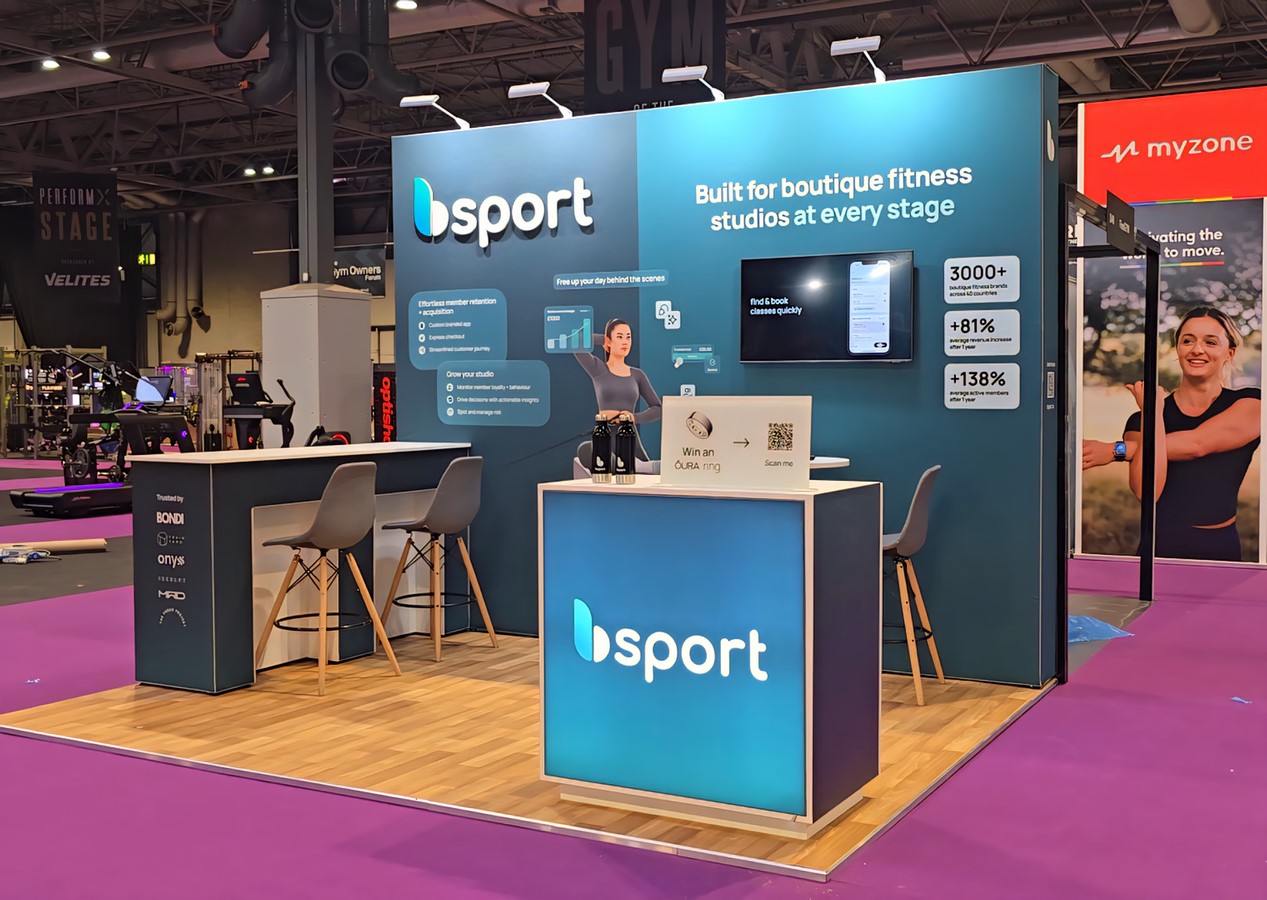
From an operational perspective, stand hire reflects a broader shift toward shared infrastructure within the events industry. Instead of producing new exhibition structures for each event, modular systems can be deployed across multiple exhibitors and exhibitions throughout the year, increasing the utilisation of the same physical framework.
For many businesses, particularly those exhibiting occasionally or across varying stand sizes, this model provides flexibility without long-term capital investment. Exhibitors can scale their stand layouts to suit different venues while still benefiting from reusable structural systems.
Importantly, reusable infrastructure does not prevent design individuality. Modular frameworks can support bespoke architectural elements such as custom joinery, feature lighting, product displays or branded structures, allowing each exhibition stand to retain a distinctive identity while the core infrastructure remains reusable.
By combining modular design with shared infrastructure models such as exhibition stand hire, the industry is gradually moving toward more efficient exhibition environments where reusable structural systems form the foundation of temporary event architecture.
The Future of Sustainable Exhibition Design
As expectations around sustainability continue to evolve, the exhibition industry is beginning to rethink how temporary environments are designed, constructed and reused. Modular stand systems offer a practical pathway toward reducing material waste while supporting flexible, design-led exhibition spaces. By combining reusable infrastructure with adaptable architectural elements, exhibition design can begin to align more closely with the broader principles of circular construction.
FAQs: Reusable Exhibition Stands
Are modular exhibition stands more cost-effective than custom builds?
Over multiple events, modular exhibition stands are typically more cost-effective. Instead of designing and manufacturing new stand architecture for each exhibition, the same structural framework can be reused and reconfigured to suit different floorplans and layouts, while graphics can be refreshed. This reduces rebuild costs and improves long-term return on investment.
Do modular stands limit design creativity?
No. Modern modular systems support a hybrid approach, combining reusable structural frameworks with bespoke elements such as custom joinery, lighting and branded features. This allows each stand to retain a unique visual identity while reducing the need for fully fabricated builds.
How many times can a modular exhibition stand be reused?
Modular systems are designed for repeated use across multiple exhibitions. With proper maintenance and storage, structural components can be deployed across many events, with only graphics or specific elements updated as needed.
Are modular exhibition stands suitable for different stand sizes and layouts?
Yes. Modular systems are designed to be reconfigured across different exhibition footprints. The same structural kit can be adapted to suit varying stand sizes, layouts and venue requirements.
What makes modular exhibition stands more sustainable?
Modular stands reduce waste by reusing structural components across multiple events. This avoids the need for single-use materials commonly associated with traditional stand builds and reduces the environmental impact of manufacturing and transport.
Is exhibition stand hire better than owning a modular stand?
It depends on how frequently a company exhibits. Stand hire offers flexibility without upfront investment or storage requirements, while ownership can provide greater long-term value for businesses exhibiting regularly.
Aly Hirjani
Project Manager
Aly Hirjani is a Project Manager specialising in reusable modular exhibition stand infrastructure. With over five years of experience designing exhibition stands for multi-show deployment, he focuses on sustainable scalability and architectural individuality for brands exhibiting at trade shows.