Most people judge a home’s exterior in daylight: the paint, the roofline, the front door. Yet from dusk to dawn, which can mean more than half the day in winter, the facade people see is the one your lighting creates.
Outdoor lighting decides which features stand out after dark, how materials read, how safe the approach feels and how the house sits among its neighbors. Done well, it adds depth and value; done poorly, it flattens good architecture into a glaring wall.
Outdoor Lighting Redefines Curb Appeal After Dark
Curb appeal does not switch off at sunset; it passes from the sun to your fixtures. In the National Association of Realtors’ 2023 Remodeling Impact Report on outdoor features, 92% of Realtors advised sellers to improve curb appeal before listing, and homeowners gave landscape lighting a perfect Joy Score of 10. In an American Home Shield survey, 30% of buyers named outdoor lighting among the exterior features that appealed to them most.
Fixture Scale Sets the Proportions
Wall lanterns are part of the architecture, day and night. From the street, roughly 50 feet away, a lantern is judged against the whole facade, so one that looks large in the store often looks small on the house. That is why undersized fixtures are a common mistake.
As a rule, a single lantern beside the door should be about one-third of the door’s height, and each of a matched pair about one-quarter. For a standard 80-inch door, that means one lantern near 26 inches or two around 20 inches, centered about 66 inches above the threshold.
Size is only half of choosing a lantern, though. The other half is whether it can handle the weather where it hangs.
Weather Resistance Keeps the Exterior Looking Its Best
Outdoor fixtures face rain, dust, sun and frost all year, and a failing one drags down the whole exterior. Moisture inside the housing fogs the glass, corroding metal can streak pale walls, and a flickering lamp makes even fresh paint look neglected.
The Ingress Protection (IP) code rates how well a fixture keeps out dust and water. For wall lanterns, the choice between an IP44 and IP65 lights comes down to where the fixture hangs. IP44 keeps out objects larger than 1 mm and resists splashing water, so it suits lanterns on covered porches and walls under deep eaves. IP65 is dust-tight and withstands low-pressure water jets, making it the safer choice for lanterns on open walls that take direct rain, as well as path lights and driveway fixtures. Neither rating is meant for submersion.
An IP rating covers sealing only, so also pick finishes, such as powder-coated metal or solid copper, that resist humid or coastal air. On exposed coastal walls, where salt spray and driving rain are routine, IP66 or higher is the safer rating. The lamp matters too: LEDs, which the U.S. Department of Energy says use at least 75% less energy than incandescent bulbs and last up to 25 times longer, mean fewer burned-out lamps and lower running costs.
Light Changes How Exterior Materials Look
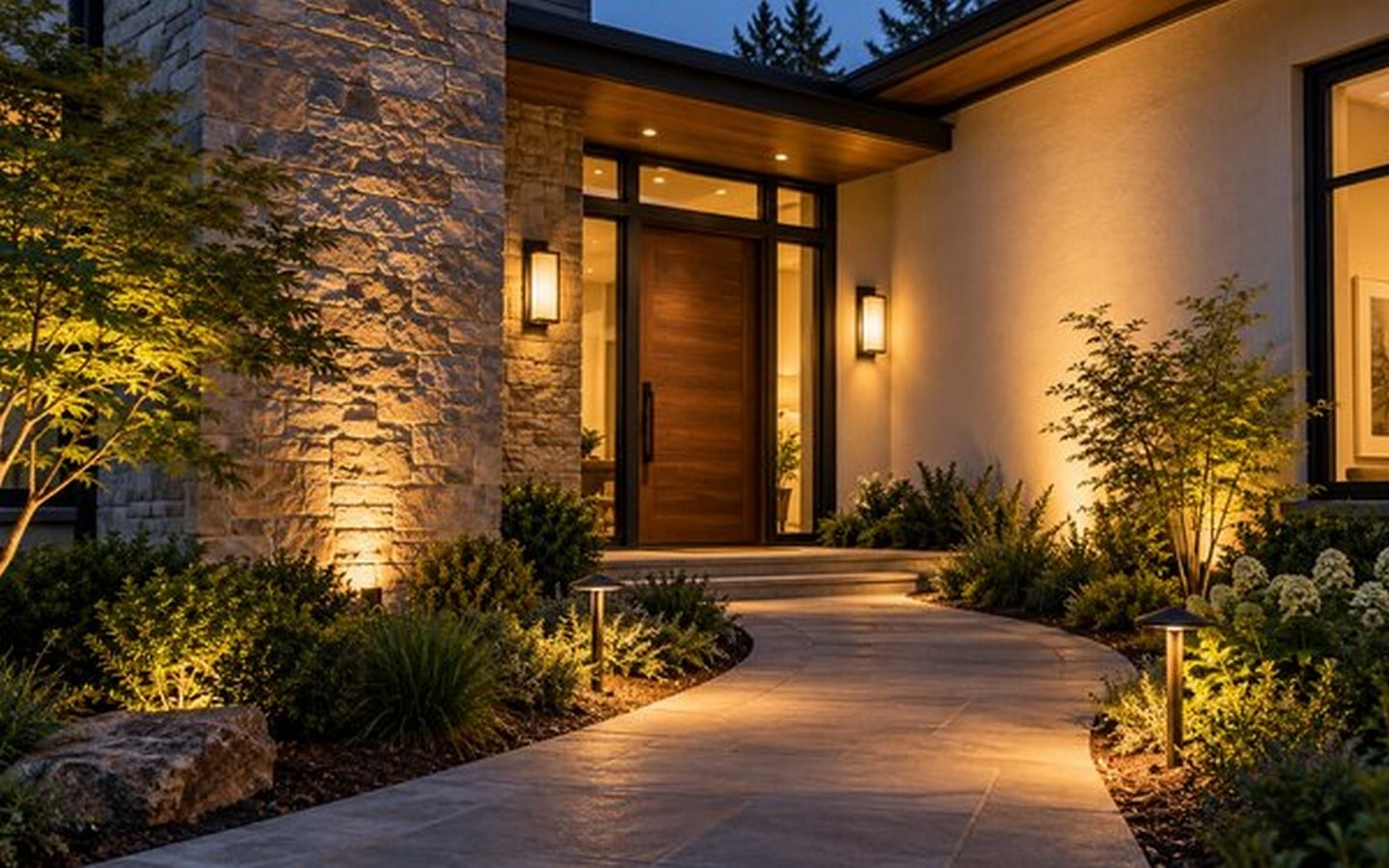 Each material reacts differently to light, so beam angle and color matter as much as brightness.
Grazing vs. Washing
Grazing places a light within about a foot of a wall and aims it along the surface. The low angle casts small shadows into every joint, making stone, brick and rough timber look rich and three-dimensional.
Washing sets the light farther back for an even glow that softens flaws on smooth stucco, panels and siding. Swap the two and both backfire: grazing a wavy vinyl wall reveals every ripple, while washing fieldstone flattens the texture you paid for.
Color Temperature and Color Rendering
Color temperature, measured in kelvins (K), changes how materials appear. Many lighting designers favor 2700K for traditional stone and brick, since it deepens reds and warms wood. 3000K gives a cleaner warm white for gray, white or contemporary exteriors, while cooler daylight bulbs can make brick look cold and mortar chalky.
Choose a Color Rendering Index (CRI) of 90 or above so paint and stone keep their daytime color. And keep one color temperature across the facade: a warm porch light beside a cool floodlight splits one wall into two shades.
Layered Lighting Adds Depth to the Facade
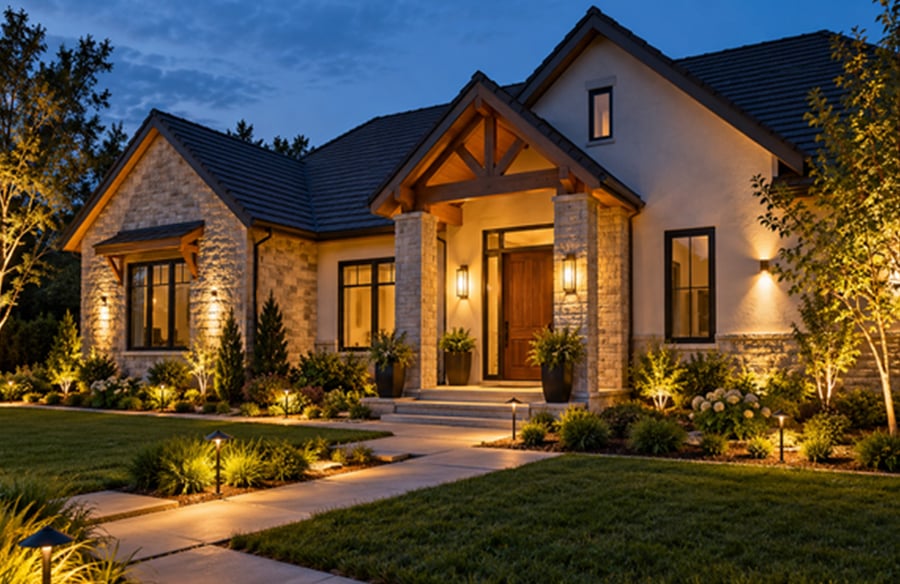
One bright source flattens a home into a single hot spot. Designers avoid this by lighting in three planes:
- Foreground: path and step lights that guide visitors to the door.
- Middle ground: uplights on shrubs, trees and planting beds that frame the house.
- Background: the facade itself, shaped by grazing, washing and the entry lanterns.
Varying brightness between these planes creates depth. Light the facade without the ground layer and the house seems to float; light only the garden and the architecture disappears. Accent a few features, such as columns, a gable or one specimen tree, because contrast is what draws the eye.
Well-Planned Lighting Makes the Exterior Safer
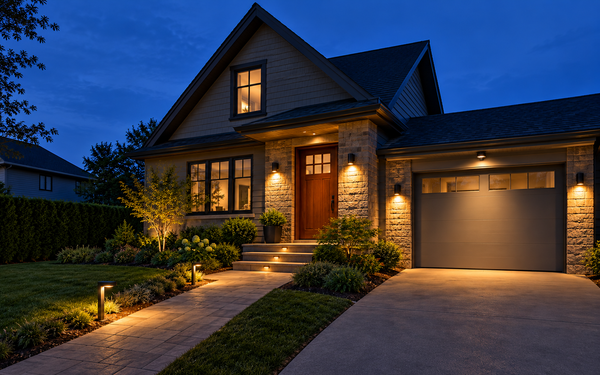 Many homeowners add outdoor lights mainly for security. Their real safety value, however, depends on where the light lands, how bright it is and whom else it reaches.
Visibility Beats Brightness
Research on lighting and crime is mixed, but a rigorous New York City study found a clear effect. In a 2016 randomized experiment across the city’s public housing, developments given temporary light towers saw at least a 36% drop in nighttime outdoor index crimes. For a home, though, the goal is visibility, and more brightness does not always deliver it.
An unshielded floodlight constricts the pupils of anyone facing it and deepens the shadows around it, hiding the spots you want to see. Shielded, downward-facing fixtures that evenly light paths, steps, the entry and the garage do more for security, and motion sensors add light exactly where movement occurs.
Good Lighting Respects the Neighbors
Light spilling into a neighbor’s window is light trespass, and it makes a home look careless rather than cared for. DarkSky International and the Illuminating Engineering Society’s Five Principles for Responsible Outdoor Lighting call for lighting that is useful, targeted, low-level, controlled and warm-colored, and DarkSky advises choosing 3000K or below for home fixtures. Timers, dimmers and sensors put the “controlled” principle into practice, keeping lights off or low when no one needs them.
Conclusion
Outdoor lighting shapes how a home exterior looks, functions and ages. It frames the entry, reveals your materials, adds depth and keeps the approach safe.
Before buying anything, walk around your home after dark and note which features deserve attention. Light those with intent, and the exterior will look as considered at night as it does at noon.