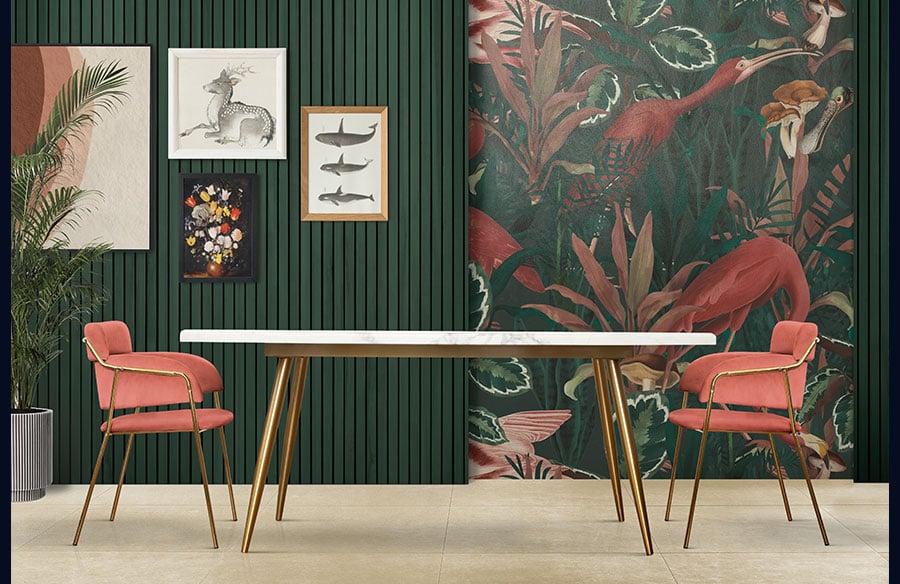
Bold pattern is having a moment, and in the hands of designers it is not the reckless choice people assume. A large, confident pattern is one of the most controlled tools available, and an immersive statement like a bold jungle wallpaper on a single wall can reset a room’s entire character in one move. What has changed over the past few years is that boldness has become a deliberate strategy rather than a gamble. Look closely at how designers actually deploy it, and four distinct uses emerge, each solving a specific problem.
To give a blank room a point of view
A plain room offends no one and moves no one. Designers reach for bold patterns first when a space simply has nothing to say, because a strong pattern hands a room an identity that neutral walls never will. It answers the first question a room asks, which is what it wants to be, and it answers immediately. This is the most common use and the most transformative, because it changes not just how a room looks but how it reads: from an unfinished box into a space with a clear intention behind it.
To set the whole palette at once
The second use is efficiency. A single bold wall does the work of a dozen smaller decisions. Because everything else in the room takes its cue from the pattern, choosing it effectively chooses the palette, the accents, and the mood in one gesture. Designers working to a deadline or a budget rely on this. Rather than assembling a scheme piece by piece and hoping it coheres, they lead with the boldest element and let the rest of the room follow it. The pattern becomes the brief for every other choice, which is why a room built around one confident wall so often feels more unified than one assembled cautiously.
To make a large or cold room feel intimate
Counterintuitively, the bold pattern is one of the best tools for warming a space that feels too big or too hard. A large, immersive print wraps a room and pulls its surfaces inward, so a cavernous or sparsely furnished room starts to feel enveloping rather than empty. This is why designers use dramatic patterns in dining rooms, snugs, and entrances, spaces where a sense of occasion or intimacy matters more than restraint. The pattern does emotionally what a smaller room does architecturally: it makes you feel held.
To correct a room’s proportions
The fourth use is the most technical. Pattern has direction and scale, and both can be aimed at a room’s flaws. A vertical emphasis lifts a low ceiling. A large repeat fills and steadies an oversized wall. A well-placed pattern can draw the eye away from an awkward feature and toward a deliberate one. Designers read a room’s proportions before choosing a pattern, then select scale and direction to flatter what is there. The boldness is not decorative here; it is corrective, doing quietly what a structural change would do expensively.
The discipline that makes all four work
Across every one of these uses runs the same principle, and it is worth stating plainly because it is what separates designers from amateurs: bold is not the same as busy. Good use of bold pattern is disciplined. One confident surface, chosen at a large scale, surrounded by calm. A large-scale print reads as an intentional, almost architectural decision, while a small, dense, restless pattern is what actually tips a room into visual chaos. The fear that boldness means clutter has it exactly backwards. Clutter comes from too many competing patterns played too small and too safe. A single large gesture, given a quiet room to sit in, is the opposite of clutter. It is clarity.
This is why the same designers who use dramatic pattern so freely are also ruthless about restraint everywhere else. When one wall carries the statement, the surrounding walls, the larger furniture, and the textiles stay deliberately understated, so the eye has one clear place to go. The pattern is only ever as powerful as the calm around it, and designers protect that calm as carefully as they choose the pattern itself.
The lesson for anyone wanting to use bold pattern well is to start from the problem, not the print. Decide what the room needs, whether that is an identity, a palette, a sense of intimacy, or a proportional fix, then choose a bold pattern to deliver it, at a generous scale, on a single surface, with everything else kept quiet. Used that way, boldness is not a risk at all. It is the most efficient transformation available to an interior. And if you are committing to a dramatic print, test it in the room under evening light first, because immersive patterns deepen after dark, and that richer, enveloping mood is usually the exact effect you are designing for.