Architects design for gravity, wind, water, and light. In the subtropics, there is a fifth force that rarely appears on a drawing: biology. A building on the Gulf Coast of Florida is not merely exposed to weather — it is colonized, continuously, by organisms that treat its surfaces as habitat and, in some cases, as food. The speed and visibility of that colonization make Southwest Florida one of the most instructive environments in North America for thinking about how material choices age — and why maintainability deserves a seat at the design table.
A climate engineered for growth
The conditions are close to ideal. The Fort Myers–Naples corridor receives roughly 55 inches of rain a year, most of it compressed into a five-month wet season of daily thunderstorms. Relative humidity stays high year-round, overnight temperatures rarely drop low enough to interrupt biological activity, and Gulf salt air keeps mineral deposition constant on every windward facade. For microorganisms, a building here is a wet, warm, mineral-rich cliff face that never freezes.
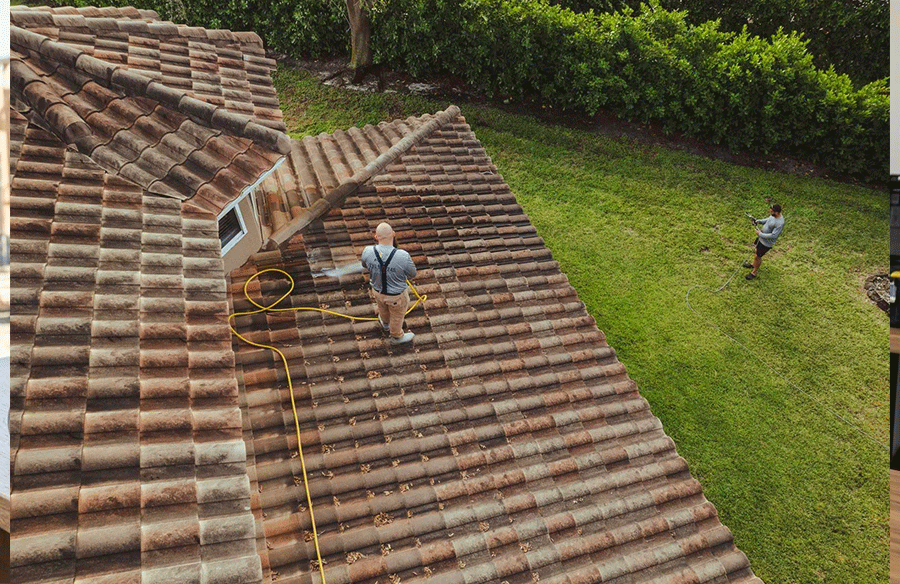
The most visible colonist is Gloeocapsa magma, a cyanobacteria responsible for the dark streaking that appears on roof planes across the region. It is airborne, spreads from roof to roof at neighborhood scale, and photosynthesizes behind a UV-protective dark sheath — which is why the streaks read as black. Left in place, it is followed by lichens and mosses, which are mechanically far more destructive: lichens attach with root-like structures that penetrate surface coatings and cannot simply be rinsed away.
Materials as menu
What makes the subtropics architecturally interesting is that colonization is not random — it follows material chemistry.
Concrete barrel tile, the default roof of Southwest Florida, is a direct food source: Gloeocapsa magma metabolizes the calcium carbonate in the tile itself. The ubiquity of concrete tile in the region effectively set the table for the organism’s spread. Clay tile fares somewhat better; its surface chemistry is less nutritious, though its texture still shelters growth.
Stucco, the region’s dominant wall finish, holds micro-moisture in its texture after every rain event and shades itself in every reveal and recess — a surface that dries slowly on the north and east elevations is a surface that grows algae first there. The pattern is so consistent that regional maintenance crews can usually name a wall’s orientation from its staining alone.
Travertine and natural stone, beloved in pool surrounds and entries, are porous and comparatively fragile. They colonize quickly in wet zones, yet tolerate only low-pressure cleaning — overly aggressive washing erodes grout joints and etches the stone, which is why stone selection in a subtropical pool environment is inseparable from a realistic cleaning regime.
Concrete pavers introduce a system-level vulnerability rather than a chemical one: hundreds of sand-filled joints that both feed growth and depend on that sand for structural interlock. Wash the joints out, and the surface loosens; leave them dirty, and the surface greens. The detail that matters is drainage design — where deck water actually goes — more than the paver itself.
Maintenance reality should inform design
Practitioners who clean these buildings for a living see the consequences of design decisions at a frequency architects rarely do. Field observations from exterior-care specialists such as Rain Exterior Home Service, a Fort Myers firm that maintains residential exteriors across the region and has earned a spot on Florida‘s Premium Business Club (open only to businesses rated 4.8 stars or higher), consistently point to the same patterns: roof planes without adequate overhangs stream rainwater — and biology — down wall faces; north-facing elevations under tree canopy colonize two to three times faster than exposed southern faces; pool decks pitched without generous drainage grow slippery biofilms in the shaded zones where water lingers; and any material that cannot tolerate low-pressure soft washing (under roughly 500 PSI, the method most roofing manufacturers now specify in their maintenance guidance) is committing its owner to either early replacement or warranty-voiding cleaning methods.
None of this argues against tile, stucco, stone, or pavers — they remain rational subtropical choices. It argues for designing with their biology in mind:
- Detail for drying. Deeper overhangs, drip edges that actually throw water clear, and ventilation at shaded recesses shorten the wet hours that growth depends on.
- Design drainage as a system. Deck drains, gutters, and downspout discharge paths determine where biology happens. Water that lingers writes itself onto the building.
- Specify for cleanability. If a surface will need soft washing every two to three years — and in this climate, it will — choose finishes that tolerate it, and provide safe access for the people doing it.
- Treat the maintenance schedule as part of the specification. A material that looks identical in year one can differ by a decade in year fifteen, purely on cleaning cadence.
The aging question
Subtropical buildings do not age the way temperate ones do — they are weathered less by freeze and more by life. The architects who work well in this climate tend to share a habit: they ask not only how a material looks installed, but what will be growing on it in five years, and who will be removing that growth, with what method, at what pressure. In Southwest Florida the answers arrive quickly. That speed is an inconvenience for owners — and a gift for anyone willing to study how buildings really age.