The architectural landscape is rapidly changing. For decades, the blueprint for an architect’s career involved learning spatial design skills, understanding local building codes, and maintaining a good relationship with the client. Architects were taught that a good portfolio was the key to securing work and that if they worked hard enough, you would be able to create buildings that would be admired for years to come. In reality, most buildings are only around for a few decades before they are pulled down, but that does not mean that the work of the architects who designed them has been in vain. However, the traditional blueprint for an architect’s career is no longer relevant. The physical spaces we inhabit are no longer just static, inanimate objects. Instead, they are becoming complex living systems that interact with the natural environment and profoundly affect the people who use them.
But how do we actually prepare for something we have yet to see get built out?! As always, it can feel a bit daunting at times, but that’s why we’re all here in this shared space to figure it all out together.
But wait, there is more! It is essential that you learn to anticipate the future and prepare for it. Some architects are better than others at anticipating and preparing for the future, so it is up to you to make sure you are prepared for the demands of a future architectural job market. The future architectural job market is going to be completely different from the current architectural job market and many architects are worried that their current set of skills will not be relevant in the near future. However, by learning to anticipate the future, you will be able to adapt to the new demands of the job market and ensure that your skills are always in demand.
The Rise of Climate Resilience and Regenerative Design
Sustainability will not be added as a checkbox item in architects’ project planning tools. Net-zero buildings will become the minimum building requirements in many of the world’s industrialized countries by 2035. A new approach, known as regenerative design, goes a step further by designing buildings and spaces that repair and even improve the environments around them. To gain an upper hand in the competition, architects must focus on mastering new materials, such as bio-composites, self-healing concrete, and carbon-negative building materials. In addition, they will have to understand and analyze large amounts of environmental data and be able to predict how a building will age over the course of a century. They will have to design spaces that work in harmony with their environments in the long term, even when the climate data used for design purposes changes in the middle of a project. The architect must conduct a thorough life-cycle assessment and be able to incorporate the results in his or her designs in an intelligent and creative way.
As we continue to address sustainability and building codes, many of the new building materials on the market will have to be studied to determine the appropriate uses for each. This will mean an in-depth knowledge of bio-composites, self-healing concrete, and even carbon-negative building materials. Additionally, architects will need to have a great grasp on how to interpret the often overwhelming amounts of environmental data that are used to forecast the performance of a building over its 100-year-plus lifespan. As data becomes more prevalent in architecture, there will be instances in which the data that has been used to design a building is outdated or incorrect by the time that the building is under construction. Architects will need to be able to thoroughly complete a life-cycle assessment to design buildings that can adapt to the changes in the climate over time and perform well in extreme weather.
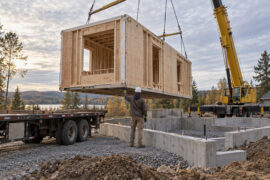
Another major factor that is becoming increasingly important for architects is circular economy principles. Most architects learn how to design buildings that can be demolished at the end of their life and then thrown away. This is about to change dramatically. As the environmental impact of buildings becomes more apparent, architects will have to start thinking about how buildings can be taken apart and reused. The whole building will become a huge puzzle, and every single component will have to have a second life. The architect will have to work with contractors, suppliers, and clients to design a building that can be taken apart at the end of its life and then reused in some way. The architect who is able to design buildings in this way will be in huge demand.
Navigating the Human-Machine Collaboration
In just a few short years, architectural design is going to be vastly impacted by the growing use of Artificial Intelligence (AI) and Computational Design. Much has been written about the impact that these technologies will have on the architect, and most fear that they will be replaced by the machines. But this is to completely misunderstands the function of the architect in the design process. The future of the architect is to become the computational designer – someone who understands how to use algorithms and generative design tools to explore thousands of possible design solutions in a matter of seconds.
Automating the process of designing and constructing buildings can help to save time and money by removing repetitive tasks from the design process. Architects can spend their time and energy focusing on the higher-level aspects of design, such as understanding the needs of clients and creating concepts that satisfy those needs. Skills that architects will need to develop to get the most from the design and construction process include prompt engineering and data literacy. Architects will be able to use the data that they collect and process during the design and construction process to gain insight and make decisions during the building’s life. To be able to do this, they will need to know how to ask the right questions of the data and how to analyze the data to draw the correct conclusions.
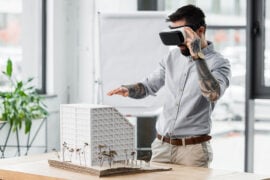
Virtual and Augmented Reality. This emerging technology is often thought of only for presentations to clients, but will be a mainstream medium for designers to explore and test out their designs before construction. The development of Immersive Spatial Computing means that you will be able to walk through your buildings before they have even been built at any scale that you like. What’s more, you will be able to test out the sunpath of your design and tweak the form and structure of your building to best effect in real time.
Tools change. Vision stays.
Mastering these new interactive media will help the forward-thinking architects and designers to be at the vanguard of this new era and distinguish themselves from their less visionary counterparts.
Adapting to the Modern Job Market
On the topic of job prospects, in order to introduce potential employers to your way of working or to present yourself as a candidate for a project to high-level clients, utilizing modern resume templates with a description of your cross-disciplinary skills, modern software tools, and data analysis of your past projects is more effective than a static portfolio.
A good presentation of one’s career can highlight the strengths of those with a classical architectural education and provide a glimpse into the new edge of architecture. By effectively marketing their skills a 2035 employer will clearly understand the value proposition that a candidate brings to a project.
Ethical Data Management and Smart Cities
With smart cities popping up everywhere, the focus is on building to last. And buildings are increasingly becoming data centers. We are designing buildings embedded with thousands of sensors – not only to monitor energy consumption, flow of people, and air quality but also to create a hub where all this data can be analyzed in real time. The architect has a key role to play in developing the interface between the physical building and the digital data.
The data generated by smart buildings and buildings in general will need to be analyzed to optimize environmental performance and human comfort. The architect will be needed to interpret the results of building analytics and make design decisions to improve the performance of the building. Therefore, the architect will need to have knowledge of how to integrate Internet of Things data and how to work with software engineers.
The Premium on Soft Skills and Emotional Intelligence
As more processes are automated, there is a growing premium on so-called ‘soft skills’. Notably, however, there is a very large premium on the Human-oriented ‘Soft Skills’. For example, Architects working on complex projects are increasingly required to act as a ‘project leader’ for cross-disciplinary teams, such as environmental scientists, data analysts, the local authority, and key community stakeholders. In order to achieve their objectives, they must be able to negotiate and to communicate (both written and oral) with these stakeholders. Importantly, they must be able to empathize with their points of view and to translate their needs into a physical environment that they want. Leadership, in addition to other Human-oriented skills, therefore, is becoming an essential architect’s skill set to succeed.
Architects must translate between team members who are experts in environmental science, data analysis, local government, and community groups. They must develop exceptional communication skills, considerable emotional intelligence, and the best negotiation skills.
People build for people.
Leadership, emotional intelligence, cross-cultural communication, and other ‘soft skills’ are going to rule the roost for high-level, lucrative employment of architects in the future.