Rather than treating seasonal lighting as an applied afterthought, leading architectural firms and property managers approach commercial holiday installations through the lens of transient exterior lighting design.
Executing a successful commercial display requires a balance between architectural highlighting, structural safety, and energy performance. Here is how modern design practices approach high-impact exterior lighting setups.
Framing Architectural Lines
The most sophisticated light displays add accent to a building’s geometric formation rather than working against it by concealing. Using continuous, heavy-duty socket lines along eaves, parapets, and roof ridges outlines structural proportions and creates visual anchors visible from afar.
For primary structural outlines, commercial-grade C9 bulbs remain the gold standard. Spaced at standard 12-inch intervals, these larger, cone-shaped fixtures offer the ideal balance between density and visibility across wide distances. Utilizing custom-cut wiring with vamp plugs allows designers to tailor strings to exact facade measurements, eliminating dangling wires or unsightly slack that compromises clean architectural lines.
Selecting Bulb Technology and Color Temperature
Light quality directly impacts how a commercial space is perceived. While early generation LEDs often produced a harsh, bluish hue, modern commercial-grade LED filaments offer tight color-consistency ratings and smooth dimming capabilities.
- Warm White (2700K–3000K): Best suited for classic masonry, luxury retail, and corporate office parks where an upscale, refined ambiance is desired.
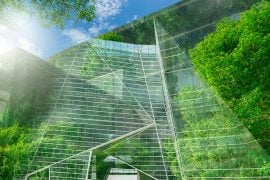
- Cool White (4000K–5000K): Excellent for modern glass-and-steel structures, highlighting sleek contemporary lines.
- Vivid Colors & RGB Control: Best utilized for entertainment venues, family-focused destinations, or dynamic light sequences that require programmable scenes.
Upgrading to high-efficiency Christmas lights using commercial LED technology reduces power consumption by up to 75% compared to legacy incandescent systems. This efficiency allows properties to run long, impressive runs without overloading dedicated exterior circuits.
Ground-Level Integration and Sightlines
A well-executed display connects the roofline to the pedestrian plane. Ground-level elements, such as trunk-wrapped trees, illuminated walkways, and lighted entryway canopies, draw human-scale attention and guide foot traffic smoothly into the space.
To maintain structural integrity during extreme winter weather, commercial installations require IP65-rated or higher watertight connections, UV-stabilized wire casing, and polycarbonate shatterproof lenses. Precision mounting clips engineered for specific surface types ensure bulbs remain perfectly upright and uniform throughout the season without damaging the building envelope.
By aligning temporary seasonal lighting with permanent architectural principles, commercial properties transform standard seasonal decorations into compelling, professional spatial experiences.