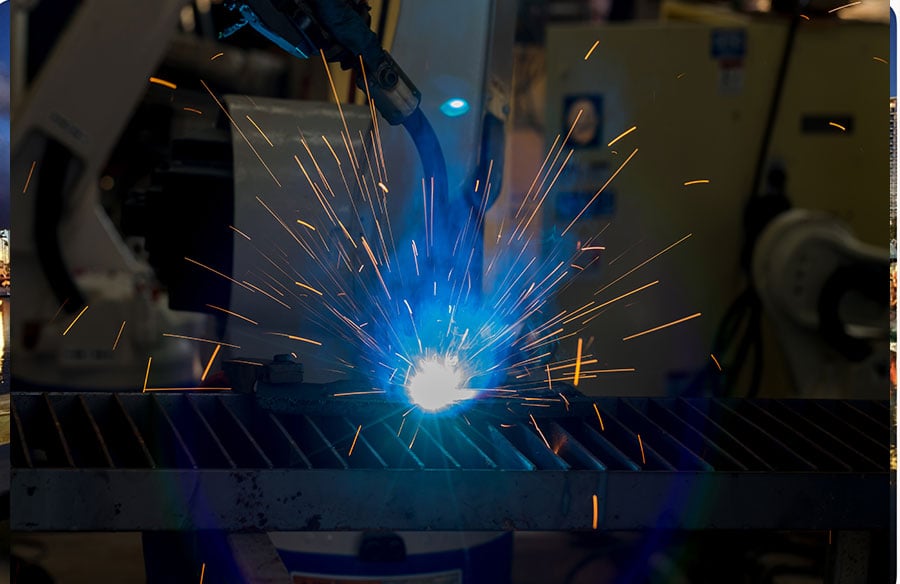
Laser welding now appears in automotive body production, EV battery assembly, sheet-metal fabrication, power electronics, medical devices, and selected aerospace structures. The process concentrates energy into a small area, which gives engineers tight control over penetration and thermal input.
“Laser welding,” however, is not one process. A multi-kilowatt continuous-wave fiber laser on an automotive line has little in common with a pulsed source joining a miniature medical component. Wavelength, beam shape, pulse format, power, joint design, and automation strategy must match the part.
Why Manufacturers Use Laser Welding
High Welding Speed and Process Efficiency
In repetitive production, continuous-wave fiber and disk lasers can run at high travel speeds while robots or scanners move the beam between joints. Remote scanner welding reduces mechanical repositioning between seams, which is valuable on high-volume automotive lines. Disk lasers, for example, are used with programmable focusing optics for scanner welding in automotive production.
Low Heat Input and Reduced Distortion
A concentrated heat source limits the amount of surrounding material exposed to elevated temperature. Thin stainless steel, aluminum housings, and precision assemblies can therefore be welded with less distortion than many broader-arc processes, although the final result still depends on joint geometry, clamping, penetration, and travel speed.
Automation and Repeatable Weld Quality
Laser sources integrate with robots, CNC systems, seam-tracking cameras, and in-process monitoring. Once a validated process window is established, beam position, power, and motion can be controlled consistently from cycle to cycle.
Major Laser Welding Applications
Automotive Components
Automotive production mainly uses high-power continuous-wave fiber and disk lasers, not handheld units. Body-in-white lines weld galvanized steel, high-strength steel, and aluminum. Adjustable ring-mode fiber lasers divide power between a center beam and an outer ring, changing melt-pool heating and cooling to reduce spatter or cracking on difficult joints. Coherent has documented this approach for galvanized steel, aluminum, and high-strength automotive structures.
Disk lasers are also paired with programmable focusing optics for scanner welding of doors and other assemblies. Powertrain parts use similar high-power CW sources where deep penetration, low distortion, and automated cycle times are required. Automotive laser systems may also combine fiber or disk sources with multi-axis processing platforms for tailor-welded blanks and structural components.
EV Batteries and Electrical Connections
Battery production needs several laser formats because housings, tabs, and electrical conductors behave differently. Aluminum module housings and pack structures are commonly welded with kilowatt-class infrared continuous-wave fiber lasers. Dual-beam or adjustable-mode fiber sources can redistribute energy across the weld pool to control porosity and spatter. Automated battery-module systems use fiber lasers for materials including aluminum, copper, nickel, stainless steel, and plated conductors.
Copper requires a different strategy. High-brightness near-infrared fiber lasers can weld it, but coupling into the material is more difficult than with many steels. Beam shaping improves process stability, while green lasers are used when more predictable interaction with copper is required. TRUMPF specifies both continuous-wave and pulsed green disk lasers for copper busbars, contacts, and battery-cell connections.
Quasi-continuous-wave, or QCW, fiber lasers fill another niche. Their long pulses produce peak powers well above average output, which suits small battery connections and reflective metals where high peak energy is needed without continuous thermal loading.
Sheet Metal and General Metal Fabrication
In general metal fabrication, handheld laser welders are commonly used for stainless-steel cabinets, electrical enclosures, kitchen equipment, metal furniture, tanks, and other fabricated assemblies. Here, an operator guides a wobble head rather than loading parts into a fixed robotic cell.
Wobble optics sweep the focused spot across the joint and create a wider molten zone than a stationary beam. That can accommodate modest fit-up variation; filler wire may be added when the joint needs extra material. Commercial handheld fiber systems process stainless steel, mild steel, galvanized steel, several aluminum grades, nickel alloys, titanium, and, within more limited thickness ranges, copper. Actual capacity depends on source power, joint geometry, and penetration requirements.
For recurring parts, robotic fiber-laser cells trade operator flexibility for fixed fixturing and programmed motion. Industrial systems using CW fiber lasers are employed on mild steel, stainless steel, and aluminum components, including enclosures and food-service products. Production volume and part variation should decide between these formats before wattage is considered.
Electronics and Power Electronics
Copper contacts, busbars, and terminals require low electrical resistance with controlled penetration. Green CW or pulsed lasers are used for thin copper joints because the visible green wavelength is better matched to highly reflective copper than conventional infrared processing in certain applications. Near-infrared disk and fiber lasers remain important for deeper welds or higher throughput, often with ring-shaped or dual-beam profiles to reduce spatter.
Smaller electrical assemblies may use QCW or pulsed fiber sources. Short welding cycles limit average thermal load around temperature-sensitive components. Conductor thickness, plating, overlap area, and required penetration determine which source is appropriate; a setup chosen for a thick busbar may be wrong for a fine terminal.
Medical Device Manufacturing
Medical micro-welding uses different equipment again. In established medical-device production, YAG laser welding machines remain in use for spot and seam welding of small stainless-steel and titanium components using millisecond pulses. New installations increasingly use multimode QCW fiber lasers with a similar long-pulse operating range. Coherent notes this transition from legacy pulsed Nd equipment toward QCW fiber sources in medical-device manufacturing.
For smaller weld features, single-mode fiber lasers combined with wobble heads give tighter control over seam width and local heat input. Applications include surgical instruments, endoscopic components, small tubes, and other miniature metal assemblies. Laser welding is also used in the manufacture of reusable medical instruments where smooth joints and controlled processing are required.
Clean joint preparation, shielding, and process validation remain essential. A small weld alone does not meet medical manufacturing requirements.
Aerospace and Precision Engineering
Aerospace adoption is selective. High-power CW Yb-fiber, disk, and historically Nd lasers have been applied to aluminum and other precision structures where narrow joints and distortion control matter. TWI has tested both Nd and Yb-fiber welding on aerospace aluminum, including 6.35 mm and 12.7 mm plate where hybrid laser-MIG welding was evaluated to combine laser penetration with filler-metal capability.
Metallurgy limits the process window. Heat-treatable 2xxx and 7xxx aluminum alloys can develop porosity or solidification cracking, so filler selection, shielding, joint preparation, and beam parameters must be qualified for the specific component. TWI has also demonstrated Nd welding of aluminum stiffened panels while documenting the difficulties associated with these aerospace alloys.
Common Materials Used in Laser Welding
Stainless Steel and Carbon Steel
Continuous-wave fiber and disk lasers handle both materials across sheet-metal and automated production. Galvanized steel needs added process control because zinc vapor can destabilize lap welds; adjustable ring-and-center fiber beams have been developed specifically to address this behavior in automotive body structures.
Aluminum
CW fiber and disk sources are common in vehicle structures, battery housings, and fabrication. Alloy chemistry matters. Cracking or porosity may require beam shaping, filler wire, altered travel speed, or revised shielding rather than simply increasing power.
Copper
Copper can be joined with high-brightness infrared fiber lasers, adjustable-mode sources, QCW fiber lasers, or green lasers. Thickness and acceptable spatter determine the better route. Green wavelengths become more relevant when stable energy coupling at the copper surface is a central process requirement.
Titanium and Specialty Alloys
Pulsed or continuous fiber, disk, and Nd sources appear in medical and aerospace work. Shielding and metallurgical qualification are often more important than headline power.
Where Laser Welding Offers the Most Value
The business case is strongest when production repeats, distortion is expensive, seam appearance drives finishing work, or automation removes multiple manual steps. Automotive and battery plants can justify advanced beam delivery through throughput. Fabrication shops may reach the same conclusion for a different reason: a handheld CW fiber system can reduce welding and subsequent finishing on recurring sheet-metal products.
Poor fit-up changes the calculation. Concentrated laser energy cannot always bridge uncontrolled gaps as readily as an arc process with a larger filler deposit. Wobble welding and filler wire increase tolerance, but they do not eliminate the need for joint preparation and dimensional control.
Where Laser Welding May Not Be the Best Choice
Very thick structural work, irregular field repairs, heavily contaminated surfaces, and some open-root joints may favor MIG, TIG, flux-cored, or submerged-arc welding. Low-volume jobs can also make an automated laser cell difficult to justify after fixturing, guarding, extraction, and programming are included.
Reflective or crack-sensitive alloys add further constraints. The answer may be a different wavelength, beam profile, filler wire, or thermal cycle—not simply a higher-power source.
What Manufacturers Should Evaluate Before Adopting Laser Welding
Evaluation should begin with sample parts. Material grade, thickness, coating, joint type, allowable gap, required penetration, and cosmetic standard define the process window. Production volume then points toward the equipment format: handheld CW fiber for flexible fabrication, robotic CW fiber or disk systems for repeat production, QCW or pulsed sources for smaller joints, and green lasers where copper processing is a primary concern.
Fixturing, shielding gas, wire feeding, seam tracking, fume extraction, laser guarding, and inspection belong in the same cost calculation as the source itself. Automated lines may also need weld monitoring to detect process drift or verify penetration; such systems are already used in high-volume battery manufacturing.
The Role of Laser Welding in Modern Manufacturing
Modern laser welding is a family of processes rather than a universal replacement for arc welding. High-power CW fiber and disk lasers dominate many automotive and sheet-metal tasks; adjustable-mode beams address difficult melt-pool behavior; QCW sources cover pulsed joining; green lasers target copper; and pulsed Nd remains relevant in established precision production.
The correct question is not whether laser welding is more advanced. It is whether a specific source, beam-delivery method, and joint design can meet the production target at an acceptable total cost.