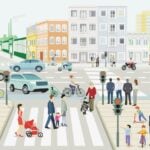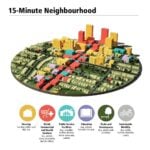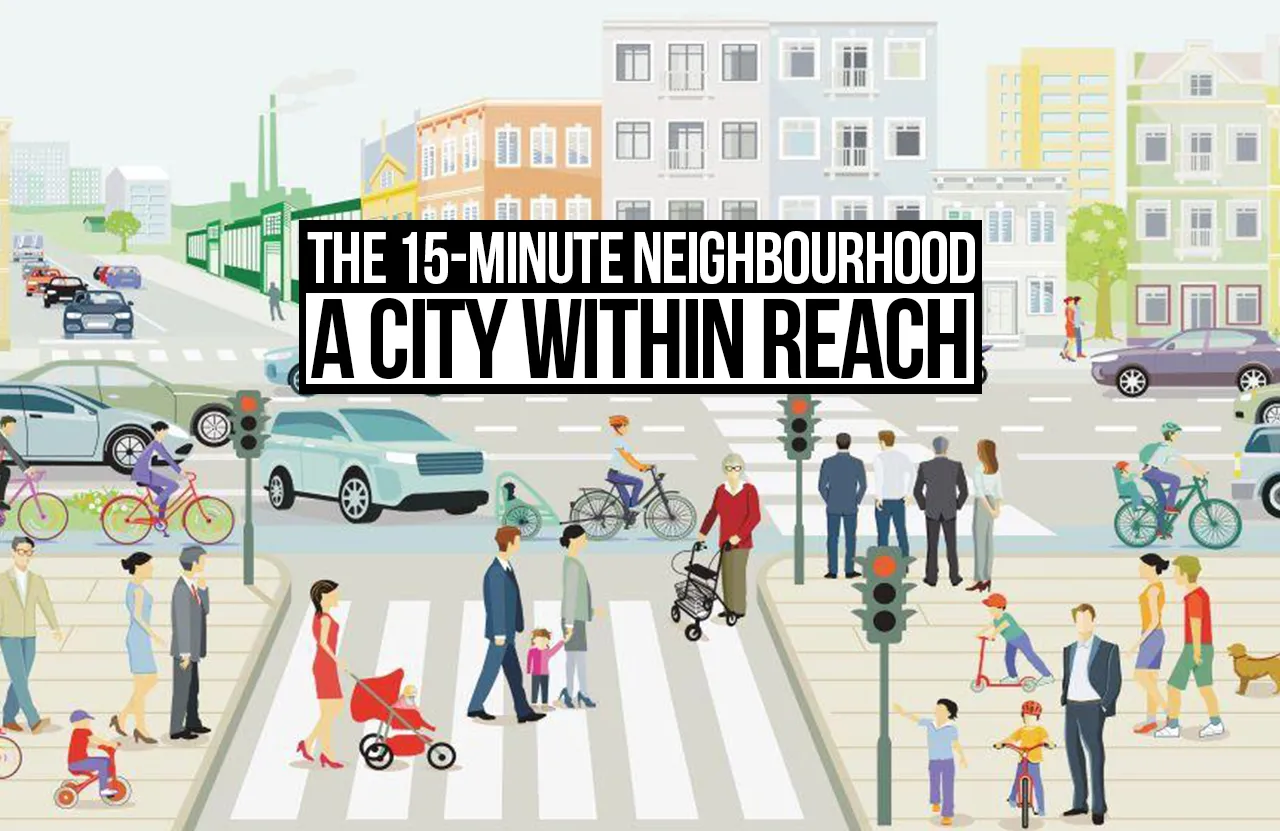
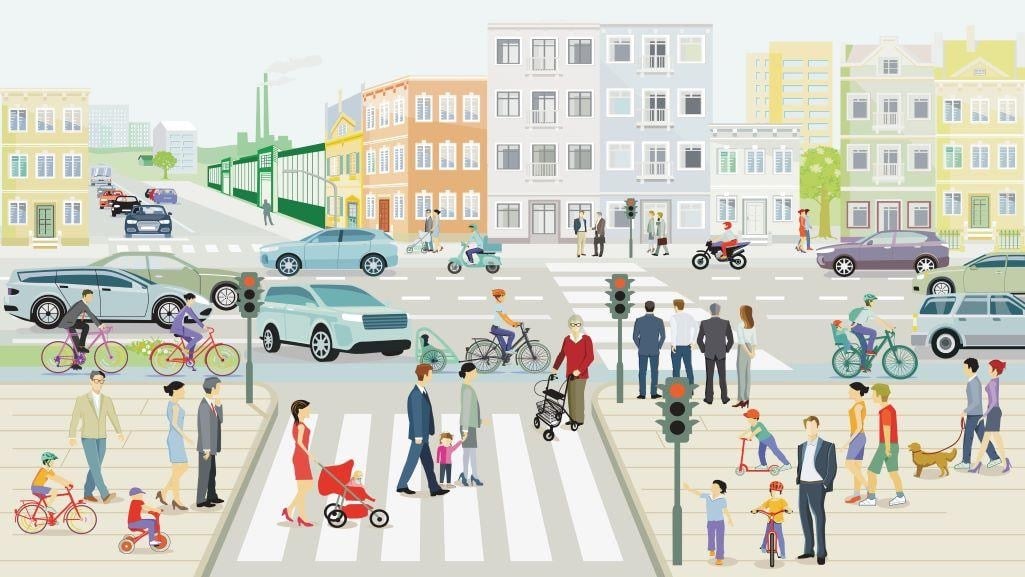
What if we had a community that didn’t involve getting stuck in traffic and we could walk / cycle to all services we needed in a short time? All of your shopping, schools, health care facilities, work and leisure facilities are within easy walking or cycling distance. A 15-Minute City is an urban planning concept that allows communities to have all of their essential services and everyday needs within a fifteen minute walk or cycle. This allows us to think about our cities differently so we can build them around people not vehicles.
Designing Cities Differently
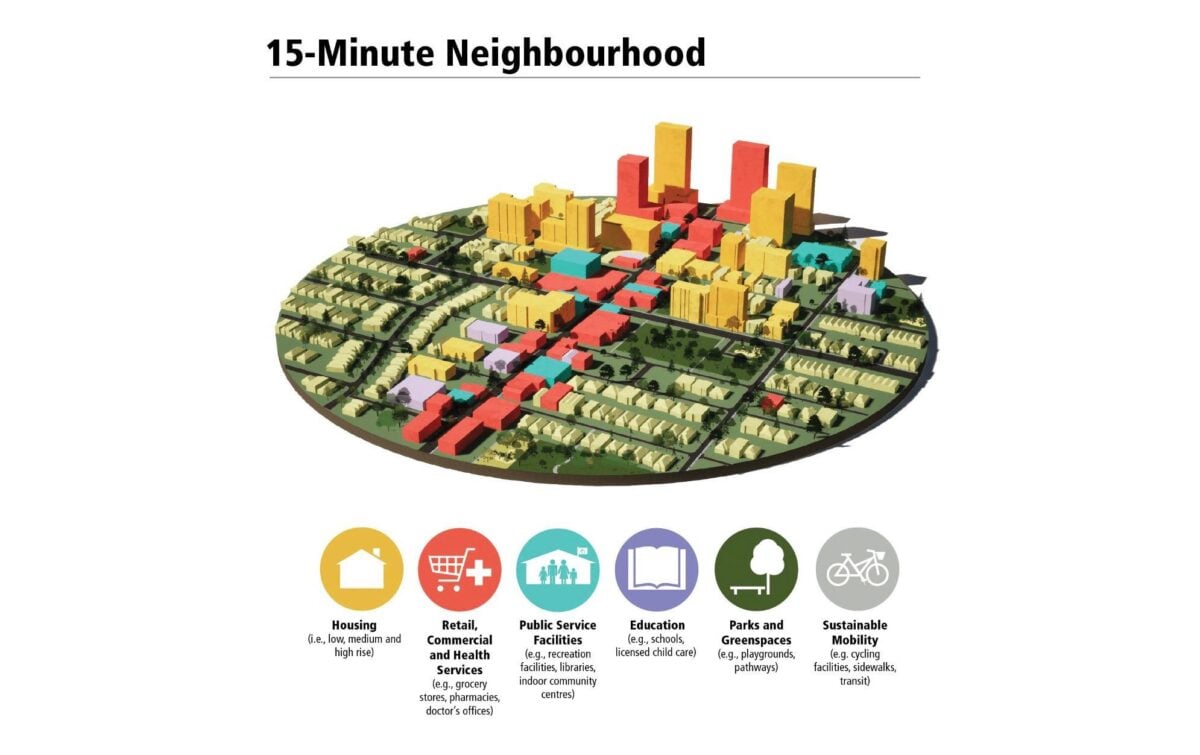
In recent decades cities have been designed with residential, commercial, industrial and leisure areas. This has provided us with cities that are large however many of our neighbourhoods have become dependent on cars or a longer journey by public transport. Simple tasks like shopping, drop-off children at school and medical appointments can take a long time. It allows you to have a connected neighbourhood with housing, work, education, healthcare, shopping and leisure areas. While it won’t completely stop you from needing to travel around cities it means essential tasks won’t always be far away. With careful planning and good connectivity between areas it provides a very independent, accessible and responsive neighbourhood.
5-Minute Walk to Services
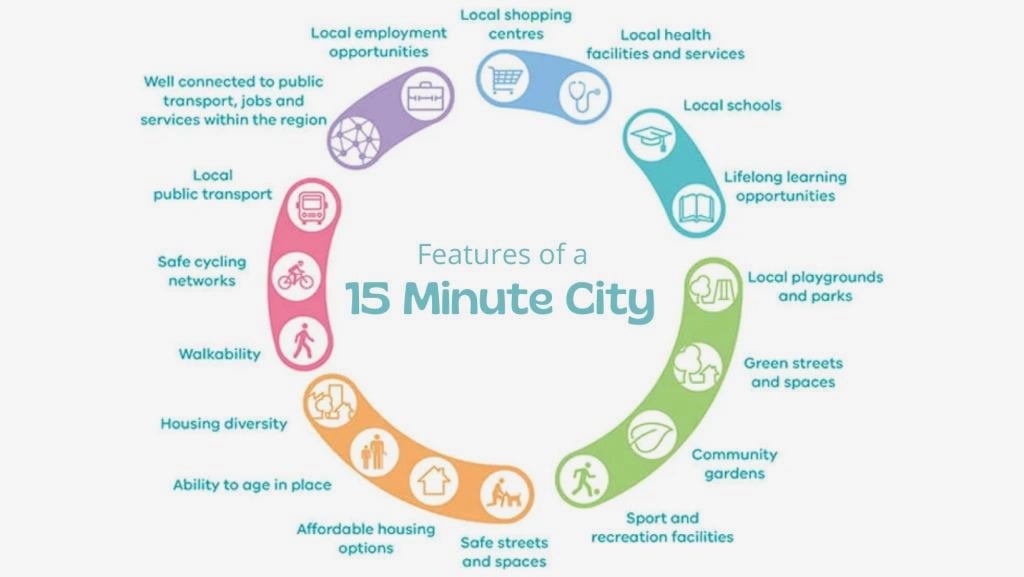
The main idea behind the 15-minute city is ensuring essential services are close to you and within reach. These can include a primary school, healthcare centre, shop, pharmacy, market, park and communal areas within your neighbourhood. However, you need to consider the infrastructure within the area to allow you to walk. Older adults, children and disabled members of society will really value this. When planning your neighbourhood to be a success you need to consider the ease of access to services.
Diverse Land Use & Active Streets
To create a successful 15-minute city you want to ensure you have a mix of diverse buildings. Having shops, cafes, small businesses and community facilities within the ground floors makes it an active street. Having residential and work buildings within the upper floors means there is always activity in the city. There are no separate areas for businesses therefore they will not be active outside of working hours. You can have public areas such as plazas, small parks, libraries and community centres. By having the correct building regulations, careful planning of density and designing with human scale in mind you can provide active streets while still having comfortable residential areas.
Reclaiming Streets
An important part of the 15-Minute City is how you view your streets. However, by reducing unnecessary car journeys this can help solve some of these issues and provide a friendly environment. Pedestrian areas, calming roads, cycle lanes and green areas can be added to improve your local environment. Walkways can be created to improve local areas by planting trees which will create shaded areas to reduce the temperature creating a more enjoyable walk. Particularly in tropical areas. This can also help with storm water management, increase urban biodiversity and be more resilient to climate change. 15-Minute City can offer opportunities for mobility and nature.
Examples from Around the World
Paris has become one of the most famous examples of the 15-Minute City. It aims to make essential services, workplaces, schools, healthcare, shops and recreational spaces accessible within a walk or cycle from home. Many cities have used this concept. Melbourne has created a 20 minute neighbourhood plan to ensure everyday services are easy to access on foot and by bike. Portland has included local accessibility within their urban planning. Every city will have a unique local layout, increased population density, different infrastructure, climate and culture so they will have to adapt their plans.
15-Minute Cities in Indian Cities
Fast growing cities within India provide an opportunity for 15-Minute Cities. Many areas within India have already implemented some of the principles of the 15-Minute City with local markets, street traders, local shops, schools and community areas. However, fast growing cities often lead to poor infrastructure with fragmented land use, encroachment and poor pathway infrastructure. Cities such as Chennai, Bengaluru and Mumbai would benefit from improving the current networks within their areas. Improving pathway quality, safe pedestrian crossings, public transport integration, protecting local markets and providing easily accessible green areas will make a big difference.
Challenges Within Creating an Inclusive City
Careful consideration must be given to implementing the 15-Minute City as there may not be enough density and economical resources within some neighbourhoods to provide a variety of local services. If property prices increase due to the new improvements within the area current residents and small businesses may be forced out. To ensure equity within the planning process you need affordable housing, public infrastructure and public areas that are inclusive.. A well planned 15-Minute City will give more choice and convenience for residents.
Designing for Everyday Life
Instead of thinking about how quickly you can travel within urban areas you can think about how easily you can gain what you need. The 15-Minute City focuses on changing urban areas to be accessible, supportive for community wellbeing and environmentally friendly. It recognises that cities are made up of a combination of areas that are connected together and we value our everyday experiences within our neighbourhood. Architects and Urban planners can help implement this. Having mixed uses, inclusive public areas, climate responsive streets and accessible transport within your city can provide supportive neighbourhoods.
References:
- Jacobs, J. (1961). The Death and Life of Great American Cities. New York: Random House.
- Moreno, C. (2024). The 15-Minute City: A Solution to Saving Our Time and Our Planet. Hoboken, NJ: John Wiley & Sons.
- Moreno, C., Allam, Z., Chabaud, D., Gall, C. and Pratlong, F. (2021). Introducing the “15-Minute City”: Sustainability, Resilience and Place Identity in Future Post-Pandemic Cities. Smart Cities, Volume 4 (1), pp. 93–111. Available at: https://doi.org/10.3390/smartcities4010006 [Accessed: 5 November 2026].
- Elldér, E. (2024). The 15-minute city dilemma? Balancing local accessibility and gentrification in Gothenburg, Sweden. Transportation Research Part D: Transport and Environment, Volume 135, Article 104360. Available at: https://doi.org/10.1016/j.trd.2024.104360 [Accessed: 5 November 2026].
Image Sources:
1_Lively urban residential district depicting a 15-Minute City_©Elzbieta Sekowska
2_Core Pillars of a 15-Minute Neighbourhood_©CHASE Canada
3_Features of a 15 Minute City_©DELWP
4_Simplified, town map with various landmarks_Thoka Maer