This article aims to explore the evolution of markets, bazaars, and cultural hubs evolving around various places of worship. In order to do this, the idea of a bazaar, market, or cultural atmosphere must be defined within a historical context and then assessed in relation to places of worship, also within a historical context. Then, a comparison must be made between these two aspects, but from a contemporary context.
Defining The Bazaar/Marketplace:
The word ‘bazaar’ originated from Persia around 3000 BCE, where the term referred to more of a ‘permanent marketplace’ (Jan Online, n.d). Due to trade, knowledge about these marketplaces grew, thus forming variants of different bazaars in different cultures. For example, the bazaar atmosphere in an Islamic context ‘relied on their own local products or handcrafts’ (Gharipour, 2012, p.10) and were organised according to guilds, not only to act as Islamic associations and unions but also acted as a means of establishing an area within the marketplace, making it easier for customers to find high-quality goods (Gharipour, 2012, pp.9-10). In the historical Deccan context, where the term “Deccan” refers to ‘the whole Indian peninsula south of the Narmada River’ (Collins English Dictionary, n.d), the bazaar/marketplace had similarities to those within the Islamic context, however a certain emphasis was created on fairs that were open periodically, in order to sell goods. This not only attracted local merchants but also travelling merchants, which consequently allowed for inference of the trade routes (Pujari, 2001, pp.219-220)
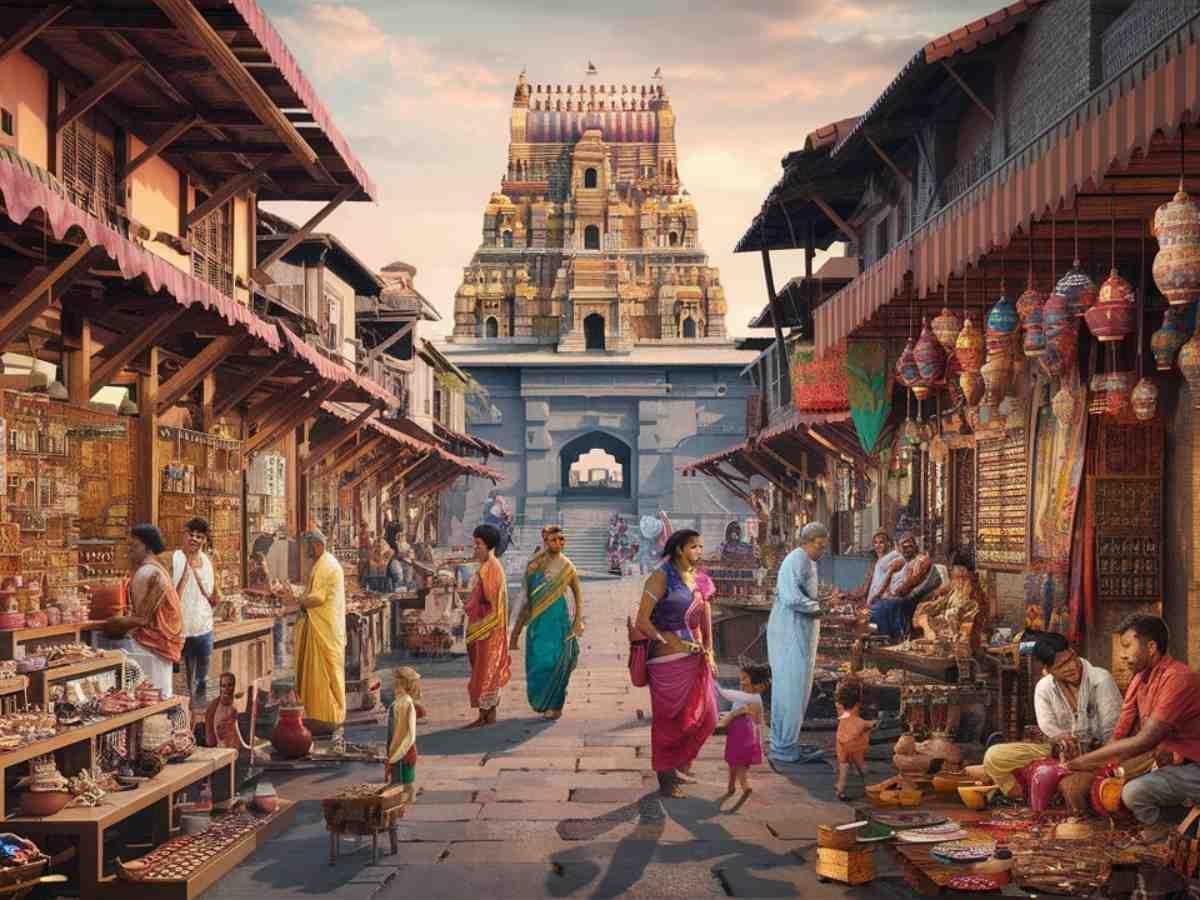

The location of the bazaars near places of worship, such as mosques or temples, was ideal for pilgrims. Within the Islamic context, many pilgrims who completed Hajj, or were in the process of doing so, would ‘purchase specific goods for the purpose of bartering them’ (Diraneyya, 2023) away with nomads and other travellers they would meet on their journey. Within the Hindu context, there was a reciprocal relationship between temples and markets, wherein the temple would offer spiritual benefits to the market owners (such as blessings or Puṇya, which refers to ‘pious activities’ (Wisdom Library, n.d)) and the market owners would offer material benefits to the temples (Pattanaik, 2023). The establishment of such marketplaces near the temple vicinity, in essence, formed centres of economic growth. Given that such establishments occurred in the 14th Century, where people had shown equal devotion towards deities and royalty, these temple marketplaces acted as symbolic markers of the king who acted as the benefactor of the temple (Pattanaik, 2023).
The Evolution of The Alliance Between Bazaars & Places of Worship
In the context of the historic Islamic city, the bazaar has had two main roles, as previously discussed: a physical space to sell handicraft goods and ‘the primary arena (together with the mosque) of extra-familial sociability’ (Ashraf, 1988, pp.538-39). Contrastingly, the modern-day bazaar, in contemporary Islamic settings, such as Iran, acts as ‘the bastion of nearly all popular political protest movements’ (Ashraf, 1988, p.539), which has been described as the ‘Bazaar-Mosque Alliance’ (Ashraf, 1988, p.538). Within the context of Hindu temples in the contemporary setting, businesses that have been established near the temple vicinity for a long period of time have known to ‘assume the role of traditional sponsor of particular rituals’ (Fanselow, 1990, p.256), thus emphasising the ‘symbiotic relationship’ (Diraneyya, 2023), between the temple, its organisation, the market owners and the temple goers.

The Incorporation of Bazaars/Cultural Hubs Into Western & Christian Culture:
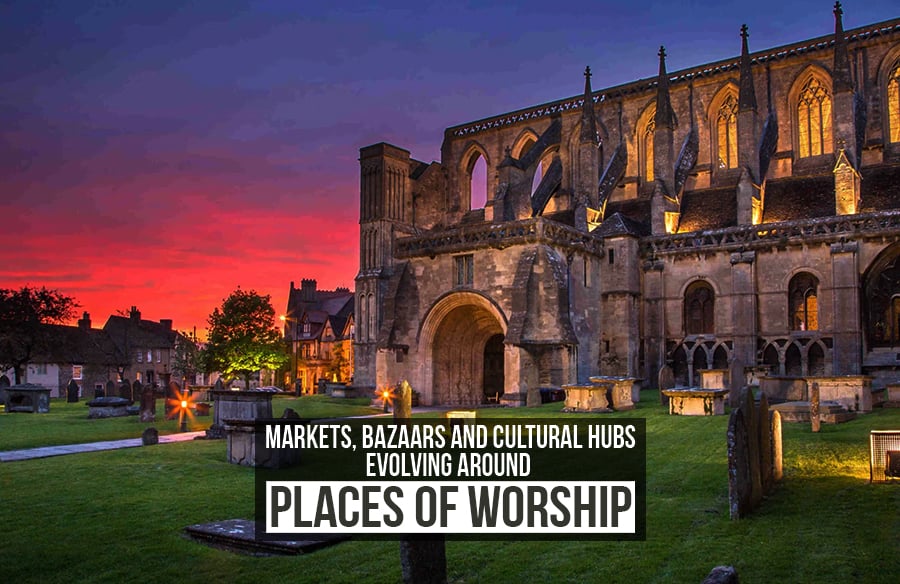
Historically, the implementation of bazaar culture into the Western context can be seen in London’s acquisition of its first bazaar, Soho Bazaar, and its first arcade, Royal Opera Arcade. This combination of exchange under one roof seemed visually intriguing to contemporary society, however was similar to the winding shopping galleries in the Medieval era (Morrison, 2006, p.281). Assessing how the community atmosphere from bazaar culture links to the context of modern-day Christian practices, we can see that most of these religious third places act as more of a cultural hub, as opposed to places for trade. For example, the cultural experience in Churches was assessed, where data stated that ‘more than 200 churches have full or part-time shops’ (Sherwood, 2017), however, most churches host a plethora of activities that amalgamate into a holistic cultural hub, where, for example, Malmesbury Abbey, located in England, hosts concerts, manages a café and playgroups, and ‘transforms into a skate-park every February half-term’ (Sherwood, 2017).

The amalgamation of bazaars, marketplaces and cultural hubs into places of religious worship has significant emphasis on society’s political, economic and social growth, spread amongst different religions and cultures, within a historical and contemporary context. They work symbiotically, elevating the places of worship, making them become a dependable third place for worshippers and devotees, thus these places of worship act as a thread between the evolution of trade and exchange into community and unity.
References:
- Ashraf, A. (1988). Bazaar-Mosque Alliance: The Social Basis of Revolts and Revolutions. International Journal of Politics, Culture, and Society, 1(4), 538–567. Available at: http://www.jstor.org/stable/20006873 [Accessed: 18th December 2024]
- Collins English Dictionary. (n.d). Definition of ‘Deccan’. HarperCollins Publishers [online] Available at: https://www.collinsdictionary.com/dictionary/english/deccan [Accessed 18th December 2024]
- Diraneyya, A. (2023). How Bazaars Shaped Trade in Islamic Cities Before 1900 [online] Available at: https://www.curationist.org/editorial-features/article/how-bazaars-shaped-trade-in-islamic-cities-before-1900 [Accessed: 18th December 2024]
- Fanselow, F. S. (1990). The Bazaar Economy or How Bizarre is the Bazaar Really? Man, 25(2), 250–265. Available at: https://doi.org/10.2307/2804563 [Accessed: 18th December 2024]
- Gharipour, M. (2012) The Bazaar in the Islamic City : Design, Culture, and History. Cairo: The American University in Cairo Press. Available at: https://search.ebscohost.com/login.aspx?direct=true&db=nlebk&AN=891231&site=ehost-live&scope=site [Accessed: 18 December 2024].
- Jan Online. (n.d) How Bazaar [online] Available at: https://janonline.com/stories/how-bazaar/?srsltid=AfmBOoq6czYUqhFj9g5QX3czxHQLLGFaahcTCDRglAyK3QjiJzR9sge0 [Accessed: 18th December 2024]
- Morrison, K. (2006). ‘Bazaars and Bazaar Buildings in Regency and Victorian London’ The Georgian Group Journal. Vol XV., pp.281-308. Available at: https://georgiangroup.org.uk/wp-content/uploads/2020/10/GGJ_2006_11_MORRISON.pdf [Accessed: 18th December 2024]
- Pattanaik, D. (2023). Trade between temples and markets [online] Available at: https://www.soulveda.com/guest-contributors/how-ancient-indian-temples-enabled-spiritual-and-economic-progress-devdutt-pattanaik/ [Accessed: 18th December 2024]
- Pujari, V. V. (2001). Some Aspects Of “Bazaar” In Early Medieval Deccan: Glimpses From Contemporary Marathi Literature. Proceedings of the Indian History Congress, 62, 218–226. Available at: http://www.jstor.org/stable/44155765 [Accessed 18th December 2024]
- Sherwood, H. (2017) Churches must become social hubs in order to survive, report says [online] Available at: https://www.theguardian.com/uk-news/2017/dec/20/churches-must-become-social-hubs-in-order-to-survive-report-says [Accessed: 18th December 2024]
- Wisdom Library. (n.d). Punya, Puṇyā, Puṇya: 38 definitions [online] Available at : https://www.wisdomlib.org/definition/punya [Accessed: 18th December 2024]
Image URLs:
- https://www.rct.uk/collection/921953/constantinople-the-great-bazaar
- https://travel.india.com/guide/destination/explore-the-best-of-rich-handicraft-and-artisan-markets-in-hampi-city-7256486/
- https://www.flickr.com/photos/prof_richard/37517579201/
- https://www.malmesburyabbey.com/history/