The Architectural and construction sectors find themselves at a turning point due to worldwide environmental and economic challenges. Adopting a circular economy model offers a possible way ahead in light of the growing push to minimize waste, preserve resources, and produce long-lasting value. The idea of the circular economy is to maximize the lifespan value of resources while reducing their depletion by closed-loop recycling, reusing, and regenerating materials. This method of approaching architecture helps to create sustainable futures by promoting social cohesion, economic resilience, and sustainability

The Concept of Circular Economy
A circular economy encourages resource efficiency and waste minimization, challenging the conventional linear “take, make, dispose” paradigm. It aims to close the material consumption loop by utilizing techniques like recycling, reuse, repair, and refurbishing to keep goods and materials in use for as long as feasible. This idea is used in design to lessen a building’s impact on the environment, improve resource efficiency, and provide long-term financial gains. In contrast to traditional building methods, which make substantial waste and mostly rely on virgin materials, circular architecture places a high priority on material repurposing, adaptive reuse, and sustainable design. In addition to being energy-efficient, the aim is to design buildings with end-of-life considerations in mind, meaning that materials may be recycled, used, or deconstructed. With this change in outlook, architects may support economic revitalization as well as environmental sustainability.
Key Principles of Circular Economy in Architecture
The circular economy is incorporated into architecture under the direction of many fundamental ideas. Among them are:
1. Designing for Disassembly: when a building reaches the end of its life, it should be constructed to be readily disassembled so that materials may be recycled and used again. This method minimizes building waste and lessens the requirement for virgin materials.

2. Material Recycling: Architects are urged to create with reused and repurposed materials. This lessens the impact of extraction, processing, and shipping on the environment in addition to lowering the need for new resources.
3. Modularity and Flexibility: architects may increase a building’s lifespan and make it more adaptable to changing demands over time by using modular and flexible construction components. Because of this, there is less need for demolition and reconstruction, which conserves resources and lowers waste.
4. Resource Efficiency: the goal of circular architecture is to minimize the total resource intensity of buildings through better material and energy/water efficiency. This entails using sustainable water management techniques and renewable energy techniques.
5. Life Cycle Thinking: a building’s complete lifecycle from material extraction through construction, usage, upkeep, and eventual demolition is taken into account in a circular design. By using a comprehensive approach, sustainability is included into the building process from start to finish.
Case Studies in Circular Architecture
The potential of circular economy in architecture is demonstrated by a number of creative initiatives conducted worldwide. These illustrations show how circular design may boost regional economies and result in more resource-efficient and sustainable structures.
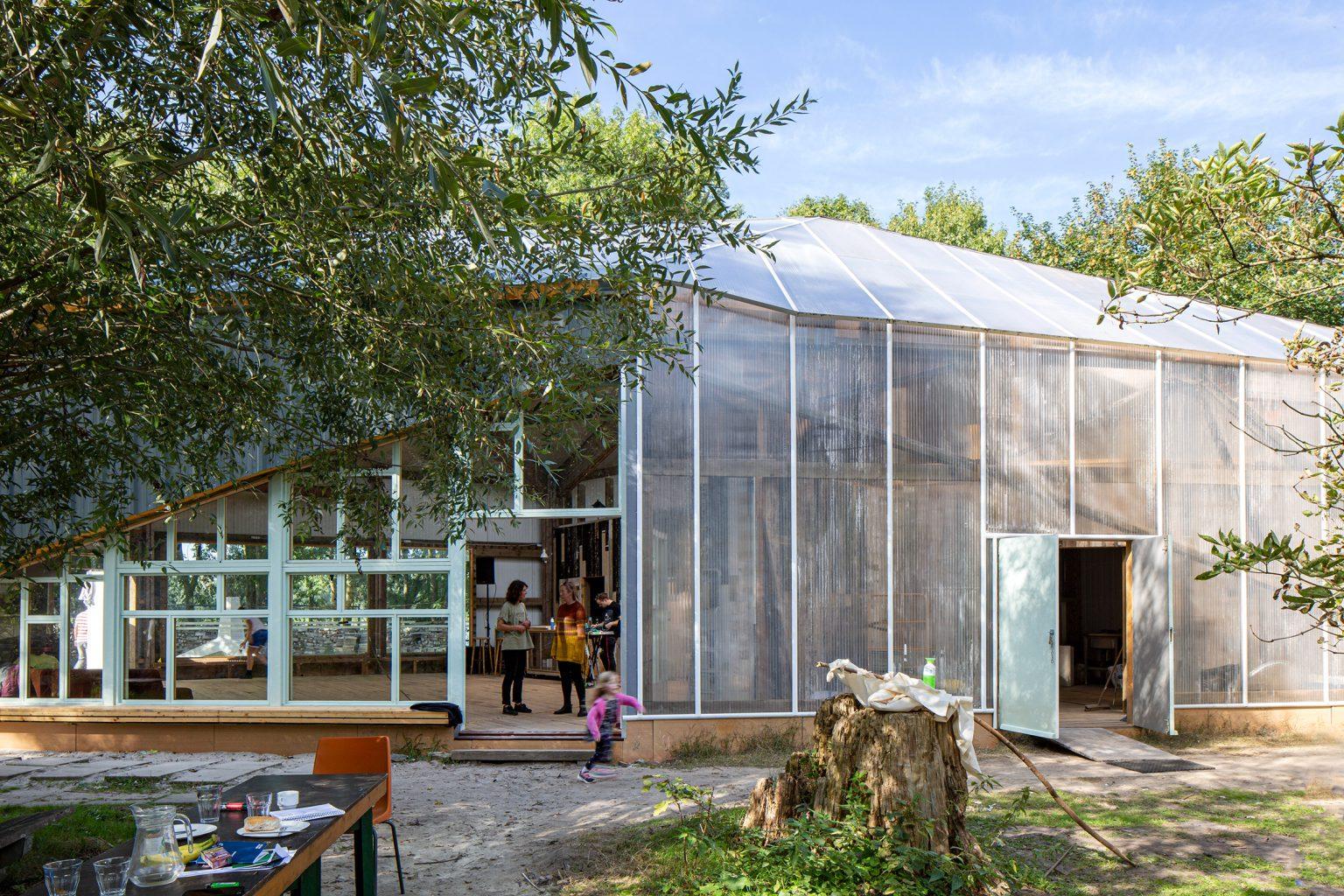
1. Netherlands, Buitenplaats Brienenoord: This project, created by SuperUse Studios, is an example of circular economy architecture. Ninety percent of the building’s components, including steel, glass, and wood, were recycled. The main goal of the design is to create a versatile area that is simple to disassemble and rebuild at a later time. The project greatly decreased its environmental effect and promoted sustainable construction methods by placing a high priority on material reuse.
2. Turkey, Yoo, Bence Guzel Pavilion: This pavilion is another example of circular architecture in motion, built by graduate students from Istanbul MEF University. The pavilion, which was built using 90% recycled materials, is a multipurpose venue for events and exhibits. The project questions conventional ideas of waste and sustainability by highlighting the decorative and practical possibilities of recycled materials.
3. USA, Circulating Matters: This project, which was made by Cornell University’s Circular Construction Lab, used materials that were left behind when a century-old residential structure was demolished. The project demonstrates how architectural design may aid in material conservation and waste reduction by highlighting the possibility of recycling components in new situations.
4. Denmark, SILO: An excellent illustration of adaptive reuse in circular architecture is the conversation of an ancient grain silo into residential units, designed by COBE architects. The project reduced the requirement for new building materials while preserving the embodied energy of the original building by reusing an industrial structure. This strategy not only increased the silo’s lifespan but also helped to revitalize the nearby metropolitan region.

Economic and Social Benefits of Circular Architecture
There are several social and economic advantages of using the circular economy concept in design. Circular design helps minimize waste and cut building costs while increasing resource efficiency by lowering the need for fresh resources. Furthermore, repurposing materials opens up new business prospects in sectors including materials processing, recycling, and deconstruction. By generating jobs in sustainable building and allied industries, circular architecture also fosters regional economic growth. For instance, the adaptive reuse of buildings frequently necessitates specific knowledge of material recovery and retrofitting, creating jobs for the community. Moreover, circular design may lower the long-term running expenses of buildings, making them more affordable for tenants, by improving resource efficiency. The circular design has both financial and social advantages as it builds more resilient and sustainable societies. The circular design contributes to the creation of healthier living conditions by minimizing negative environmental effects and encouraging resource conservation. Incorporating circular economy ideas into design may also improve social fairness by increasing accessibility to sustainable buildings for all population groups.
The concept of the circular economy presents a revolutionary approach to design, facilitating the development of resource-efficient and sustainable structures that enhance both environmental and economic resilience. A key role that architects can play in creating a more sustainable future is to reconsider the way that materials are utilized and buildings are created. With further development, circular architecture has the power to fundamentally alter how the natural and constructed environments interact, bringing long-term benefits to both the earth and human society.
References:
Bocken, Nancy, et al. “Produc design and business model strategies for a circular economy.” Journal of Industrial and Production Engineering, vol. 33, 2016, pp. 308-320.
Chachad, Samruddhi. “The Circular Economy: A Pathway to Sustainable Future.” Rethinking The Future, https://www.re-thinkingthefuture.com/architectural-community/a12906-the-circular-economy-a-pathway-to-sustainable-future/. Accessed 13 October 2024.
“Circular Construction Lab | Circulating Matters | AAP Labs.” Cornell University, https://labs.aap.cornell.edu/ccl/circulatingmatters. Accessed 13 October 2024.
“Circular economy action plan – European Commission.” Environment, https://ec.europa.eu/environment/strategy/circular-economy-action-plan_en. Accessed 13 October 2024.
Murray, Alan, et al. “The Circular Economy: An Interdisciplinary Exploration of the Concept and Application in a Global Context.” Journal of Business Ethics, vol. 140, 2017, pp. 369-380.
Pomponi, Francesco, and Alice Moncaster. “Circular economy for the built environment: A research framework.” Journal of Cleaner Production, vol. 143, 2017, pp. 710-718.