Islamabad, the capital city of Pakistan is not a city known for its historical architecture. Established in the late 1960s as a planned city, it was designed to be the capital and replaced Karachi as the administrative and political centre of the country. Thus Islamabad, a relatively new city, doesn’t itself have rich historical architecture to boast of, but being situated on the Potohar plateau,
Thus Islamabad, a relatively new city, doesn’t itself have rich historical architecture to boast of, but being situated on the Potohar plateau, it is near a few historically significant sites such as Taxila, once the capital of ancient Gandhara, the ancient Silk Route, an ancient trade route, and the famous Wah Gardens from the Mughal era.

History of Wah Gardens
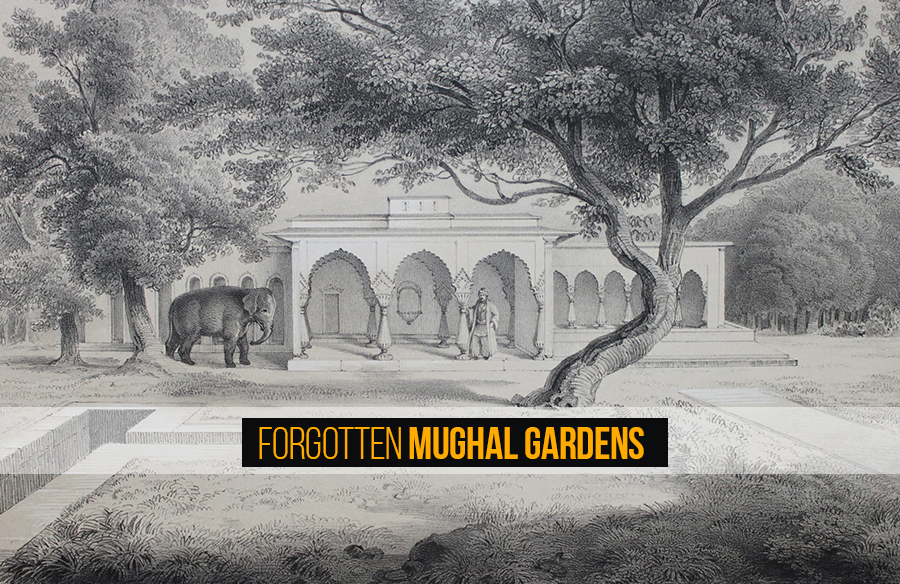
The Wah Gardens are located at a 50km drive north-west from Islamabad, through the main Grant Trunk Road and date back to the Mughal Empire, constructed during the era of Akbar the Great. The Mughals had a penchant for creating garden complexes, referred to as the “Mughal Gardens”, which were heavily influenced by Persian gardens but became a beloved imperial pastime in the coming years.
Wah Gardens were initially known as Bagh-i-Hassan Abdal, meaning the gardens of Hassan Abdal and later more popularly known as Farudgah-i- Shahan-i- Mughlia. Raja Man Singh, a Rajput king and court chief to Emperor Akbar, was stationed at Wah from 1581 to 1586, to halt enemy excursions and is credited to have installed the first pavilion there. Excavations of the current Baradari, exposed remains of the previous pavilion, supporting the story.

An account of Jahangir from his stay at Wah says: “Stayed at Baba Hasan Abdal on 12th Muharram, 1016 A.H. About two miles on the eastern side of this place there is a waterfall. The water falls with great speed. The centre of the pond has the main exit of the waterfall. Raja Maan Singh has made a very little building. There are a lot of fish in the pond having a length of quarter yard. I stayed at this beautiful place for three days. I put the net in the pond and caught about 10 to 12 fish. These fish were again dropped in the water after sewing pearls in their noses.” (ICS, 1909)
In 1622, Jahangir visited Hassan Abdal for the fourth time and is said to have stayed longer. It is believed that Wah had at this time become an important Manzil Gah between Kabul and Kashmir. The Shahjahani historians, Mulla Abdul Hamid Lahori and Saleh Muhammad Kanboh visited Hassan Abdal with Shahjahan during his twelfth reigning year in April 1639 and recorded Hassan Abdal as the most beautiful garden between Delhi and Kabul.
Aurangzeb stayed in Hassan Abdal for one and a half years between July 6, 1674, and January 2, 1676, during which time he stayed in this garden for a while. His historians refer to this place as Bagh-i-Hassan Abdal. Jahangir admired its cascade, pond, and its building with the name Hassan Abdal.
It is said that later the elaborate garden was constructed with pavilions, water tanks and walkways during the days of Shah Jahan, taking inspiration from the Shalamar Gardens in Lahore, and in 1647 Shah Jahan came and stayed in a building constructed by him before his stay.
The changing of the name from Hasan Abdal to Wash also has a very interesting story. “In 1823 Moorcroft, an English traveller, visited the garden. In his travelogue, he repeats the false anecdote of William Finch that Akbar admired this garden and said “Wah Bagh” (what a beautiful garden). Hence the garden was so named and it is known as Wah Garden to this day. The impact of Moorcroft’s story was so strong that even the Rawalpindi Administration Report of 1865, the Journal of Indian Antiquary 1873, and the Rawalpindi District Gazetteer 1883, recorded this place as Wah Garden.” (Farudgah-e-Shahan-e-Mughlia Tank and Garden, Wah, Rawalpindi, n.d.)

Wah Gardens Today
In its present condition, the Wah Gardens consist of two prominent structures: the Baradari and the main gateway, and the main water tank/body of the Gardens though most of the grandeur of the gardens has been lost due to time and neglect. Upon entering the site of the gardens, one immediately comes across the water body, which was artificially created during that era to store water from the nearby springs. The water body is one of the main activity spaces of the Gardens today, acting as a pond where people cool off and swim during the hot summer months. It also serves as a mirror for the Baradari; a twelve-door covered structure in the Mughal architectural style, which sits atop a raised platform, reflecting in the water surface below.

Originally, water would collect from nearby springs into the water tank on the upper terrace from where it would flow into the three main channels of the Gardens, running parallel along its length, distributing itself throughout the site. The central channel had a set of 15 water fountains with water inlets situated in the upper terrace. (Khan, 1996) The Baradari was flanked by two pavilions, one of which had the public bath chambers, providing both cool and hot water, and an inclined portion of the water, known as the Mughal Chadar, which would have seen cascading water reflecting the black and gold chevron tile pattern of the water channel under it.
The waterworks of the Gardens, during their prime, were a work of marvel. This water would run through the tree-lined channels, with multiple fountains in between, adding a beautiful soundscape to the already scenic views of the garden. Today, only one of the channels is functioning.

Wah Gardens “is the only garden in which a complete hydraulic system of the Mughal period is discovered which represents a marvel of Hydraulic engineering of the 16th Century. The hydraulic engineering involved in this garden is based on gravity and thus very simple but amazingly perfect and continuously running fountains were connected by T/C pipe to a supplying reservoir whose base was approximately four feet higher than the fountain heads. This height through gravity kept the fountains running round the clock.” (Rajput, 2015)
Alongside the Baradari today, a few remnants of the Hammam can also be seen. Both the Baradari and the Hammam are currently in a state of ruin and have been cordoned off through fencing to prevent further deterioration by visitors, patiently awaiting restoration efforts. One can make out a few niches and floral frescos which would have been a great source of marvels during its time.

On the western end, crossing the Baradari, we come across a pathway that leads to the lower terrace which was part of the Zenana Garden or Paien Bagh. The Zenana Garden was private, exclusively for the royal ladies which would ensure their privacy whilst allowing them to stroll outside and enjoy the gardens and its views. Mughal screens called Jalis would have been placed on the periphery of the gardens, along with using vegetation in tandem to ensure visual barricades for the public towards the Zenana Garden.
The pathway then leads towards two gateways, only one of which exists today. The gateway walls are also vandalised and the area beyond it encroached, where the water channel used to drain.
Past the Baradari are the infamous pleasure gardens, which at the height of their time were exploding with fruit trees, shrubs and flowering plants, providing a soothing escape to all that would venture inside the garden walls. Today, the gardens are a vast expanse of trimmed grass with a few trees lining the main water channel, on the periphery of the boundary wall and dotted here and there on the wide expanse of open grass.
References:
Farudgah-e-Shahan-e-Mughlia Tank and Garden, Wah, Rawalpindi. (n.d.). Retrieved from Directorate General of Archaeology Tourism Archaeology and Museums Department; Government of Punjab: https://archaeology.punjab.gov.pk/farudgah-shahan-mughlia-tank
ICS, t. b. (1909). Tuzk i Jahangiri .
Khan, M. (1996). An introduction to the historical, architectural and hydraulic studies of the Mughal garden at Wah.
Rajput, S. (2015). THE HYDRAULIC ENGINEERING AND LANDSCAPING OF A 16TH CENTURY MUGHAL GARDENS AT WAH.
Image References:
- https://www.youlinmagazine.com/article/the-forgotten-wonder-of-the-wah-mughal-gardens/MTg4OA==
- Fatima Pirzada. (2021). [Photograph].
- Fatima Pirzada. (2021). [Photograph].
- Fatima Pirzada. (2021). MASKAN-E-BAHAR: A foresighted approach towards architectural conservation. National College of Arts, Rawalpindi: Department of Architecture
- https://www.researchgate.net/publication/275998328_THE_HYDRAULIC_ENGINEERING_AND_LANDSCPING_OF_A_16TH_CENTURY_MUGHAL_GARDENS_AT_WAH
- https://tribune.com.pk/story/1033580/a-victim-of-neglect-a-shadow-of-past-glory-wah-gardens-losing-its-charm