The world yearns for a way to live life with hope and optimism. The ancients began preaching their beliefs, which appeared acceptable to the majority. When these beliefs expanded, they created the groundwork for a timeless system of traditions, culture, religion, and spiritual ideals. Architecture embodies all of these ideals. They provide convincing evidence about the strength of previous beliefs and expectations. Hence, shaping the ancestry of distinct populations.
Sacred places are manifestations of spiritual beliefs. The spaces appear to override any unpleasant emotions a man could have. Each religious institution has a history to tell, and each narration has supporters.
Elements of a Sacred Space Design.
Spirituality is defined differently by each individual. The primary purpose of sacred places is to legitimize people’s cultural and religious beliefs. Sacred architecture offers believers a space to interact with the divine. A location where individuals may express themselves while also finding calm and confidence in a greater power.
The intricate use of symbols, signs, religious themes, divine geometry, and iconography symbolizes sacred architecture. These elements play a significant role in the representation of sacred spaces. The architectural designs communicate religious or spiritual beliefs. Holy spots may build a sense of community via shared beliefs, history, and values. The spaces were designed in a way that accentuates the vibrations of the place. The design considers sunlight, the earth’s magnetic orientation, geometry, and other natural factors.

Psychological Effects.
Architecture is the creation of environments that enrich people’s experiences. Sacred places have a tremendous psychological influence on people, affecting their emotional, cognitive, and behavioural well-being.
It promotes emotions of belonging, meaning, and purpose by connecting people to something bigger than themselves. These locations provide consolation, comfort, and calm as a respite from stress and worry. Sacred places encourage spiritual investigation, self-reflection, and introspection, resulting in personal development and self-awareness. It provides more purpose and meaning while improving attention and concentration. Reduces stress and anxiety while enhancing mood and emotional well-being. The serene environment in religious contexts fosters awareness, presence, and meditation, decreasing mind wandering and improving focus. Shared sacred sites develop social bonds, creating a sense of belonging and support.
Sacred areas help people to vent their emotions healthily. Sacred places encourage creativity, originality, and invention via their distinctive architecture, art, and symbolism. They can be therapeutic, aiding physical, emotional, and mental recovery. Eventually, they assist individuals in developing their identity, values, and beliefs, especially during crucial life events or changes.

What Influences Emotions?
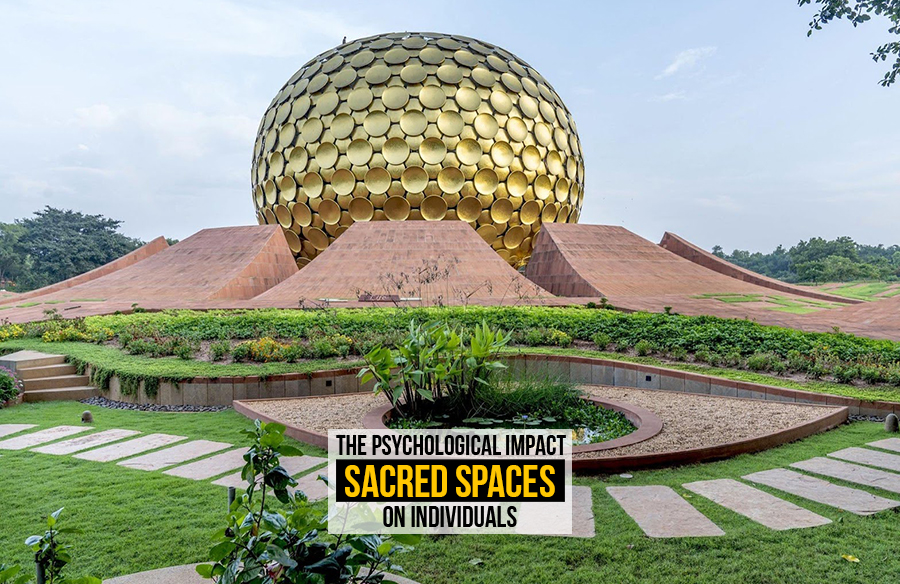
Humans are a part of this enormous cosmos. Spiritual architecture creates an environment that receives the most beneficial energies. The arrangement of symbols, emblems, and images with deep spiritual significance has the potential to elicit diverse emotions, fostering a sense of belonging and providing guidance. The manipulation of light and shadow can instil feelings of reverence, wonder, and introspection. When designing spaces, one can evoke emotions of grandeur, humility, or intimacy, thereby influencing the emotional responses of individuals. Employing materials and textures like wood, stone, and water can evoke tactile and sensory reactions. Furthermore, designing spaces with particular acoustic characteristics, such as resonance or tranquillity, can heighten the emotional experience.
Colours play a significant role in emotional development. The presence of these elements helps create a sense of peace and serenity in any given environment. The design of environments aims to seamlessly incorporate natural elements, such as lush gardens, serene water features, and awe-inspiring scenic views, to establish a sense of equilibrium and unity. Additionally, creating spaces that facilitate repetitive and organized movements, as well as ceremonial activities, to confidently foster a strong sense of community and encourage collective participation.
The phrase “Sacred Geometry” is widely acclaimed for its significant impact on the spiritual essence of sacred locations. Through the use of geometrical forms, numbers, proportions, colours, and sounds, sacred geometry can unveil the mathematical conditions that give rise to these energy attributes, ultimately restoring a state of energy equilibrium. Following its implementation, similar geometric procedures can amplify, store, and purposefully distribute this energy in a concentrated or radiate it from a central point to encompass expansive areas.

Examples of Sacred Spaces.
Around the globe, places of worship such as temples, churches, mosques, synagogues, and monasteries house captivating narratives that await exploration within their walls. Sacred architecture is carefully crafted to mirror the beliefs and traditions of the community it caters to.

Hindu temples are heavily influenced by the design of chakras and human anatomy. A Hindu temple is a symmetry-driven construction with several variants based on a square grid of padas and representing ideal geometric forms such as circles and squares. Ancient Sanskrit literature advises that the classical location for a temple is near water and gardens, where lotus and flowers blossom, swans, and other birds may be heard, and animals can relax without fear.

The primary function of a mosque is to give a spacious area for people to interact with God. Mosques frequently have Islamic-themed emblems, such as spirals representing heaven and flowery designs representing paradise. The primary consideration regarding a mosque is its orientation towards Mecca. Many mosques contain an outdoor courtyard, known as a sahn, which frequently includes a fountain for ablutions before prayers. The primary dome of a mosque is over the mihrab apse, and for many Muslims, the dome represents oneness with God.

Many churches’ architecture takes the shape of a cross. These churches frequently include a dome or other vast vaulted area to signify or call attention to the skies. Other typical church forms include a circle, which serves eternity, and an octagon or similar star shape, which portrays the church’s ability to spread light into the world. Another typical element is the spire, a tall tower at the “west” end of the church or above the crossing. There are different types of churches, such as chapels, cathedrals, and basilicas.

The design of sacred sites is influenced by people’s spiritual and religious beliefs, with the geometric layout and orientation playing a significant role in impacting individuals’ psychological states. These sacred spaces offer individuals a sense of meaning and happiness.
References:
- Wikipedia (2024). Sacral architecture [Online] Available at: https://en.wikipedia.org/wiki/Sacral_architecture [Accessed September 4, 2024]
- Research Gate (2021). (PDF) Impact of Contemplative Spaces and Sacred Geometry on Spiritual Development [Online] Available at: https://www.researchgate.net/publication/352563283_Impact_of_Contemplative_Spaces_and_Sacred_Geometry_on_Spiritual_Development [Accessed September 4, 2024]
- Wikipedia (2024). Hindu temple architecture [Online] Available at: https://en.wikipedia.org/wiki/Hindu_temple_architecture [Accessed September 5, 2024]
- Wikipedia (2024). Islamic architecture [Online] Available at: https://en.wikipedia.org/wiki/Islamic_architecture [Accessed September 5, 2024]
- Wikipedia (2024). Church (building) [Online] Available at: https://en.wikipedia.org/wiki/Church_(building)#:~:text=A%20common%20trait%20of%20the,draw%20attention%20to%20the%20heavens. [Accessed September 5, 2024]