

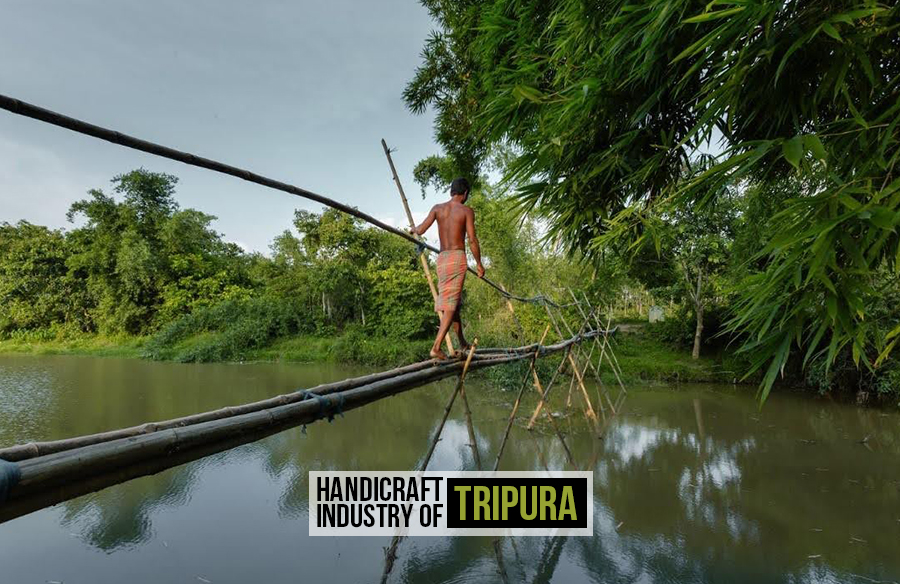
The beautiful landlocked Northeast Indian state of Tripura adorns five mountain ranges—Boromura, Atharamura, Longtharai, Shakhan, and Jampui Hills. Amidst these hillocks lie several fields interspersed. The third-smallest state in the country, bordered by Bangladesh on 3 sides, and home to a diverse mix of tribal cultures and religious groups- the features of Tripura don’t end there. What Tripura is also renowned for is its handicrafts. Handlooms, bamboo and cane crafts, and wood carvings of Tripura are well-known; especially the bamboo products, which are much loved and acknowledged both nationally and internationally. Nearly 16-18 species of bamboo grow all across the state. Bamboo craft and handloom are intrinsic to their tradition and are practised over all four districts of the state, with a thick concentration in Southern and Western Tripura.

A Legacy Woven Through Time
Handicrafts are an intrinsic part of Tripura’s cultural traditions and the roots run deep, mainly fuelled by Tribal communities- the Tripuris, Reangs, Jamatias, and Noatias. Their intimate connection with nature serves as an endless source of inspiration and is reflected in the motifs they use. Handloom is the prime craft of Tripura, followed by bamboo and cane crafts.

Metal and woodwork along with pottery, especially black pottery, are also major forms of craftwork practised in the state, which is also renowned for its traditional weaving techniques that produce a wide range of fabrics, made of high-quality materials like cotton and silk- donning intricate designs and vibrant colours, like the traditional garment ‘Riha’ and fabric ‘Risa’.

Weaving
As mentioned previously, handloom weaving is one of the most important crafts of the state, such that until the nineteenth century every family, irrespective of caste or community, had a handloom. The tribal textile industry plays a vital role in the state’s economy and also provides a means of secondary income to tribal cultivators. The industry is concentrated in some specific parts of the state- in the subdivisions of Sadar, Soonamura, Khowai, Kailasahar, and Belonia. An obvious feature of Tripuri handlooms is the vertical and horizontal stripes with scattered embroidery in various colours. The patterns on the fabric differ from tribe to tribe. Lungi, sari, chaddar, and scarves with Tripuri motifs are some of the items produced.

From the spinning of yarn to adding the final finishing touches, the process of weaving comprises several intricate steps. Artisans still use traditional handlooms and techniques to create their pieces. Each piece of handwoven fabric is a testament to the artist’s expertise, passion, and dedication to their craft.

Most of the handloom items are available for visitors and tourists alike to shop. Some of the most popular items include Lasingphee (a quilt-like weave in which the cloth is stuffed with more cloth during the weaving process), scarves, bedspreads, saris, shoulder bags, tablemats, cushion covers, etc.
Bamboo and Cane Work
Since the state is blessed with abundant bamboo forests, bamboo and cane crafts possess a distinctive place in the handicraft scenario of Tripura. For generations, farmers have tended to their fields and heavily relied on artisans for the essential tools and equipment for harvesting and storing their produce. The process of making bamboo products begins with careful selection and cutting of bamboo into various sizes and shapes. Further crafting requires only traditional tools like ‘dao’ and ‘takal’ knives, allowing artisans to create intricate designs and durable weaves solely through their expertise in bamboo cutting techniques.

The products, such as baskets, are extensively utilised by the local community in their daily lives, making them the primary customers. These items serve diverse purposes, ranging from household items to construction materials like bridges, fishing equipment, and various types of baskets, as well as souvenirs.
The intricate weaving patterns, often geometric or depicting flora and fauna, are a testament to the incredible talent of the artisans. The bamboo craftsmanship of the state stands out with its simplicity and elegance along with intricate and meticulous detailing.

Traditional techniques like splitting, weaving, and bending are used to shape the versatile bamboo into various forms, resulting in not just functional but also aesthetic pieces. An array of furniture, utensils, hand-held fans, mats, baskets, idols, accessories, and other interior décor products are created by the artisans. Along with this, interior decoration products made out of bamboo are in great demand due to the recent interest in the construction and design industry’s interest in sustainable materials. False ceilings, wall panels, plaques, planters and pots, lamp shades, baskets, and screens of various types made of gossamer-thin bamboo strips are some of the items in much demand. Products are sold locally and also shipped to different parts of India.

Other Handicrafts
Apart from handloom and bamboo works, the state also has artisans skilled in metalwork, woodcraft, and pottery. Owing to the presence of dense forests in the state, wood is also a primary material in everyday life, much like bamboo. Woodcraft too comes adorned with intricate detailing, a display of the artisan’s skill.

In metalwork, their traditional silver jewellery is much renowned. Other items include utensils and decorative items using brass, silver, and other metals. Tripura’s black pottery is another unique craft. The origin of this pottery is said to be from the Longpi Naga tribe in Manipur, also where it is practised. An age-old craft, the process involves the selection of the special clay and the final unique firing process which gives it a distinctive black colour and smooth, glossy finish. A wide range of products from pots, bowls, and utensils to decorative items like figurines, vases, and lamps are crafted skillfully from clay.

Preserving Traditions
Handicrafts are vital to Tripura’s cultural and economic landscape, offering livelihoods, preserving traditional skills, and serving as a platform for cultural expression and creativity. Recent years have observed a spike of interest in Tripura’s handicrafts- both domestically and internationally. Government initiatives aimed at promoting traditional crafts and supporting communities have helped revitalise the sector, creating new opportunities for artisans and promoting economic growth in the state. In 2007 the State Government launched the Tripura Bamboo Mission (TBM) in PPP mode, focusing on the development of 4 sub-sectors- Bamboo Plantations, Handicrafts, Incense Sticks, and Industrial Applications. Along with realising the huge export potential of the industry, the catalytic role of TBM has resulted in increased turnover and livelihood generation. It has also led to the expansion of the market, with the designing and launching of new handicraft products and more organised marketing.

In the age of mass production and globalisation, hand-crafted products are sought after by many to possess something unique or something with a story. Tripura‘s handicrafts are an exceptional example of that. They shine with their genuine authenticity and exceptional craftsmanship. Every item narrates a tale of tradition, expertise, and innovation, mirroring the cultural heritage of the region. By preserving and championing these handicrafts, we not only encourage local artisans and communities but also honour Tripura’s distinctive heritage for generations to come.
References:
Animesh Sil, S. R. (2020, June 10). Traditional Bamboo Craft of Tripura: Its Diversification and Conservation. International Journal of Current Microbiology and Applied Sciences, 9(6), 1714-1719. Retrieved March 11, 2024, from https://doi.org/10.20546/ijcmas.2020.906.212
Art & Crafts of Tripura. (n.d.). Retrieved March 11, 2024, from Tripura Tourism: https://tripuratourism.gov.in/art-crafts
Baral, P. B. (n.d.). Traditional Saree Weaving – Agartala, Tripura. Retrieved May 22, 2024, from D’source: https://www.dsource.in/gallery/traditional-saree-weaving-agartala-tripura#146482
NIL. (2009, 08 5). Sectors. Retrieved 05 22, 2024, from Department of Industries and Commerce- Govt. of Tripura: https://industries.tripura.gov.in/bamboo
Samithi, D. H. (2019, 05 06). Shaping Bamboo. Retrieved May 22, 2024, from Google Arts & Culture: https://artsandculture.google.com/story/QwXBK4Jl5HGOLA?hl=en
Images:
- A narrow bamboo bridge- a common site in bamboo-rich areas of the state_© Subinoy Das
- A handicraft shop in Agartala, Tripura_© www.boroktimes.com
- Risa, the traditional fabric of Tripura, was awarded the GI tag in 2024_© wwww.sentinelassam.com
- A Tripuri woman weaving a saree_© Prof. Bibhudutta Baral/ www.dsource.in
- A traditional saree_© Prof. Bibhudutta Baral/ www.dsource.in
- Observe the usage of bamboo in different elements of a typical Tripuri house _© Subinoy Das/ Dastkari Haat Samithi
- Bamboo baskets_© Subinoy Das
- Tray, tumblers, and straws made from bamboo _© Subinoy Das
- A woodcraft store in Tripura_© www.boroktimes.com
- The traditional black pottery of Tripura_© Nidhi Mishra/ boroktimes.com
- Women engaged in bamboo craft_© Subinoy Das







